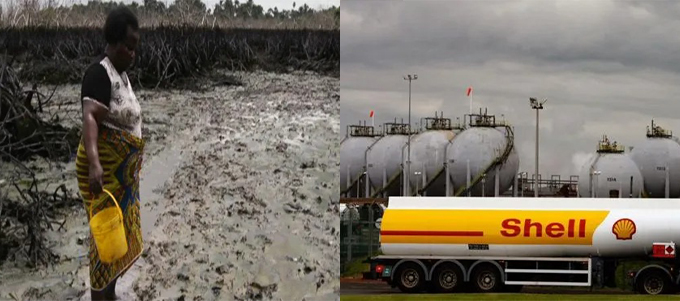
Communities in Nigeria’s Niger Delta have taken legal action against Shell, accusing the company of causing widespread pollution from more than 100 oil spills recorded between 2011 and 2013.
They want the oil giant held responsible for the environmental damage and its impact on local livelihoods.
Internal records obtained by the BBC show that Shell plc continued to run a major pipeline in Nigeria for several years even after staff raised concerns about environmental risks.
The documents form part of an ongoing court case in the United Kingdom.
The BBC reports that emails and presentations submitted in court reveal a senior Shell executive warned as early as 2008 about the dangers of operating the Nembe Creek Trunk Line under conditions of widespread oil theft and repeated damage.
The legal action comes from affected communities in the Niger Delta who are demanding accountability for pollution linked to the repeated spills.
They are seeking $1 billion in total compensation, which includes $250 million in direct damages and $750 million for environmental cleanup.
The Nembe Creek Trunk Line stretches 96.5 kilometres and once carried crude oil from inland fields to export terminals along the coast.
Before Shell sold the asset in 2025, it served as one of its major oil transport routes in Nigeria, with a capacity of up to 150,000 barrels per day.
In its defence, Shell states in court filings that most of the pollution resulted from “large-scale oil theft, sabotage” and illegal refining activities.
The company also insists that its Nigerian operations invested in spill prevention and response measures.
However, residents of Bille, a riverine community in Rivers State, told the BBC that repeated oil spills have destroyed their environment and ruined fishing activities that once supported their families.
“Before 2011, here was a beautiful area. People play here and go into the river,” said 64-year-old fisherman Balafama Augustus Bruce. “We used to fish around here. But because of the damage [the spills] have caused, nobody is fishing here again.
“Because of that I’ve become poor. I eat from hand to mouth.”
Bruce, who is part of the group bringing the case, said fish populations have dropped sharply over the years. He added that some of the remaining fish now appear deformed.
The United Nations estimates that Nigeria has suffered at least 13 million barrels of crude oil spilt since 1958, resulting from more than 7,000 separate incidents across the country.