Across Ghana, a puzzling trend is unfolding in the country’s food economy: farmers are receiving significantly lower prices for their crops, yet consumers are still paying almost the same or even higher prices for everyday meals.
Since the beginning of 2025, the market price of maize, one of Ghana’s most important staple crops, has fallen sharply. Farmers in several parts of the country say a 100-kilogram bag of maize that previously sold for around GH¢600 in 2024 is now trading at about GH¢300 or less, representing a decline of approximately 50 per cent.
However, this reduction has not translated into cheaper meals for ordinary consumers. A ball of kenkey, a popular Ghanaian food made from fermented maize dough, which sold for about GH¢5 in 2024, remains at the same price in many locations, with some vendors charging as much as GH¢7.
The situation has raised questions about Ghana’s food supply chain: if farmers are earning less from their produce, why are consumers not benefiting from lower food prices?
FARMERS TRAPPED BY FALLING COMMODITY PRICES
For many farmers, the decline in commodity prices has become a serious economic challenge. Some say they are struggling to sell their previous harvests, leaving them without the income needed to purchase fertiliser, seeds and other inputs for the next farming season.
Ghana’s agricultural sector remains heavily dependent on smallholder farmers, who produce a significant share of the country’s staple foods.
In Binduri District in Ghana’s Upper East Region, maize farmer Abugri Azumah says he abandoned maize farming this year because he has been unable to find buyers for his previous harvest.
“I have not farmed maize this year. I have my seven bags of maize lying down, nobody is ready to buy, so I can’t get fertiliser to buy for the new crops,” he said.
The situation, he explained, has created a cycle where farmers are producing food but are unable to earn enough from their labour to continue farming.
Solomon Gumah, a farmer and journalist based in Ghana’s Northern Region, expressed similar concerns. He said farmers are bearing the impact of low commodity prices while consumers continue to struggle with expensive food.
“I won’t farm this year. I have 50 bags of maize lying down, no one is ready to buy. They say a bag is less than GH¢200,” he said.
Mr Gumah believes government intervention is needed to improve price stability and ensure that reductions in farm-gate prices benefit consumers.
“I think the government should have regulated the prices of some of these foods at the vending points. The women selling food are not honest,” he added.
WHY FOOD VENDORS SAY PRICES CANNOT FALL
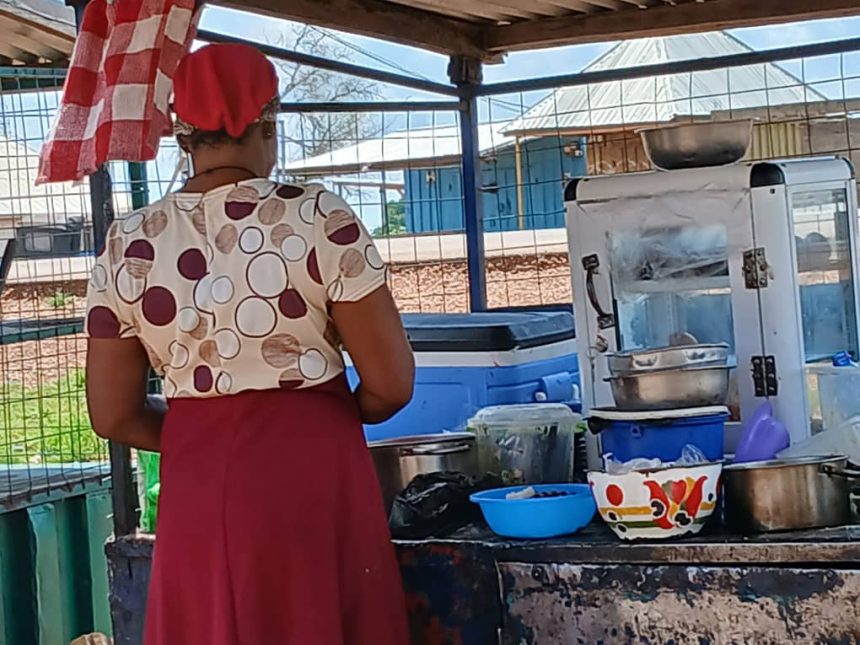
Food vendors, however, reject claims that they are deliberately keeping prices high despite lower commodity prices.
Daavi, a kenkey seller operating opposite Kinbu Senior High School in Accra, said maize is only one part of the total cost involved in preparing and selling food.
According to her, other expenses, including labour, transportation, grinding services, utilities and packaging, have remained high.
“We pay labourers; it hasn’t decreased. We send the maize to the grinding mill; it hasn’t decreased. We pay utility bills; it hasn’t decreased. So we cannot reduce prices just because of the reduction in the price of maize,” she said.
Her explanation reflects a wider challenge facing food systems globally: the price consumers pay is influenced not only by the cost of raw materials but also by the cost of processing, storage, transport and distribution.
ECONOMISTS EXPLAIN THE DISCONNECT
Anaba Elvis, a PhD Economics student and assistant researcher at Ghana’s Parliament, explained that falling maize prices alone cannot automatically lead to cheaper processed foods.
“Although maize prices may fall, processed foods such as kenkey, banku and corn flour do not always become cheaper because maize is only one part of production costs,” he wrote.
He noted that processors must also consider expenses such as labour, transport, energy, packaging, storage and distribution. Some producers may also still be using older stocks purchased when prices were higher.
“Limited competition in the market can also reduce pressure to cut prices. As a result, processed food prices are driven by total production costs, not just the cost of raw maize,” he added.
The explanation highlights why consumers may not immediately see the impact of lower farm prices, even when commodity markets experience significant changes.
A CHALLENGE FOR GHANA ’S FOOD SECURITY
Agricultural officers say the situation presents a difficult challenge because both farmers and consumers are feeling the pressure.
Bukari, a senior Agricultural Officer in the Bawku West District of the Upper East Region, described the situation as concerning.
“The issue is somehow challenging because the farmers are really suffering, but at the end, they have nothing to take home. Meanwhile, when one goes to a restaurant to buy food, it is unaffordable,” he said.
The contradiction between low earnings for farmers and high prices for consumers exposes weaknesses in Ghana’s food supply chain.
Experts argue that improving storage systems, strengthening market linkages between farmers and buyers, reducing production costs and improving competition among food processors could help ensure that price reductions at the farm level benefit consumers.
For farmers like Abugri Azumah, however, the immediate concern is survival.
Without reliable markets and fair prices, he fears many smallholder farmers may be forced to reduce production a development that could have consequences for Ghana’s future food security.
As Ghana continues efforts to manage inflation and improve economic conditions, the challenge remains clear: reducing the cost of producing food and ensuring that savings reach consumers will require solutions that go beyond lowering the price of raw commodities.