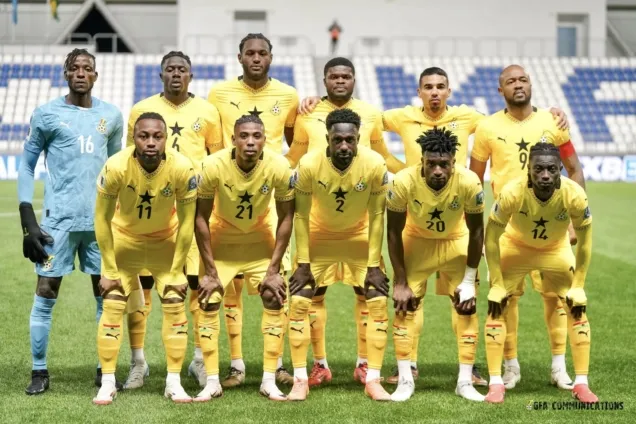
The GFA’s two-stage squad announcement has manufactured controversy where none needed to exist and it is the latest symptom of an institution that has consistently failed the national team.
When Carlos Queiroz unveiled Ghana’s 28-man squad for 2026 World cup preparation camp, on May 25, the immediate reaction was not excitement but bewilderment.
It is a story Ghana’s football public knows well. Every major tournament brings the same cycle; a controversial squad, a flurry of public outrage, Ghana Football Association officials rushing to defend the process, and the nagging suspicion voiced by fans, former players, and sometimes the players themselves that something beyond pure football judgment is at work.
None of this needed to happen. The friendly against Wales is on June 2. The final 26-man squad is due June 1. There was nothing, not a single footballing reason that required the GFA to name 28 players, generate a week of public debate, and then quietly trim out two names the day before the friendly against Wales.
The GFA chose complexity. And that choice is entirely consistent with how this current administration has managed the Black Stars.
A PROVISIONAL LIST OR IS IT?
The 28-man list announced on May 25 is not, strictly speaking, the final World Cup squad. Ghana are due to announce their official 26-man squad on June 1, a day before the friendly against Wales in Cardiff on June 2. That means two players currently in camp will be cut, and in theory players currently absent could still be added before the FIFA deadline.
If the 28-man list is functionally the World Cup squad with only two spots to be resolved, why name 28 at all? The answer the GFA and technical team would give is that it provides flexibility, as Queiroz can assess players in training, observe how they respond to the camp environment, and make his final two cuts on informed rather than assumed grounds. That is a reasonable justification in isolation.
But it has a significant side effect. By announcing 28 names rather than 26, the GFA has guaranteed a second wave of controversy. On June 1, when two players are dropped, there will be new headlines, new accusations, and new questions about why those specific two were cut. The process that was supposedly designed to reduce uncertainty has instead created a fortnight of rolling debate where a single announcement on May 25 would have sufficed.
THE SIMPLER PATH NOT TAKEN
The Wales friendly on June 2 is probably Ghana’s final preparatory match before the World Cup. It is not a tournament. It is one game. Virtually every major footballing nation calls up exactly the players they intend to take to the tournament for their final pre-tournament warm-up, sometimes with one or two additional cover options. They do not name 28 players, generate a week of squad controversy, and then quietly trim out two names.
Had Queiroz simply named a 26-man squad on May 25, the squad he was always going to take to the World Cup, the debate would have been sharper, clearer, and concluded in a single day. The GFA would have been obliged to defend a final decision rather than a provisional one. The public would have had the information it deserved without being strung along through a two-stage announcement that serves the administration more than it serves the supporters, the players, or the coach.
Instead, the 28-man approach has given the GFA a buffer. Painful omissions such as Paintsil, Ashimeru and Köhn are not technically final yet. Officials can deflect questions by pointing to the June 1 announcement. “Let’s wait and see,” becomes the default response. It is a convenient posture that extends the uncertainty while managing the news cycle.
THE SAME STORY, DIFFERENT TOURNAMENT
This pattern did not start with Queiroz. Ahead of the 2022 World Cup in Qatar, Jeffrey Schlupp was left out of the final squad and his agent went public with accusations of corruption within the GFA. Coach Otto Addo in a moment that said more than he intended felt it necessary to thank GFA President Kurt Okraku publicly “for letting him do his work the way he wanted to.” A head coach, thanking the football association for letting him pick his own squad.
When Addo was eventually dismissed in March 2026 after losses to Austria and Germany, former GFA Vice President George Afriyie laid the blame directly at Okraku’s door accusing him of sidelining key stakeholders in decisions that affected the entire national team setup.
Queiroz arrived in April with credibility and a track record that commands respect. His appointment was welcome. But a good coach cannot fix a broken institution when the institution has not fixed itself.
THE GFA’S DEFENCE AND ITS LIMITS
To the GFA’s credit, they have gone to considerable lengths to explain the current process. The Communications Director revealed that the technical team reviewed approximately 200 player videos and monitored 170 matches live. 75 players were scouted, 30 observed in person. On paper, this sounds thorough and professional.
Yet the numbers alone do not resolve the underlying concern, which is not about whether scouting was conducted, but about whether the final decisions are made freely by the coach. The problem is structural; when a football association retains local assistants, influences backroom composition, the question of who ultimately controls selection cannot be answered by citing a scouting database.
THE FOREIGN COACH QUESTION
There is a notable parallel in Ghana’s tournament history. The team’s best World Cup run, the 2010 quarter-final came under Serbian coach Milovan Rajevac. Ghana’s worst performances have tended to come under coaches who operated in an environment where GFA influence was most visible. Carlos Queiroz, with his extensive international experience managing Portugal, Iran, Egypt, and others, may prove harder to manage internally than his predecessors. But the structures that enabled interference have not been dismantled, they have simply received a new occupant at the top.
WHAT NEEDS TO CHANGE
The fix is not complicated in principle, even if it is difficult in practice. Selection must be genuinely insulated from administrative influence. And when it comes to squad announcements, the simpler the process, the harder it is to obscure.
Name 26 players. Tell the public why those 26 were chosen and the others were not. Do it once, clearly, and move on.
The naming of a 28 then 26 format might seem like a minor procedural detail. But it is symptomatic of a broader culture in which the GFA manages its own exposure rather than prioritising clarity for fans and respect for players. Players left out need a clear explanation as to why they have been left out, so does every supporter who has spent a week debating a squad that is not yet technically final.
Ghana goes into the 2026 World Cup in Group L alongside Panama, England, and Croatia with genuine talent and a coach who commands respect. By June 1, the official 26 will be known. Whatever they are, the question that follows will be the same one that has followed every Black Stars squad announcement for the past years; did the best players make it in or just the right ones?