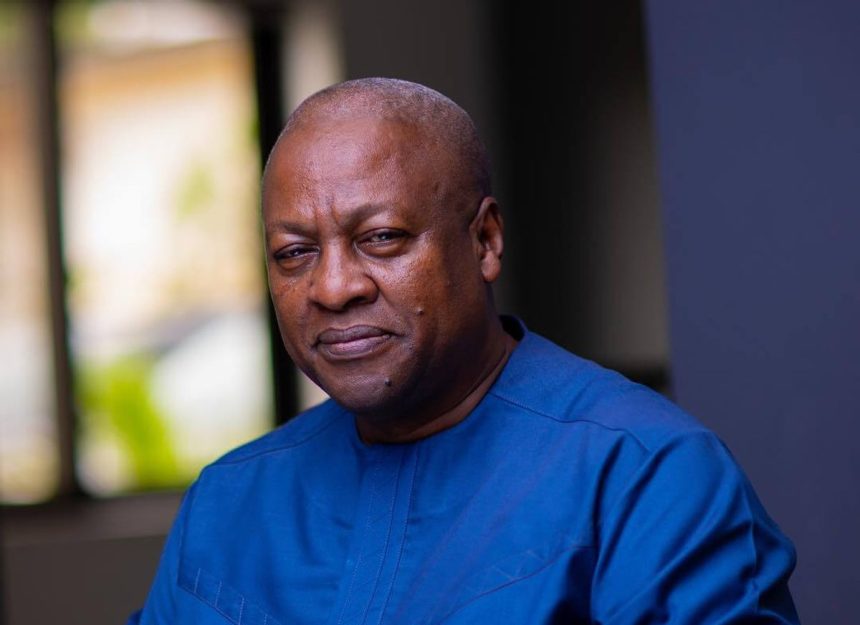
With two fresh applications to the Supreme Court in recent days seeking an interpretation of Article 66(2) of the constitution on presidential term limits, a whole new frenzy on this matter has erupted, pushing President Mahama to yet again make a pronouncement on the matter.
I am sure the President must have been going through a weary ‘read my lips’ moment when he declared in the Volta Region the other day that those who have gone to court are free to do so, that he has read Art 66(2) several times over and that its provisions are clear.
Crystal clear law
Indeed, the provisions of Article 66 (2) are crystal clear; “A person shall not hold office as President of Ghana for more than two terms.”Ghana news updates
As I argued on this page in November 2025 on this issue, “‘two terms’ is exactly what it says ‒ no need to twist, knead or massage those words to mean anything else.
It is the ordinary meaning in its simplest form.”
“If the framers of the Constitution intended for a break in presidential terms to wipe the slate clean, as it were, they would have expressly said so.
But that would have provided a dangerous and absurd scenario where after two terms, a President would simply lie fallow for a term or two and come back again ‒ in effect treating the presidency as a revolving door and making mockery of a clear provision through deft, fancy political footwork”
Franko Speed Shopping
Of course, this is not the first time he has expressed a view on this matter. Ordinarily, this should put the matter to rest and assuage the minds of those who feel there is an unholy agenda brewing to push through a third term for the President.
Complex politics, strange politicians
However, politics is a complex business and politicians are even stranger creatures, and so this matter keeps popping up through the political revolving door and refuses to go away.
Whilst some believe there is a scheme to wedge President Mahama into a third term by keeping the conversation alive and to test the Ghanaian pulse, others believe the President’s detractors are just bored and mischievously want to keep this non-issue in the news and thus dent his image.
At the heart of all of this is political trust ‒ or lack thereof. Breaking political promises is something politicians take in their stride, even if it makes them look absurd.
As a result, trust in our political class is rather low, which means so many ordinary citizens tend to have little confidence in what politicians say.
We live in a country and continent where a politician discreetly sponsors ‘fan clubs’ and ‘movements’ whose sole aim is to publicly call on them to run for a particular office, and then, subsequently, she or he ‘acquiesces’ to the growing public calls to serve their country, even if ‘reluctantly’.
We routinely see ‘ordinary’ citizens file complex constitutional and other applications in court, who are generally suspected to be fronting for politicians pursuing a particular agenda.
All over the continent, several African leaders have routinely manoeuvred around firm constitutional limits to literally entrench themselves in power, despite earlier assurances to the contrary.
It is therefore unsurprising that some people are nervous and read a grand agenda into these perennial lawsuits at the Supreme Court, preferring to ignore the President’s firm indications.
The fact that some prominent NDC politicians, such as Abraham Amaliba and former Adentan MP, Kojo Adu Asare, have made pronouncements suggesting a preference for a third term gives fodder to the Doubting Thomases.
SC on constitutional disputes
Of course, by law, the President cannot order a citizen to withdraw an application lodged with the Supreme Court.
Prof. Kwaku Asare has urged the Supreme Court to throw the applications out without even bothering to interpret Article 66(2).
He argues that under Article 2(1) of the Constitution, a person must allege that an act or omission by a person is inconsistent with or contravenes the Constitution if he or she is seeking constitutional interpretation.
In other words, there must be something concrete for the court to examine.
According to him, it is only if President Mahama were to actually trigger the process of seeking a third term that the Supreme Court can properly be invited to declare its constitutionality.
In a Facebook post, he states that “…the Supreme Court decides constitutional disputes; it does not give legal advice on hypothetical facts…what we have instead are invitations for the Court to pronounce on what Article 66(2) would mean if certain events were ever to occur.”
He continues, “Those are subjects for classroom debates, television panels and social media banter.
They are not, without more, constitutional controversies.
Our politics and social media can indulge in and thrive on konkosacracy.
The Supreme Court cannot.”
Bringing finality
I am generally inclined to agree with Prof. Asare. In NPP v NDC (2000), the Supreme Court ruled that the mere intention by the NDC to nominate two civil servants as parliamentary candidates did not constitute an ‘act or omission’ as required by Article 2(1)(b) to invoke the court’s jurisdiction to, in that instance, rule on their constitutional eligibility to run for office as MPs.
However, a more politically pragmatic side of me suggests that a declaration either way by the Supreme Court would bring much clarity and finality to this needless debate fuelled by suspicion, speculation and gossip and which detracts from the realities and challenges of today.
If the court were to decline jurisdiction for want of a live ‘act or omission’, it would merely be postponing the question to when a President in similar circumstances may be tempted to push their luck by triggering his or her third candidacy.
Of course, if the judicial door were firmly shut against a third term adventure, it would be left with Parliament to push an amendment to what is an entrenched clause of the constitution, if it were so inclined, to achieve that objective. But then, I doubt Parliament will go down that tumultuous path.
Whilst the mandatory two-thirds majority approval for amendment could possibly be achieved given the composition of the House, the weightier hurdles of a referendum with a 40 per cent turnout and a 75 per cent approval of the turnout would most certainly shoot the idea down.
Indeed, I believe that even within the NDC there would be strong opposition to that idea, given that other ambitious politicians within the party are determined to inherit the President’s crown.
Given how our politics feeds on ‘kokonsacracy’ (apologies to Prof. Asare), I doubt this issue will ever really go away until the NDC actually triggers its presidential primaries for the 2028 elections and President Mahama is not included in the lineup of its flagbearer hopefuls.
I suppose that until then, it will keep popping up every now and then like a dormant, tiresome volcano.