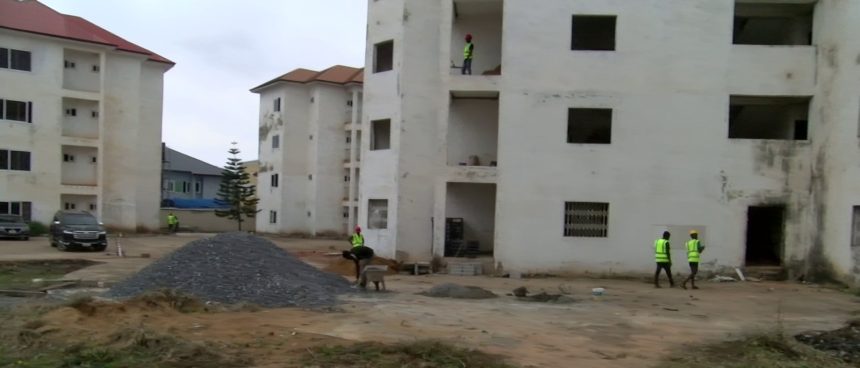
About 90% of housing delivery in Ghana is financed through personal savings and gradual construction, highlighting the limited access to affordable mortgage facilities in the country.
Chief Executive Officer of the National Housing Fund Limited (NHFL), Prosper Hoetu, said Ghana’s mortgage penetration remains extremely low at just 0.3% of Gross Domestic Product (GDP).
He explained that the situation has forced many prospective homeowners to depend on their earnings and other informal sources to finance construction, often resulting in houses taking several years to complete.
Speaking at the opening of the National Conference on Housing Finance on Wednesday, October 7, 2026, Mr Hoetu said the country’s housing challenge goes beyond the availability of physical structures.
According to him, access to affordable and long-term financing remains a major obstacle preventing many Ghanaians from acquiring or completing homes.
“About 90 percent of housing delivery takes place through incremental self-financing. On average, it takes about ten years for people to complete their houses,” he said.
He added that the formal real estate sector currently accounts for only about 10% of Ghana’s housing needs, making it necessary to expand financing options for both developers and potential homeowners.
Mr Hoetu noted that the financing gap is particularly severe among people working in the informal sector. Although many may have the ability to repay loans, he said they often struggle to meet conventional mortgage requirements because they lack formal payslips, employment records and other documentation demanded by financial institutions.
He disclosed that the NHFL recently resumed lending under the National Mortgage Scheme at an interest rate of 8.4%, down from 13.5%. Developer financing, he said, is now available at 10.4%.
He attributed the improved rates to prudent economic management and a blended financing arrangement between the NHFL and partner financial institutions.