Ghana is a deeply religious country where Christmas in December is traditionally marked by church services, family gatherings, community celebrations, and generous sharing of food.
Christmas has always been a season of joy, togetherness, and reflection.
Yet, within these celebrations, a subtle but troubling contradiction continues to grow with the widespread adoption of Christmas symbols that have little or no connection to Ghanaian or African identity.
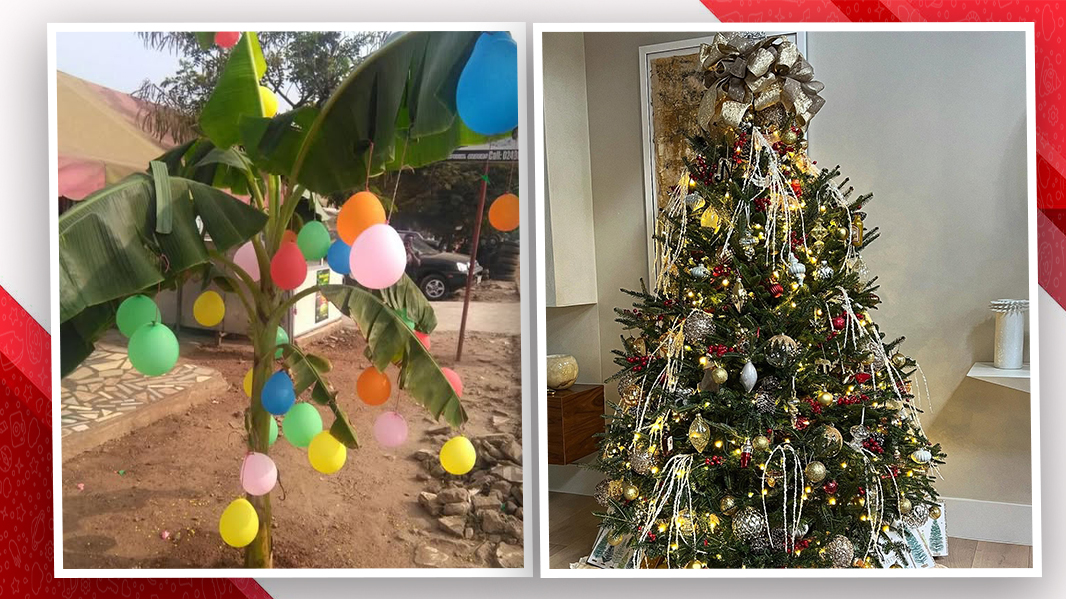
In recent years, local Christmas trees that were improvised from pawpaw stems and palm branches have become a thing of the past in recent festive seasons.
In the 1980s, 1990s, and early 2000s, young people cut palm branches and wove them into simple shelters where friends gathered.
Food and drinks provided by parents were shared, laughter filled the air, and community bonds were strengthened.
These practices reflected creativity, togetherness, and cultural authenticity.
For many Ghanaians, especially during childhood, the sight of decorated Christmas trees brings excitement and wonder, especially around the 23rd and the eve of Christmas.
The glowing lights, colourful ornaments, and festive atmosphere evoke happiness and create lasting memories.
Christmas, for a child, represents magic, celebration, and anticipation.
Before the widespread influence of Western-style decorations, Ghanaian Christmas celebrations had distinct local expressions.
Today, those local expressions are gradually disappearing.
Alongside them are ornaments, lights, and decorations that mirror Western traditions.
In December, the Christmas decoration industry becomes a brisk business across Ghana, from homes and churches to hotels, restaurants, malls, and pubs, particularly in Accra.
However, with maturity comes reflection.
Questions now arise about why symbols rooted in the European climate, history, and culture pine trees, snow, reindeer, polar bears, and Santa Claus, have become dominant representations of Christmas in an African setting.
These elements, alien to Ghana’s geography and heritage, are increasingly presented as the standard image of Christmas.
In their place are artificial trees, imported decorations, cotton wool made to resemble snow, and foreign imagery that holds no relevance to Ghanaian/ African realities.
This shift is especially noticeable in upscale eateries, hotels, shopping centres, and increasingly, private homes.
The growing dominance of Westernised Christmas imagery raises important questions.
Why are non-African symbols being promoted as the ideal way to celebrate Christmas in Africa? Who sets this standard? Who benefits from the production and sale of artificial trees and imported decorations, and where are these items manufactured? More importantly, what is the long-term cost to African cultural identity?
There is a growing concern that African societies are gradually abandoning their own cultural expressions in favour of imported traditions.
In doing so, local identity is weakened, and the richness of African heritage risks being sidelined.
This is not a rejection of Christianity or cultural exchange, but a call for balance and self-awareness.
Multiculturalism thrives when cultures interact while remaining respected and preserved.
The beauty of humanity lies in diversity, not imitation.
Christmas in Africa does not require snow, reindeer, or pine trees to be meaningful.
It can and should reflect African values of community, generosity, faith, and shared joy.
Africa must recognise that celebrating Christmas does not mean surrendering cultural identity.
The earlier this realisation takes root, the greater the chance of preserving what makes African societies unique and relevant in a diverse global culture.