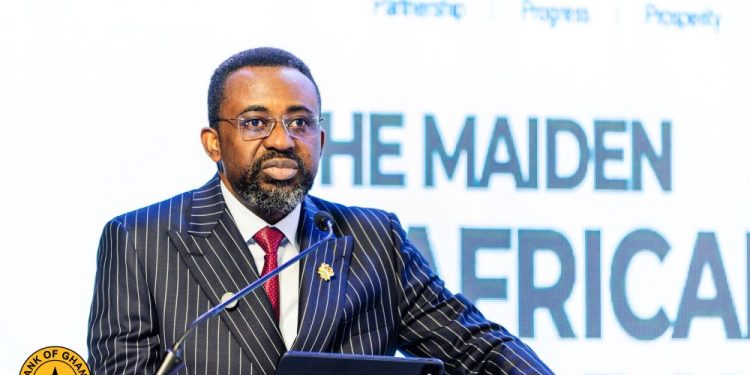
The Governor of the Bank of Ghana has outlined four priorities for strengthening Africa’s digital payments ecosystem, urging central banks to focus on cross-border efficiency, financial health, consumer trust and regulatory cooperation.
Speaking at the IMF-World Bank meetings in Thailand, the Governor said Africa must move beyond expanding access to digital payments and ensure that the growing use of mobile money and other financial technologies delivers broader economic benefits.
Ghana’s mobile money transactions exceeded one billion in August 2026 for the first time, reaching GH¢519 billion in value.
This represented a 46.5% increase compared with the same period a year earlier.
The Governor said the scale of activity presents an opportunity to deepen financial inclusion, support trade and investment, and improve the resilience of financial systems across the continent.
The first priority is to make cross-border payments faster and cheaper.
The Governor noted that many payments between African countries still pass through correspondent banks outside the continent, with transaction costs exceeding 8%—well above the 3% target.
The Bank of Ghana is testing cross-border interoperability using central bank digital currencies, stablecoins, bank accounts and mobile wallets along the Ghana–Rwanda and Ghana–Nigeria corridors. It has also extended the Pan-African Payment and Settlement System (PAPSS) to mobile wallets on the Ghana–Nigeria corridor.
The objective, he said, is to move these initiatives into live services by building on existing infrastructure rather than creating parallel systems.
The second priority is to turn financial access into meaningful financial inclusion.
Although 81% of Ghanaian adults have access to financial services, only 52.7% are financially included when actual usage and service quality are considered. Private sector credit also remains at about 10% of GDP.
The Governor said digital platforms must do more to support responsible savings, credit, insurance and investment.
The Bank is strengthening oversight of digital lenders and developing tools to monitor borrowers’ exposure to multiple lenders.
Its open banking initiative is also advancing towards a pilot phase to improve customer control over financial data and encourage competition.
The third priority is to strengthen trust and protect consumers.
Reported fraud cases in Ghana rose by 48% in 2025, largely involving payment service providers, although the total value at risk remained broadly unchanged.
The Governor said this points to a shift towards a greater number of smaller incidents affecting ordinary users.
Measures to address the problem include consumer education, payee confirmation, stronger SIM replacement controls and enhanced cybersecurity supervision.
The fourth priority is to reduce regulatory fragmentation.
The Governor argued that African fintech companies face costly and duplicative licensing requirements when entering different markets, even when their activities and risk profiles are similar.
Ghana’s Licence Passporting Framework with the National Bank of Rwanda offers a model for closer regulatory cooperation.
The Bank is engaging more than ten countries to join the initiative.
He said common standards for payment messaging, payee verification and fraud data sharing would further strengthen regional integration.
The Governor stressed that Africa’s digital payments future should not depend on any single technology. Central banks, he said, must instead ensure that emerging systems are safe, efficient, resilient and inclusive, supporting the continent’s wider trade, investment and development ambitions.