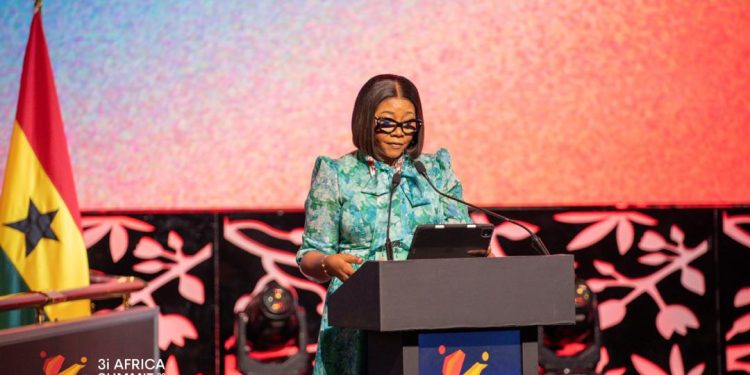
The Second Deputy Governor of the Bank of Ghana, Matilda Asante-Asiedu, has called for stronger digital infrastructure across Africa to sustain financial inclusion gains and attract more investment into the digital economy.
Speaking on the final day of the 3i Africa Summit 2026, she stressed that innovation alone is not enough without systems that support large-scale access and impact.
“Innovation without infrastructure cannot and does not scale. Investment without systems do not reach people, and impact without inclusion will not last,” she stated.
Using Ghana as an example, she highlighted the success of USSD-based mobile money services, which allow people to send and receive money using basic mobile phones without internet access.
“In Ghana today, anyone and everyone can send money from a phone with no internet connection, no smartphone, no app, no data plan, just a basic phone… and a USSD code,” she said.
She noted that this simple system has been key in expanding access to financial services, helping Ghana reach 81% financial inclusion, according to the World Bank Global Findex Report.
“The system was built for the reality that we have, for the people who we serve, because the infrastructure also already existed,” she explained.
Mrs. Asante-Asiedu also pointed to the importance of mobile money agents, describing them as central to financial inclusion efforts.
“The woman at the roadside… who handles your cash in and your cash out is not some side conversation—that is central to the inclusion strategy.”
On investment, she said capital flows depend on trust, reliable systems, and clear regulations.
“Capital flows where systems work, where payment rules are reliable, and where regulatory frameworks are clear and trust exists,” she noted.
She called for stronger digital public infrastructure, better coordinated regulations, and systems that support cross-border transactions under the African Continental Free Trade Area.
“There’s nothing more frustrating than trying to transact and then being caught up in the middle not being able to complete that kind of transaction,” she said.
She warned that digital progress must not deepen inequality.
“If digital progress only serves those who are already visible and easy to serve, then we’re simply digitising advantage and not digitising inclusion.”
Concluding, she said Africa must focus on building trusted, integrated systems that work for everyone, especially small businesses, rural users, and informal workers.
“The truest test for us then is whether our systems would work better for the market trader, the small business owner, the rural user, that farmer, the woman-led enterprise,” she said.
She added that Africa’s digital future depends on building strong systems that promote trust, inclusion, and scalable growth.