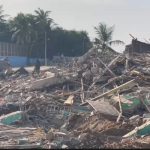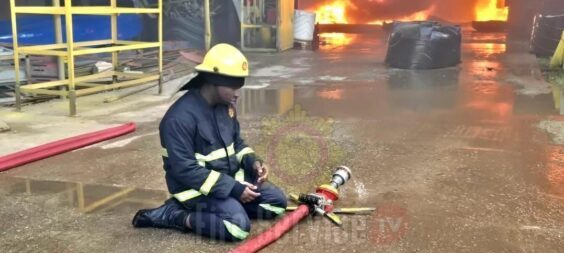
The October 1 inferno at Avenor has reopened an uncomfortable but necessary debate about the state of Ghana’s firefighting infrastructure and our collective attitude towards fire safety.
Whenever a major fire breaks out, the Ghana National Fire Service (GNFS) is often among the first institutions to face public criticism. The expectation is straightforward: firefighters arrive, deploy their fire tenders and put out the blaze within minutes.
But is firefighting really that simple?
Perhaps it is time we asked what we expect the Ghana National Fire Service to achieve with the resources at its disposal.
The GNFS has consistently identified adequate resources, equipment and appliances as essential to its ability to protect lives and property. Its mandate extends beyond responding to fires to include prevention, public education, rescue operations and fire suppression.
Yet, the realities firefighters encounter at the scene of emergencies often make their work far more difficult than many people appreciate.
At Avenor, reports indicated that firefighters struggled to access parts of the affected area because roads and surrounding structures obstructed their movement. The Service reportedly had to clear some structures to create access for its equipment.
So, when a fire tender cannot get close enough to a burning building, what exactly do we expect the firefighter to do?
Fly?
The fire tender cannot fly.
This is where the conversation must move beyond the familiar question: “What is the work of the Fire Service in this country?”
We must also examine our own role in creating the conditions under which firefighters are expected to operate.
We put up structures on or around spaces needed for emergency access. We block roads and passages, build in areas not designed for habitation and, in some cases, disregard fire-safety requirements until disaster strikes.
At Avenor, reports from the scene indicated that structures obstructed firefighters’ access. An official of the affected company also said the facility’s fire hydrants were empty.
When hydrants are inaccessible or have no water, where do we expect firefighters to find the supply needed to tackle a raging blaze?
From the sea?
Of course not.
Fire safety, therefore, cannot be left to the Fire Service alone. It is a shared responsibility involving the government, local authorities, property owners, businesses, communities and individual citizens.
The Ministry of the Interior has also described fire safety as a shared responsibility and urged individuals and institutions to comply with fire-safety laws.
Retooling cannot be an afterthought
There is, of course, a legitimate and necessary debate about the equipment available to the Ghana National Fire Service.
In June 2025, the government acknowledged the need to replace ageing and broken-down fire vehicles and announced plans to acquire new fire tenders.
The 2026 Budget subsequently provided for the procurement of 100 fire tenders and assorted fire equipment, with GH¢150 million allocated to retooling the Service.
In May 2026, the Minister for the Interior, Mohammed-Mubarak Muntaka, also said processes were far advanced for the procurement of the 100 fire engines and other rescue equipment.
These are important developments. But announcements and budgetary allocations are only part of the process. The real test is whether the equipment is delivered, distributed according to operational needs, properly maintained and ready for use when emergencies arise.
Retooling the Fire Service must not become a political talking point. It is an investment in human lives, property and national infrastructure.
And the exercise must go beyond fire tenders.
Ghana needs accessible hydrants and reliable water sources. Emergency routes must remain open. Firefighters need appropriate equipment for industrial fires, high-rise buildings and other complex emergencies, alongside adequate protective gear, dependable communication systems and continuous training.
Without these essentials, even the most determined firefighter can be constrained by circumstances beyond their control.
Firefighters cannot perform magic
Perhaps the biggest change required is a shift in public attitude.
The arrival of firefighters at an emergency scene should not automatically create the expectation that the fire will be extinguished immediately.
These men and women work in extremely dangerous conditions. They enter burning buildings, confront intense heat and smoke, rescue people and animals, protect neighbouring properties and, in many cases, put their own lives at risk.
The Avenor incident is a reminder that their work is not magic.
If roads are blocked, the fire tender cannot pass.
If hydrants are inaccessible or empty, securing water becomes a challenge.
If buildings are constructed in ways that restrict emergency access, firefighters are forced to work under even more difficult conditions.
And if the equipment available is inadequate for the scale or nature of a fire, the limitations become even more apparent.
None of this means the Fire Service should be shielded from scrutiny. Institutions entrusted with public safety must be held accountable for their performance.
But accountability must be informed by the realities on the ground.
If we want a Fire Service capable of responding effectively to major fires, we must demand that the government equips it adequately. At the same time, we must insist that assemblies enforce planning and building regulations, property owners comply with fire-safety requirements, and citizens stop creating obstacles that emergency responders must struggle to overcome.
The current leadership of the GNFS, under Chief Fire Officer Daniella Mawusi Ntow Sarpong, has also been pursuing reforms aimed at improving the Service. One such initiative is the Automated Fire Safety Compliance System (AFCAS), which is intended to modernise fire-safety inspections and compliance.
But leadership alone cannot resolve every challenge.
The government must provide the resources.
The Service must maintain and deploy them effectively.
Local authorities must enforce planning and safety regulations.
Businesses and property owners must comply with the law.
And citizens must recognise that fire prevention is not somebody else’s responsibility.
So, the next time a major fire breaks out and we are tempted to ask, “What is the work of the Fire Service?”, perhaps we should pause and ask a different question:
What have we done as a country to give our firefighters the tools, access and working conditions they need to do their jobs?
If we cannot collectively advocate for a properly equipped Ghana National Fire Service while continuing to contribute to the very problems that make firefighting difficult, our outrage after every major fire risks becoming little more than a familiar cycle of blame.
We cannot demand miracles from firefighters while denying them the conditions they need to perform their duties.
Equip the Fire Service. Keep emergency routes open. Protect our hydrants. Enforce fire-safety laws. Educate the public. And take fire prevention seriously.