This debate has come up often in the recent weeks during conversations I have had with colleagues and friends alike.
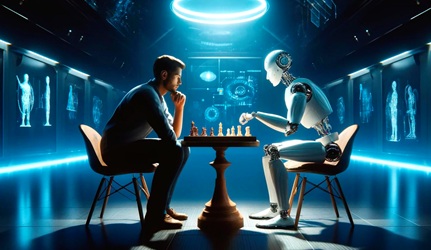
It is about the rise of Artificial Intelligence (AI) and the fact that it is changing the world at a pace few could have imagined. Take Psychology Courses
The conclusion has been that the emergence of AI could be a blessing or a curse to humanity as far as human intellect is concerned.
If harnessed well, AI could be a blessing but could also be a bad master if not used effectively.
Today, and in fact since the emergence of technology such as the computer, the human mind is fed virtually with everything: AI writes speeches, drafts legal documents, diagnoses diseases, translates languages, composes music and even creates works of art.
Tasks that once took hours can now be completed in minutes.
No wonder that AI is often described as the most revolutionary technology since the invention of the Internet.
Will AI make human beings intellectually lazy and gradually rob them of their ability to think for themselves?
The answer is not as simple as many assume, including me.Order DNA Kits
Technology has always changed the way people live and work.
There was a time when people memorised dozens of telephone numbers.
Today, our mobile phones do that for us.
Calculators have largely replaced mental arithmetic, while search engines have become the first stop for almost every question.
None of these inventions destroyed human intelligence. Instead, they made life easier and improved productivity.Explore Philosophy Books
Artificial Intelligence, however, is different.
Internal Audit Leadership Summit 4th Edition • Ghana • 2026 23rd–25th September, 2026 AUDIT REIMAGINED From Compliance To Consequence Bold Leadership. Foresight. Strategic Impact. CLICK TO REGISTER NOW!
Unlike earlier technologies that mainly replaced physical effort, AI is beginning to perform tasks that require reasoning, writing, analysis and decision-making.
For the first time, machines are assisting in work that had traditionally been regarded as the exclusive preserve of the human mind.Explore AI Tools
And this is where the danger lies. Human intelligence grows through the exercise of use.
Thinking and exercising the mind through reading, solving problems, debating ideas and conducting research all strengthen the mind. If people increasingly allow AI to perform these tasks on their behalf, the tendency is that they may gradually lose the habit of independent thinking.
In Ghana, there have been reports that WAEC is reported to have cancelled examination results just because candidates relied on AI to answer questions and write essays instead of mental drill. Some professionals rely on AI-generated reports without carefully checking the facts.
Others accept AI’s conclusions without asking whether they are accurate or fair, and this has affected many people such that they have been put to shame.Take Psychology Courses
Convenience
Undoubtedly, convenience can become a silent enemy of intellectual growth.
History reminds us that true knowledge rarely comes easily. It requires patience, discipline and curiosity. The struggle to understand a difficult concept is often what produces genuine learning.
If AI removes that struggle entirely, people may gain answers but lose understanding.
These days, I have lost my writing skills.Try CAD Software
I used to write excellent stories on a piece of paper as a journalist, but now the computer suggests words and sentences for me, which is devoid of the emotions attached.
AI can write poems, compose songs and generate impressive images within seconds, but creativity is more than just producing attractive words or pictures.
It is born from human experience, imagination, emotion and reflection.
A machine cannot experience grief, hope, sacrifice or love.
It cannot dream of a better society or draw wisdom from personal failure.Order DNA Kits
That is the preserve of the mind, which no machine can replace.
Man cannot challenge the creator of the mind.
Great works of literature, music and art have always reflected the human condition.
AI can imitate style, but it cannot live the experiences that inspire authentic creativity.
On the contrary, AI has enormous potential to improve lives. In health care, for instance, it can assist in early diagnosis or in detecting diseases.Explore AI Tools
In agriculture, it can help predict weather patterns and improve crop yields.
In law, it can analyse thousands of documents within minutes.
In journalism, it can free reporters from routine tasks, allowing them to spend more time investigating issues of public interest.
In education, it can provide personalised learning support to students.
Therefore, if used wisely, AI can become one of humanity’s greatest partners, albeit to some extent since it is devoid of emotions.Ghanaian politics coverage
A carpenter does not become less skilled because he owns better tools.
Likewise, a teacher, lawyer, journalist or engineer should not become less intelligent because AI helps with routine work.
Problems arise only when the tool begins to replace the thinking instead of supporting it.
Responsibility
Perhaps the greatest responsibility now rests with our educational institutions.
Schools and universities must teach students not merely how to use AI but how to question it.Explore Philosophy Books
Critical thinking, ethical reasoning, originality and problem-solving should become the foundation of education in the AI era.
Students must understand that AI is a starting point for inquiry, not the final authority.
Parents also have an important role to play.
Children should continue to read books, solve problems independently and engage in thoughtful discussions.
These activities develop the habits of mind that no machine can replace.Order DNA Kits
Governments, businesses and technology companies must also ensure that AI is developed responsibly.
Decisions affecting justice, healthcare, employment and public policy should always involve human judgement.
Technology must serve humanity—not the other way around.
The future of AI is not predetermined. It depends entirely on the choices we make today as a people, especially those of us in the Third World.Access Clinical Journals
If we use AI as a shortcut to avoid thinking, we risk becoming intellectually dependent on machines and bankrupt.
But if we use it to eliminate repetitive tasks while devoting more time to creativity, innovation and critical reasoning, AI could usher in one of the greatest periods of human progress.
The greatest threat is not that machines will become intelligent.
The greatest threat is that people may stop exercising the intelligence they already possess.
Artificial intelligence is a remarkable invention, but it should remain what its name suggests- artificial.Explore AI Tools
Human intelligence, with its wisdom, compassion, conscience and creativity, must always remain at the centre of civilisation, as it had been.
The future belongs not to those who rely entirely on AI, but to those who know how to use it without surrendering their capacity to think.
That is the challenge of our generation and our part of the world, and meeting it will determine whether AI becomes humanity’s greatest servant or its most subtle master.
The time to act is now so that we are not overtaken by events.