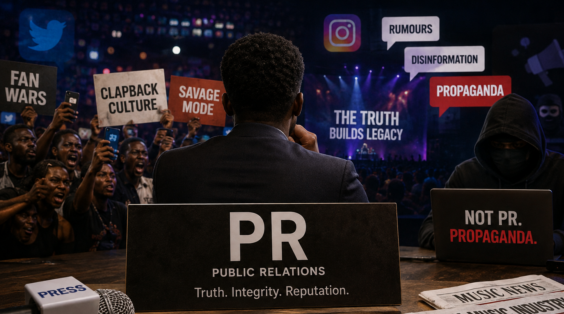
There is a strange thing happening in Ghana’s entertainment industry. We have become very good at making noise about our artists, but increasingly poor at managing the reputations we claim to be protecting.
In some corners of the music industry, public relations has become a competition over who can clap back the hardest, trend the longest, insult a rival most creatively or manufacture the most flattering version of reality.
The loudest publicist gets noticed. The most aggressive social media handler gets celebrated. The person with the sharpest tongue is sometimes treated as though they must also be the best communicator. Somewhere in all that noise, however, the actual practice of public relations is getting lost.
This is not an attack on Ghanaian music publicists as a collective. There are excellent communications professionals working quietly behind the scenes, building relationships with journalists, positioning artists, managing crises, developing narratives and protecting reputations without making themselves the story.
The problem is that the loudest examples are increasingly setting the standard, and that should concern anyone who cares about the future of Ghana’s creative industry.
PR is supposed to protect reputation, not manufacture reality
At its core, public relations is about reputation, relationships and understanding. The Chartered Institute of Public Relations defines PR as the planned and sustained effort to establish and maintain goodwill and mutual understanding between an organisation and its publics.
It describes reputation as the result of what an organisation does, what it says and what others say about it. Importantly, the CIPR also stresses that effective PR requires listening and understanding, not simply broadcasting information.
That definition is important because it tells us what PR is not.
It is not lying, propaganda, abusing journalists because they published something unflattering, mobilising a fan army to attack another artist or creating a fictitious version of events because the truth does not look good enough.
The Public Relations Society of America similarly places honesty, accuracy, independence, loyalty and fairness among the profession’s core values. Its code requires practitioners to be honest and accurate in their communications and to correct erroneous information for which they are responsible.
The British CIPR is equally explicit. Its current code requires members to maintain professional integrity, deal honestly and fairly with clients, colleagues and the public, and uphold the reputation of the PR profession.
Its guidance on accuracy says information given to journalists or others should be truthful and reasonably verified, and that practitioners should not omit or obscure information in a way that creates a misleading impression.
So when did being a good PR person become synonymous with being the best defender of an artist at all costs?
The fan army has changed the game
Ghana’s music industry already operates within an intensely polarised fan culture. Bhim Nation, Shatta Movement, SarkNation, High Grade Family and other fan communities have become powerful digital ecosystems. They can mobilise quickly, amplify songs, sell tickets, defend an artist and create extraordinary visibility.
That power is not inherently bad. Passionate fan communities are valuable assets for artists, and every major music market has them.
The problem begins when professional communicators start behaving like fan soldiers.
A publicist should be able to defend an artist without becoming indistinguishable from the artist’s most aggressive fan. That distinction matters because the moment a communications professional begins insulting another artist, mocking supporters or deliberately provoking a rival fan base, they are no longer simply managing communication. They are contributing to the very toxicity that makes the industry harder to navigate.
And once the publicist becomes part of the fight, who is managing the reputation?
This became particularly visible around awards season. The race for the Telecel Ghana Music Awards’ Artist of the Year has increasingly generated a parallel communications battle, with publicists and representatives making cases for their respective artists across radio, television and social media.
A 2025 analysis of the TGMA race described the publicists behind King Paluta, Stonebwoy and King Promise as prominent voices shaping the contest and noted that some of their exchanges had become heated.
Another commentary from Graphic Online argued that the debates sometimes resembled political contests in which communicators appeared to be trying to dominate or outdo one another.
There is nothing wrong with campaigning. Strategic awards campaigning is a legitimate part of the entertainment business, particularly when an artist has a strong factual case to make.
But there is a difference between presenting a compelling case for your client and attempting to discredit everyone standing in their way. The first is advocacy. The second can quickly become insecurity disguised as strategy.
We are confusing visibility with competence
Perhaps one of the biggest problems is that social media has distorted how we measure PR professionals.
A communicator with 50,000 followers can look more influential than someone with 5,000 carefully cultivated media relationships. A publicist who trends every weekend can appear more effective than one whose work rarely becomes visible because it is happening behind the scenes.
But PR is not a popularity contest.
The best publicist may not be the person tweeting the most. They may be the person who knows which journalist to call early in the morning, which story should be addressed before it becomes a headline, which interview the artist should decline, which controversy requires a statement and which one should simply be ignored.
They may be the person sitting in a management meeting saying, “No, we should not put this out.”
That is PR too. In some situations, the most valuable thing a publicist does is stop their client from speaking.
The professional value of PR goes far beyond press mentions. The CIPR identifies media relations, stakeholder relations, crisis and issues management, copywriting, editing and management of people and resources among the core tasks of modern PR professionals.
That is a much bigger job than being the person who wins an argument online.
A crisis is where the real professional is revealed
This is where the recent conversation around Stonebwoy’s BHIM Festival concert at OVO Arena Wembley becomes instructive.
The August 15, 2026 performance was a significant moment for Ghanaian music. OVO Arena Wembley describes it as the first time a Ghanaian artiste had headlined the iconic London venue, while subsequent Ghanaian media reports described the event as a sold out 12,500 capacity show.
The achievement itself is significant. A Ghanaian artist taking a self-produced headline show to one of London’s major indoor entertainment venues is exactly the kind of international progress the industry should be celebrating.
But the conversation quickly shifted after photographs and videos showed curtains covering sections of the arena. Questions followed online about the venue’s actual attendance and what “sold out” meant in that context.
There are legitimate reasons why sections of a large arena might be closed or curtained. Production configuration, acoustics, sight-lines, lighting, ticket inventory and audience concentration can all influence how a venue is configured. Commentary following the event offered some of these explanations, including the argument that curtains can help create a more intimate atmosphere and improve acoustics.
That is precisely why the communications response should be calm, factual and precise.
Headlining a 12,500-capacity venue is not automatically the same thing as selling 12,500 tickets. Those are different claims.
If the available ticket inventory was limited to a smaller configuration, explain it. If sections were closed for production or venue management reasons, explain that. If every ticket made available for sale was sold, provide the number. If there is a discrepancy between what was initially communicated and what the evidence appears to show, acknowledge it and clarify.
None of these explanations diminishes the achievement.
In fact, transparency could make the achievement stronger.
The temptation in entertainment PR is often to make an accomplishment sound bigger than it already is. But a credible achievement does not need unnecessary inflation. A major Ghanaian artist performing at OVO Arena Wembley is a story worth telling on its own.
That is the PR lesson.
You do not protect a reputation by asking people to believe what the available evidence does not support. You protect it by giving people a credible account of what happened.
The best PR people know when not to fight
This is something the Ghanaian creative industry needs to learn.
Not every criticism deserves a response. Not every tweet deserves a quote tweet. Not every rival needs to be answered, and not every negative story requires a counterattack.
Sometimes silence is strategy. Sometimes clarification is enough. Sometimes you need to admit that something went wrong. Sometimes the smartest response is simply to provide the facts and move on.
Music Business Worldwide recently profiled veteran music communications executive Andy Saunders, whose approach to crisis management begins with a basic question: “Did you do it?” Saunders explained that he needs to be confident his client is telling him the truth because without the truth, he cannot properly manage the crisis.
That should be compulsory thinking for anyone working in artist PR.
Before crafting the statement, find out what happened. Before defending the artist, ask the difficult questions. Before telling journalists something, verify it. Before posting, consider whether the statement will still look credible five years from now because the internet remembers.
Your artist’s reputation is not the only reputation at stake
There is another issue we rarely discuss.
Every time a PR professional knowingly puts questionable information into the public domain, they are also spending their own professional credibility.
Artists change management teams. Labels change. Managers leave. Publicists move from one client to another. Relationships end and careers evolve. But screenshots remain.
Old interviews remain. Press statements remain. Tweets remain. Videos remain.
The publicist who spends years defending questionable claims on behalf of one artist may eventually leave that camp and apply for another communications role. A future employer, client or collaborator can search their name and find the same material.
That is the digital footprint.
You may think you are protecting the artist today, but you could be damaging your own professional reputation tomorrow.
This is why professional independence matters. A good publicist is loyal to the client, but loyalty does not mean surrendering professional judgement. The PRSA framework places loyalty alongside honesty, independence and fairness, while the CIPR expects practitioners to exercise professional judgement with integrity and accuracy.
Your job is not simply to tell your client what they want to hear. Your job is to tell them what they need to hear.
Sometimes that means saying, “We need to apologise.” Sometimes it means saying, “That claim cannot be substantiated.” Sometimes it means saying, “Do not respond.” Sometimes it means telling an artist, “You are wrong.”
That is not betrayal. That is professional counsel.
Ghana needs fewer digital warriors and more strategic communicators
There is an uncomfortable irony here. We keep saying Ghana’s music industry needs to become more professional, yet we sometimes reward precisely the behaviour that undermines professionalism.
We celebrate the person who “finished” another camp online. We praise the publicist who produces the most savage response. We mistake virality for effectiveness. We count followers instead of relationships and measure noise instead of outcomes.
Meanwhile, a genuinely skilled communicator who prefers strategy, diplomacy and facts can appear invisible.
That has to change.
A serious artist needs more than someone who can write a press release. They need a reputation strategist who understands media, audiences, brands, sponsors, crisis management, data, stakeholder relationships and international markets. They need someone who can distinguish publicity from public relations and publicity from propaganda. Most importantly, they need someone who is not afraid to disagree with them.
This is not about importing a foreign model and pretending Ghana has no professional communications expertise of its own. Ghana has talented PR practitioners who understand the local media ecosystem, culture and audience better than any imported playbook ever could. The issue is what the industry rewards and what artist managers demand from those professionals.
In mature music markets, artist communications increasingly sits within a broader ecosystem that includes media relations, brand positioning, digital strategy, stakeholder management and crisis communications.
The lesson worth borrowing is not a particular Western formula. It is the understanding that reputation management is strategic work, not simply social media combat.
PR should build bridges, not deepen the trenches
Ghana’s music industry is too small to sustain endless warfare.
The same journalist covering Stonebwoy today may cover Shatta Wale tomorrow. The same brand sponsoring Sarkodie may partner with another artist next year. The same promoter working with one camp today may work with its rival tomorrow.
Burning relationships for a temporary social media victory is poor business.
A professional PR representative should be able to fiercely advocate for an artist without destroying the ecosystem around them. There is nothing wrong with competition, competition can make artists better. Awards should be competitive. Concerts should compete. Songs should compete. Brands should choose who they want to work with.
But the professionals behind these artists should not turn competition into permanent hostility.
We need to remember that the objective of PR is not to win on Twitter or Facebook. It is to build and protect reputation.
And reputation is built slowly, through consistency, credibility, relationships and trust.
The CIPR makes a similar point in its definition of PR, describing understanding as a two way process that requires organisations to listen to their publics rather than simply broadcast information.
That distinction could transform the way we approach artist communications in Ghana.
The industry needs a professional reset
I do not think Ghana lacks good publicists. I think good publicists are sometimes being drowned out by bad incentives.
We need to redefine what we celebrate.
The best PR person should not be the one who insults the rival’s camp most effectively. It should be the one who makes their artist more credible.
The best communications team should not necessarily be the one that trends every week. It should be the one that understands when to speak, when to listen, when to clarify, when to apologise and when to remain silent.
And the best artist manager should not hire a publicist simply because they have a large following or a reputation for being “savage.”
Hire the person who can protect the brand when the room is on fire. Hire the person who can tell you the uncomfortable truth. Hire the person who understands that today’s headline is not more important than tomorrow’s reputation.
That is the reset Ghana’s creative industry needs. We need to stop confusing aggression with advocacy, virality with effectiveness and propaganda with PR.
Because ultimately, public relations is not about making an artist look perfect. It is about making the artist believable.
And in an industry increasingly crowded with noise, credibility may be the most valuable publicity money cannot buy.