Every generation has its favourite villain. Once upon a time, calculators were accused of destroying mathematics. Then the internet arrived and lecturers became suspicious of every well-written assignment. Today, artificial intelligence has inherited the title of Public Enemy Number One, especially in the creative arts.
Mention AI at any gathering of musicians and producers in Ghana and prepare for fireworks. One camp insists the technology is the end of music as we know it. The other believes it is the greatest innovation since the invention of the digital audio workstation.
As usual, the truth is somewhere in between.
Artificial intelligence is not visiting. It has unpacked its bags. Whether we applaud or protest, AI will continue to shape our lives, our work and our music. The real question is not whether AI belongs in Ghana’s music industry. The real question is how we choose to use it.
Every New Tool Arrives With Fear
History has a funny way of repeating itself.
There was a time when recording music meant assembling an entire live band in one studio. Everyone had to perform almost perfectly because mistakes were expensive. Producers worked with tape machines, engineers balanced microphones manually and editing required both patience and skill.
Then computers arrived.
Software such as Cubase, Pro Tools, Logic Pro and FL Studio transformed music production forever. Suddenly, one producer with a laptop could create music that once demanded an entire recording studio. Traditionalists declared the death of “real music.”
It never happened.
Instead, software became another instrument. Great producers remained great because technology amplified their creativity instead of replacing it.
Artificial intelligence represents the next chapter in that same story.
From Research Panic to AI Panic
The education sector offers another familiar lesson.
Years ago, lecturers frowned upon research conducted online. Students were expected to spend endless hours in physical libraries, flipping through dusty books and photocopying journal articles.
Eventually, universities accepted that the internet was simply a better research tool when used responsibly. What mattered was not where the information came from but how students analysed, interpreted and presented it.
Today, the conversation has shifted again.
Many lecturers are comfortable with students using online research, yet they become concerned when assignments are produced entirely by AI without original thinking.
That distinction matters.
Using technology to support learning is different from allowing technology to replace thinking altogether.
Music faces exactly the same dilemma.
When AI Becomes the Studio Assistant
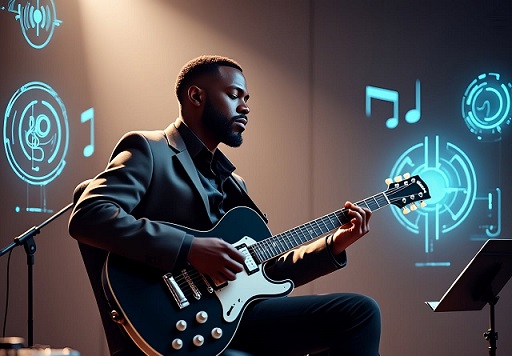
The most exciting use of AI is not replacing musicians. It is helping them become better musicians.
Modern AI tools can analyse songs and assist with mixing and mastering by balancing frequencies, improving equalisation and producing cleaner sounding tracks.
Songwriters experiencing writer’s block can generate fresh chord progressions, rhythmic ideas or lyrical inspiration. The final song still depends on the artist’s judgement, emotion and storytelling.
AI can also restore old recordings by separating vocals from instruments, reducing unwanted noise and improving overall audio quality. Imagine preserving priceless recordings from Ghana’s musical legends with greater clarity for future generations.
Perhaps the biggest advantage is accessibility.
Young musicians in Kumasi, Tamale, Takoradi or Ho no longer require expensive studios to produce professional sounding music. AI-powered production tools are lowering barriers and giving talented creators opportunities that were once reserved for those with deep pockets.
That is progress worth celebrating.
The Other Side of the Microphone
Of course, not every AI story deserves applause.
Today, someone with no musical background can type a few prompts into an AI platform and generate an entire song within minutes. The same person can upload that song to streaming platforms and potentially earn revenue.
That reality understandably frustrates musicians who have spent years mastering instruments, studying harmony and perfecting their craft.
Another major concern involves copyright.
Around the world, music companies and artists continue to challenge AI developers over allegations that their systems were trained using copyrighted music without permission. Courts and lawmakers are still trying to determine where inspiration ends and infringement begins. Recent legal disputes involving AI music companies such as Suno demonstrate that the debate is far from settled.
Current copyright guidance in several jurisdictions also makes an important distinction. Music created entirely by AI without meaningful human creative input generally does not qualify for copyright protection. However, when a human meaningfully shapes, arranges, edits or contributes original creative expression to AI-assisted work, copyright protection may still apply to those human contributions. Simply typing a prompt is generally not enough.
These are complex issues that Ghana’s creative industry will eventually have to confront.
Talent Still Has the Final Word
One fear refuses to disappear. People worry AI will replace musicians altogether. That fear misunderstands what audiences truly value. Nobody attends a concert because software wrote a chorus. Fans connect with stories, personalities, emotions and lived experiences. They celebrate authenticity.
AI can imitate patterns. It cannot genuinely experience heartbreak, childhood struggles, spiritual conviction or the joy of finally making it after years of rejection. That human experience remains the heartbeat of great music.
Technology may help polish a song, but it cannot manufacture the soul behind it.
Ghana Must Prepare, Not Panic
Rather than resisting AI, Ghana’s music industry should prepare for it. Musicians should learn how to use AI responsibly to improve production, songwriting and preservation of musical heritage.
Industry associations should educate members on copyright, licensing and ethical AI practices. Government agencies and copyright institutions should begin reviewing policies that address AI generated works before disputes become widespread.
Music schools should teach students how to work alongside AI rather than pretending it does not exist. Preparation will always outperform panic.
The Future Needs Both Human and Machine
Artificial intelligence is neither a miracle worker nor a monster. It is a tool. Like every powerful tool, it can build or destroy depending on the hands that use it.
There will always be individuals who abuse AI by mass producing soulless songs in search of quick streaming revenue. There will also be artists who use AI intelligently to refine their craft, expand their imagination and produce better music.
The difference will become obvious. Talent has a signature that shortcuts cannot imitate forever. Eventually, audiences recognise authenticity. They always have.
AI is here to assist creativity, not replace it. The future belongs not to those who fear the technology or worship it blindly, but to those who understand that the greatest instrument in any studio is still the human mind.
No algorithm has yet learned how to dream like an artist.