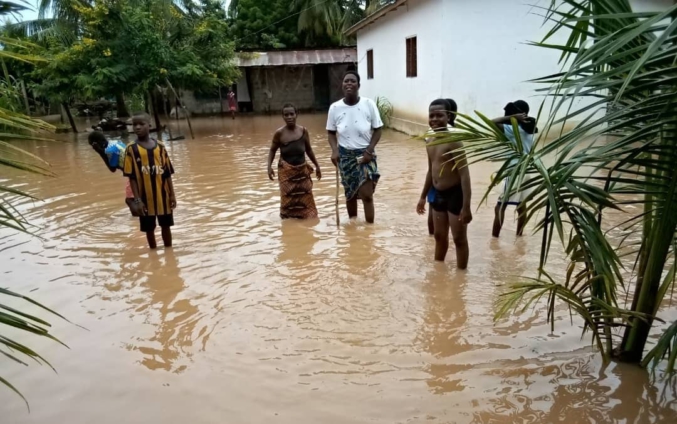
Flooding has become one of Ghana’s most difficult national challenges. Each year, the rainy season brings renewed anxiety as communities, businesses, and households face the possibility of losing lives, property, and livelihoods. The recurring nature of this challenge suggests that Ghana must move beyond temporary responses and adopt a more strategic, long-term approach.
While government has the responsibility to protect citizens and provide public infrastructure, the solution to flooding requires a national transformation involving research, innovation, private-sector participation, and responsible citizenship.
1. Move from Crisis Management to Prevention
For many years, flood response has largely been reactive. After floods occur, attention turns to rescue operations, relief support, and repairing damaged infrastructure. Although these actions are necessary, they do not address the root causes.
Government must invest more in prevention. This requires proper urban planning, enforcement of building regulations, protection of waterways, and continuous maintenance of drainage systems before the rainy season begins. A nation cannot continue to spend more money repairing flood damage than preventing floods.
2. Make Research the Foundation of Flood Solutions
Flooding is a complex problem influenced by climate change, urbanisation, drainage capacity, waste management, and human behaviour. Government must strengthen institutions such as the Ghana National Research Fund to support research that generates practical solutions. Policies should be guided by evidence rather than assumptions.
3. Develop a National Flood Innovation Strategy
Government should create an environment where universities, technology companies, engineers, entrepreneurs, and communities collaborate to develop solutions.
Flood management can become an area for innovation and job creation. Young entrepreneurs can develop technologies for early warning systems, environmental monitoring, recycling, and water management. The private sector should not only be invited after disasters; it should be part of designing solutions.
4. Strengthen Urban Planning and Enforcement
One major contributor to flooding is unplanned development. Construction on waterways, poor drainage layouts, and weak enforcement of planning regulations increase the risk.
Government must strengthen institutions responsible for land use and urban development. Planning decisions must prioritise safety, environmental sustainability, and future population growth. Development without proper planning creates future disasters.
5. Reform Waste Management Systems
Blocked drains remain a major contributor to flooding. However, the solution is not only public education; it also requires efficient waste management systems. Government should encourage:
-Modern waste collection systems;
-Recycling industries;
-Stronger enforcement against illegal dumping;
-Partnerships with private waste management companies.
Waste should be viewed not only as a problem but also as an economic resource.
6. Invest in Climate-Resilient Infrastructure
Infrastructure built today must consider future environmental realities. Roads, drainage systems, buildings, and public facilities should be designed to withstand changing rainfall patterns. Government investment should prioritise quality and sustainability rather than short-term solutions.
7. Create Stronger Community Partnerships
Flood prevention cannot succeed without citizens. Government must work with communities to develop local solutions. Traditional leaders, resident associations, schools, businesses, and civil society organisations should be involved in protecting waterways and promoting environmental responsibility.
8. Encourage Insurance and Risk Management
Flooding creates significant economic losses. Government can work with financial institutions and insurance companies to develop affordable risk-management products that protect households and businesses. A resilient economy is one where citizens and businesses can recover quickly after disasters.
Conclusion
The flooding challenge in Ghana requires a new national mindset. Government must lead, but leadership must go beyond emergency responses. It must involve investment in research, innovation, infrastructure, planning, and partnerships.
Floods are a national challenge, but they also present an opportunity to build a smarter, safer, and more innovative Ghana.
The question is no longer only “How do we respond when floods come?” The more important question is “How do we build a country where floods no longer create national emergencies every rainy season?”