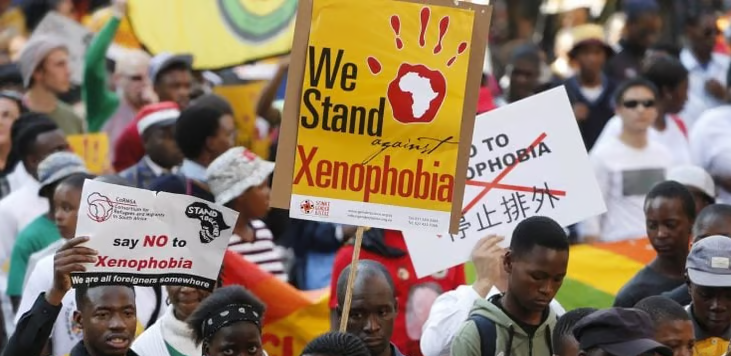
Long before South Africans were filmed telling Africans to “go back to your country,” Africans elsewhere had already heard those words. Before South Africa, there was Ghana, Nigeria, Gabon, Mauritania, and more.
This is not to justify South Africa’s treatment of other African nationals. Rather, it is to place it in context. South Africa’s xenophobia is part of a longer history of African countries turning against fellow Africans in times of tension and uncertainty. They are not the first to experience xenophobia and will probably not be the last.
Background
Beginning in mid-April 2026, scattered confrontations with migrants spilled onto South Africa’s streets and social media feeds. Activists such as Victoria Africa, also known as Queen Vee, and groups like “March and March” emerged at the forefront of anti-immigration campaigns, demanding that undocumented migrants leave the country.
In one widely circulated video, Queen Vee and some South Africans cornered a Ghanaian man over his visa status. In another, a Kenyan woman was helplessly forced out of her own shop, while a Ghanaian man was allegedly physically assaulted.
As tensions escalated, South Africa’s President Cyril Ramaphosa announced tougher measures against undocumented immigration, including stricter enforcement of immigration laws and calls for employers to stop hiring undocumented migrants. He maintained, however, that immigration enforcement was the responsibility of the state, not ordinary citizens.
In Ghana…
In 1969, Ghana’s Prime Minister, General Abrefa Busia, enacted the Aliens Compliance Act, requiring all foreigners to leave the country. The policy led to the displacement of over 200,000 foreign nationals, including about 140,000 Nigerians, according to the Migration Policy Institute (MPI). Many were forced to abandon their livelihoods and restart life in their home countries.
In Nigeria…
In 1983, under President Shehu Shagari, Nigeria carried out a mass expulsion of undocumented migrants. Some analysts describe the move as retaliation for earlier expulsions of Nigerians from Ghana.
The action led to the displacement of over 2 million people from Niger, Togo, Cameroon, Chad, and Ghana, according to the International Organisation for Migration (IOM). Many migrants were forced to leave suddenly, carrying their belongings in checkered bags that became famously known as “Ghana Must Go” bags. In South Africa, however, the phrase has often echoed differently: “Go back to your country.”
In 1985, under President Muhammadu Buhari’s military government, Nigeria carried out another mass expulsion of foreign nationals.
South Africa again…
In 2008, under President Thabo Mbeki, xenophobic violence left at least 60 people dead and displaced about 50,000 migrants.
In 2015, during President Jacob Zuma’s tenure, anti-foreigner attacks killed at least 7 people and displaced thousands.
In 2019, under President Cyril Ramaphosa, renewed xenophobic violence caused deaths, property destruction, and diplomatic tensions.
In 2026, with Cyril Ramaphosa still in office, another wave of anti-migrant attacks led to looting, displacement, and widespread criticism.
On the other hand, anti-immigrant cases in Mauritania and Gabon have been linked more to political and security concerns than purely economic pressure.
In Gabon…
The expulsion of thousands of Beninese nationals was primarily linked to political and security concerns rather than economic competition. Gabonese authorities accused some migrants of involvement in activities they said threatened national security and political stability. Although economic factors may have played a secondary role, the official justification centered on security considerations.
In Mauritania…
During the 1989–1991 crisis, thousands of Black Mauritanians and Senegalese nationals were displaced amid ethnic tensions and mass expulsions. Mauritania’s case is complex and will require further exploration in a separate analysis.
Countries that have also recorded xenophobic incidents, expulsions, or anti-foreign violence at various points in their history include Ivory Coast, Angola, Libya, Kenya, Tanzania, Egypt, Sudan, and Equatorial Guinea, among others.
The Connection
Security and International Relations Analyst Prof. Vladimir Antwi-Danso says, “There is only one thing connecting all of them: it’s the economy. Anytime an economy faces a downward trend, unemployment rises and inflation is high, ordinary people start to believe that foreigners are to blame.
Invariably, in such times, foreigners often do well because they have adapted to the system, taken up odd jobs, and may be thriving in various economic activities. As a result, they become objects of hatred and attack.”
What Happens When Foreigners Leave (Where Xenophobia Is Economy-Driven)?
“That is the irony of the whole thing: they do not take on the jobs. Some may do so, but in most cases they don’t. The economy becomes worse because these people have left. You see a dent in the economic indices simply because work is not going on well,” says Prof. Vladimir Antwi-Danso.
“Influxes of illegal immigrants are a problem for every country, and that is why migration has been securitized,” Prof. Antwi-Danso added. If there must be the expulsion of individuals, it should be done diplomatically, not violently.
Xenophobia often drives “a simple solution”; remove the foreigners and the problems will disappear. Across Africa, history suggests otherwise. From Ghana to Nigeria, from Gabon to South Africa, migrants have repeatedly been blamed for economic hardship, insecurity, or political instability. Yet long after they are gone, the challenges that fueled the hostility often remain. Borders may separate people, but they are never enough to solve a nation’s problems.