Fibre-optic drones have become Hezbollah’s primary weapon against Israeli soldiers and civilians, along both sides of the Lebanese border, and are now seen as the biggest threat there, as fighting continues six weeks into a supposed ceasefire.
One Israeli soldier was killed and two others injured in a drone attack near the Israeli border community of Shomera on Wednesday.
Of the 11 Israeli soldiers and one civilian defence contractor killed since the ceasefire came into force, eight have been killed by fibre-optic drones.
Most of the attacks have targeted Israeli forces, which are currently occupying a large area of southern Lebanon, but Hezbollah is also increasingly attacking Israeli communities across the border, according to the Alma Research Center, an Israeli think tank which monitors the conflict.
It has recorded more than 100 drone attacks against communities inside Israel since the ceasefire began in April.
In Shomera, a leafy town at the western end of the border, drone attacks have left trails of fibre-optic wires along the roads and a new sense of fear in this battle-hardened community.
“The problem is you don’t feel them coming. You’re sitting there, and suddenly it arrives,” said Shomera’s council chief, Sami Zanetti. “And if you run away, it follows you.”
He showed me a bus-stop, scarred by a recent drone attack this week that struck minutes after a school bus had left.
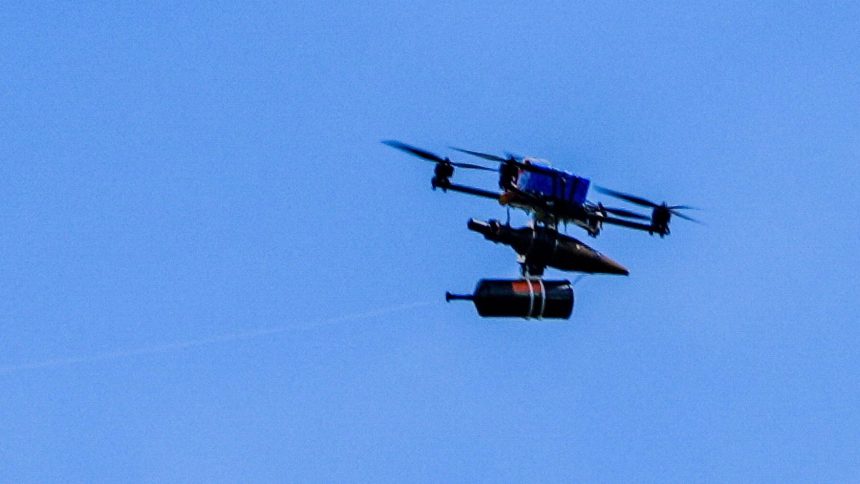
The fibre-optic drones used by Hezbollah also known as First-Person View or FPVs are much harder to detect than the rockets and mortars this town is used to. The drones are loaded with explosives and fly low, without a radio signal that can be jammed by Israel’s military. They are connected to their operators by a thin optical wire, which allow them to see and chase targets on the ground. It’s a tactic learned from the war in Ukraine.
Several times a day, sirens sound in these frontier communities, warning of a drone crossing the border from Lebanon. Here, the warnings and the weapons come seconds apart; sometimes there’s no warning at all.
“With rockets, I’ve got 15 seconds to go into a bomb shelter. With drones, you have no way of knowing when it will fall,” Sami Zanetti said.
As we were talking, sirens erupted.
The alerts on our phones said a drone had been spotted, heading straight for Shomera.
From inside the public bomb shelter, we scan the sky.
Israel’s army sometimes intercepts drones that cross the border, but also often loses contact with the small, low-flying devices.