United Nations experts have warned that Ghana’s ongoing rural and agricultural transformation risks excluding smallholder farmers, artisanal fishers and pastoralists unless stronger political will is shown to protect vulnerable rural communities and ensure the effective implementation of existing laws and policies.
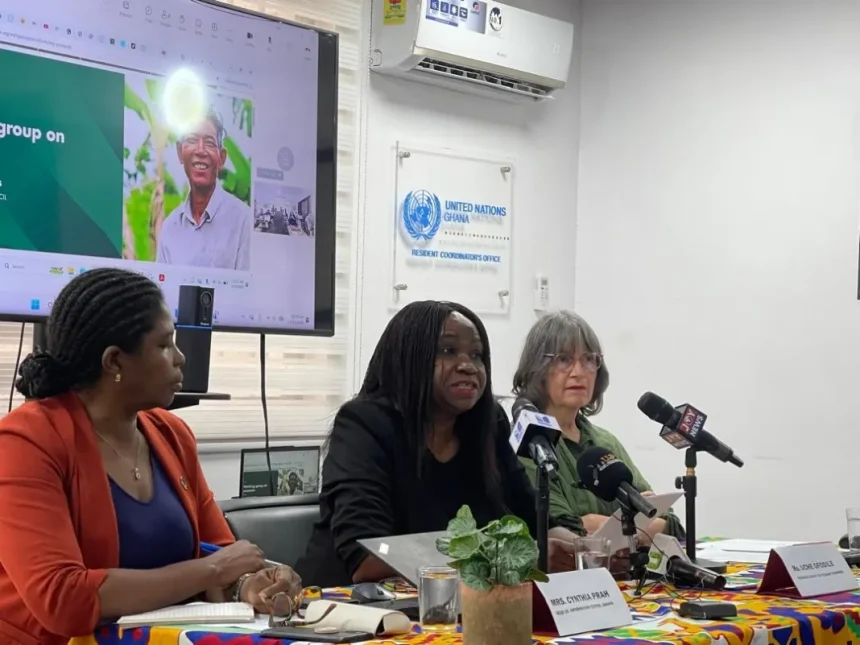
The concerns were raised by the UN Working Group on the Rights of Peasants and Other People Working in Rural Areas at the end of a 10-day official visit to Ghana from May 5 to 14. The Working Group is chaired by Carlos Duarte of Colombia. Its members include Uche Ewelukwa Ofodile of Nigeria, Geneviève Savigny of France, Shalmali Guttal of India and Davit Hakobyan of Armenia.
While in Ghana, the members met government institutions, farmers, fisherfolk, pastoralists, civil society organisations, traditional authorities and rural communities to assess the human rights situation of peasants and rural workers.
In a preliminary end-of-mission statement released in Accra, the experts acknowledged Ghana’s progress in strengthening its legal and policy framework on human rights, agriculture and social protection, but stressed that implementation gaps continue to expose rural communities to poverty, exclusion and environmental degradation.
“Ghana stands at the cusp of an agricultural transformation,” the Working Group stated, noting that government has taken “concrete and commendable steps” toward improving food security, agricultural modernisation, climate resilience and export competitiveness.
The experts cited reforms including the Fisheries and Aquaculture Act 2025, the Social Protection Act 2025, the Affirmative Action (Gender Equity) Act 2024 and Ghana’s ratification of the International Labour Organisation’s Work in Fishing Convention No. 188.
However, they cautioned that “small-holder farmers, artisanal fishers and pastoralists, who constitute the actual backbone of food production, continue to suffer from poverty and exclusion”.
According to the Working Group, Ghana’s increasing focus on mechanised and export-oriented agriculture could deepen inequality in the food system if safeguards are not introduced to protect family-based farming systems.
“The current transformation model risks entrenching a dual food system in which large-scale, input-intensive commercial agriculture serves an integrated export sector, while the family-based agrarian sector is left increasingly marginalised,” the statement said.
The experts identified land insecurity as one of the most pressing challenges facing rural communities under Ghana’s dual customary and statutory land tenure systems. They noted that weak enforcement and regulation continue to expose smallholder farmers to dispossession and livelihood losses, particularly in rapidly urbanising and high-value rural areas.
Women and young people were identified as among the most vulnerable groups. “Despite their critical roles throughout agricultural and fisheries value chains, women remain excluded from land ownership and decision-making,” the Working Group said, attributing this to entrenched social norms and statutory gaps.
The experts also linked rising illegal mining activities, known as galamsey, to worsening rural poverty and limited economic opportunities for young people.
Describing galamsey as “the most acute, rapidly expanding and politically charged environmental emergency facing the country,” they warned that pollution from mining is destroying rivers, farmlands and rural livelihoods. “The contamination of rivers, destruction of farmland and the spread of cyanide, mercury and heavy-metal hazards reach far beyond mining sites,” the statement said.
The Working Group argued that enforcement alone would not resolve the crisis, insisting that government must address broader development failures and unemployment pressures driving young people into illegal mining. They also raised concerns about the exclusion of pastoralist and Fulbe communities, many of whom face barriers in accessing citizenship documentation and legal protection frameworks.
According to the experts, shrinking grazing lands due to climate pressures and agricultural expansion are intensifying tensions between herders and farming communities. Climate change was also identified as a growing threat to rural livelihoods through erratic rainfall patterns, failed crop seasons, declining fish stocks and post-harvest losses worsened by weak infrastructure and limited access to finance.
The Working Group warned that recent seed and biotechnology reforms could undermine traditional seed systems and increase the dominance of commercial seed varieties at the expense of smallholder farmers. Despite the challenges, the experts commended inclusive governance initiatives, including community-based natural resource management models and alternative livelihood programmes for rural youth.
They urged government to establish formal consultation platforms at district and national levels to ensure farmers, fishers and pastoralists are actively involved in designing and implementing policies affecting their livelihoods.
“The policy and legislative framework that Ghana has assembled constitutes a foundation that commands respect. The open question before us is not whether Ghana possesses the tools. It is whether it commands the political will to apply them,” the experts stated.