The temptation to cast Iran as the “world’s bogeyman” makes for compelling headlines. It offers a neat moral narrative: a misunderstood state unfairly maligned by Western propaganda.
But this framing, while convenient, does not hold up under scrutiny.
To argue that Iran’s global image is largely manufactured by Western governments and media is to ignore a more uncomfortable truth: perception, in this case, is not detached from reality.
It is shaped by it.
International system
Iran’s standing in the international system reflects not only how it is portrayed, but how it behaves.
Over the years, the country has expanded one of the most significant ballistic missile programmes in the Middle East.
It has built and sustained relationships with armed non-state actors across Lebanon, Iraq, Syria, and Yemen.
Through these proxies, it has engaged, directly and indirectly, in confrontations with both Israel and the United States.
Additionally, since the 1979 revolution, the regime has constantly called for Israel to be wiped off the face of the earth.
Documented developments
These are not abstract accusations.
They are documented developments that have contributed to how Iran is viewed globally.
To dismiss this as mere propaganda is to overlook the role of state policy in shaping reputation.
A recurring claim in the “bogeyman” narrative is that Iran poses little threat because it has not invaded another country in over two centuries.
This argument rests on an outdated understanding of power. In today’s geopolitical landscape, influence is rarely exercised solely through conventional invasion.
It is projected through proxy networks, strategic partnerships, and asymmetric capabilities.
By this measure, Iran is deeply embedded in multiple regional conflicts, not as a passive observer, but as an active participant shaping outcomes.
Religious extremist state
Equally reductive is the portrayal of Iran as merely a “religious extremist state.”
While ideology plays a role in its governance, Iran’s foreign policy is not driven solely by theology.
Its support for armed groups and its regional posture reflect calculated strategic choices: methods for extending influence, deterring adversaries, and avoiding direct, large-scale confrontation.
It is, in essence, a doctrine of asymmetric power.
Perhaps the most glaring omission in arguments that downplay Iran’s role is the nuclear issue.
Concerns over uranium enrichment levels, reduced transparency with international inspectors, and the erosion of previous agreements are not inventions of political messaging.
They are grounded in standard security calculations. Even the capability to develop nuclear weapons, absent confirmed intent, reshapes regional dynamics.
Proxy engagements
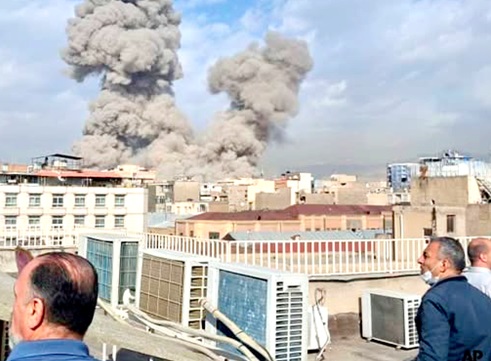
Meanwhile, tensions between Iran, on one hand, and Israel and the United States, on the other hand, have moved beyond proxy engagements. Missile and drone exchanges, strikes on strategic infrastructure, and disruptions to global energy routes are unfolding realities.
At this stage, it is difficult to argue that Iran’s image is primarily constructed when the consequences of its actions are so visible.
Iran’s internal dynamics also matter. Economic pressure, sanctions, and domestic unrest have created a context in which external assertiveness can serve both as a distraction and as a strategy.
History shows that states under internal strain often project strength outwardly, consolidating influence abroad while managing pressure at home. Iran appears to follow this pattern.
Regional order
The real issue, then, is not whether Iran has been unfairly demonised or misunderstood. It is that the current regional order is defined by mutual suspicion and escalating competition. Iran is neither a caricatured villain nor an innocent victim of Western storytelling.
It is a state making calculated choices: pursuing influence through unconventional means, engaging in strategic confrontation, and shaping the trajectory of a region critical to global energy, security, and diplomacy.
The “bogeyman” narrative may be rhetorically satisfying, but it obscures more than it explains. Iran’s global image is shaped by how it is portrayed and what it does. Ignoring either dimension leads to distortion.
In 2026, the more pressing question is not whether Iran has been framed unfairly.
It is how the international community responds to a ruthless regime of clerical and fanatic religious leaders who commit themselves to destabilising the Middle East and beyond, and to wiping a whole state of 10 million people (Israel) from the face of the earth.
Iran is (only) a bogeyman?
Millions of people all across the Middle East – from the Gulf states to Israel – will find such an assumption very controversial if not ridiculous.