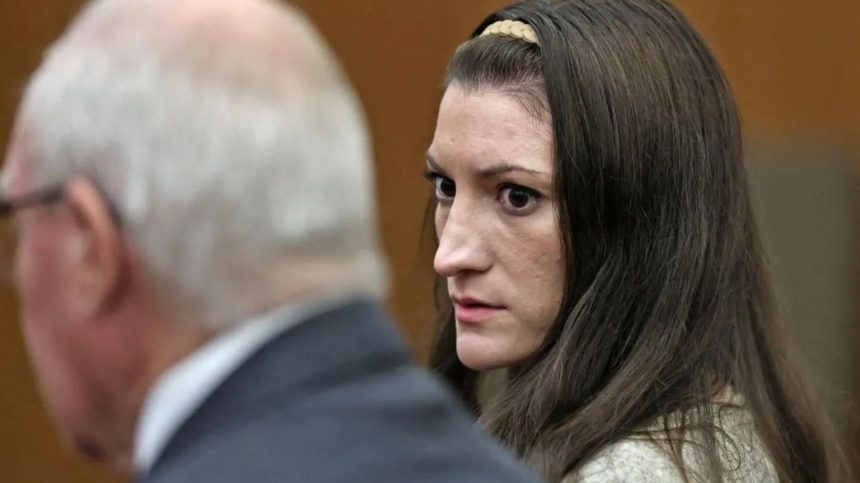
Jurors in LindA judge in the US has asked jurors in the trial of Lindsay Clancy to keep trying to reach a verdict, 23 hours after they began deliberations.
Clancy is facing three counts of first-degree murder over the deaths of her three children at their family home in Duxbury, Massachusetts, in 2023.
She has pleaded not guilty. Her lawyer does not dispute that the 36-year-old former nurse killed the children, but argues that Clancy was suffering from postpartum psychosis at the time and was unable to distinguish right from wrong – meaning she should not be held criminally responsible.
But the prosecution argues she made a calculated, intentional decision to kill her children.
The jury, made up of nine women and three men, will return to court on Wednesday morning.
They began deliberating on Thursday after hearing weeks of testimony from dozens of witnesses.
Audible gasps could be heard in the courtroom as Judge William Sullivan read out a note from the jury the previous day, indicating that it was deadlocked.
Clancy, who was left paralysed after jumping from a second-floor window shortly after the killings, appeared stoic as she sat in a wheelchair beside her lawyer.
It is not uncommon for jurors in high-profile trials to struggle to reach a decision, and judges have protocols for such situations.
A deadlock among the jury such as this one happens in “complex and emotionally charged trials”, Heather Cucolo, a New York Law School professor and expert in mental health law, told the BBC.
“If the deadlock persists, the judge might issue an additional ‘dynamite’ instruction [known as a Tuey-Rodriguez charge in Massachusetts] to encourage the group to consider alternative perspectives and strive for an agreement while upholding their genuine convictions,” Cucolo said.
But it is “typically a last-ditch effort” from a judge, she said.
Criminal defence lawyer Elyse Hershon told the BBC she was not surprised to hear that the jury was deadlocked, as people had strong opinions on the case.
“The facts are difficult and a lot of the evidence is graphic so they have a lot weighing on them,” she said.
The judge can declare a mistrial if the jury is not able to agree on a verdict.
The five-week trial in Plymouth, Massachusetts, has generated significant public interest and crowds have sometimes gathered outside as hearings take place.
A woman was arrested on Tuesday by state police outside the court building, Massachusetts State Police confirmed to the BBC. She was expected to be charged on Wednesday with “intimidation of a witness, jurors, or person furnishing information”.
Police did not give any further information, and it not clear whether the incident was connected to the Clancy trialClancy is accused of strangling her kids – Cora, five, Dawson, three, and Callan, who was eight months – with fitness bands in their Massachusetts home in January 2023.
The defence argues that Clancy was experiencing postpartum psychosis – a severe mental health condition that can develop after childbirth – and that for this reason she should therefore not be held criminally responsible for the killings.
If she is found guilty of first-degree murder, the intentional and premeditated killing of another person, Clancy will face a mandatory life sentence in prison without the possibility of parole.
She could also be found guilty of a lesser charge, including second-degree murder – committed with malice or extreme recklessness, but without prior planning – or manslaughter – unintentionally killing “by wanton and reckless conduct”. In either of those instances, she would face time behind bars.
If Clancy is found not guilty by reason of insanity, she will not be set free – she would instead be sent to a psychiatric hospital where her status would be periodically reviewed. She could stay in hospital for the rest of her life.say Clancy trial deadlocked but judge asks them to keep trying