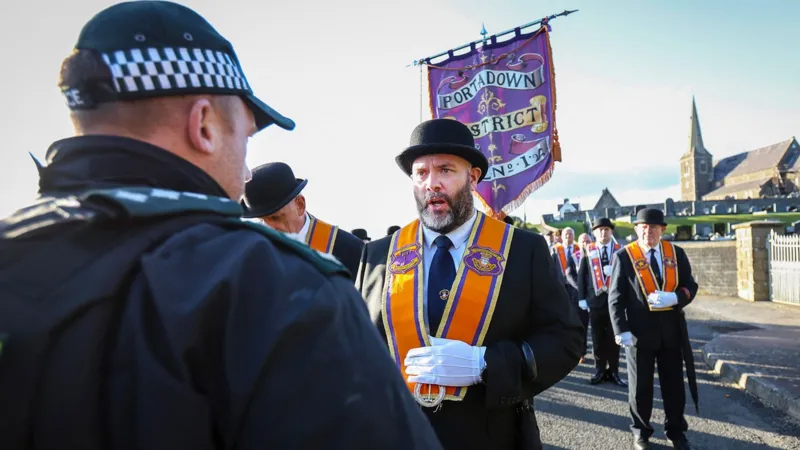
The police prevented an early morning attempt by the Orange Order to make a controversial parade down a road which had previously been blocked by protesters.
A group of men tried to march from Drumcree Church down the mainly-nationalist Garvaghy Road in Portadown in the early hours of Monday but a line of police Land Rovers stood in the way.
They had been unable to make the permitted parade on Sunday morning because protesters had gathered on the Garvaghy Road. The stand-off continued throughout Sunday, with the Orangemen waiting at the church, around a mile from the road, for the go-ahead from police.
Sinn Féin First Minister Michelle O’Neill joined the protest, prompting Democratic Unionist Party leader Gavin Robinson to accuse her of acting unlawfully.
The Drumcree parade, which in the 1990s sparked some of the most serious disorder in Northern Ireland’s history, was due to go ahead for the first time in 30 years after a series of legal challenges.
Since 1998, the Orange Order had been banned from completing its Drumcree march – and until this year had been repeatedly refused permission to finish the route by the Parades Commission, which was set up to adjudicate disputes.
The Orange Order is a Protestant pro-British organisation, while the area where it wants to walk – specifically along the Garvaghy Road – is largely Catholic and predominantly inhabited by pro-Irish nationalists.
Northern Ireland Secretary Sir Chris Bryant, who returned from the Labour Party conference for talks on Sunday, urged both sides to “double down on compromise”.
He said “nobody should be attending an unlawful protest”, but he added it was not his job “to decide whether somebody has or hasn’t broken the law”.
Breandán Mac Cionnaith, from the Garvaghy Road Residents Coalition, spoke to protesters at midnight.
He told them: “We’ve stopped them once. The process now is to ensure we stop them permanently.”
He said he was meeting the secretary of state and chief constable on Monday, and that he would not prejudge those conversations.
On Monday morning, a small group of protesters are on the Garvaghy Road but traffic is flowing normally.
A group of Orangemen remain at Drumcree Church. Just before 08:00 BST – 24-hours after they intended to begin their parade – they walked down the hill from the church for a brief conversation with police officers before returning to continue the wait.
At 09:30, five Orange Order members walked to the police line again and were told they were not permitted to proceed.
After a member of the public walked along the road, the five members removed their v-shaped orange collars but were still denied permission.
Nigel Dawson, who is the Orange Order’s Portadown district master, told BBC News NI there was frustration.
He said they had a legal right to parade down the Garvaghy Road and the police should facilitate their route.
On Monday, the Portadown district called for the resignation of the Chief Constable Jon Boutcher and Assistant Chief Constable Ryan Henderson.
“The chief constable has treated this community with disdain, flatly refused to uphold our rights, and most shockingly of all has approached this matter, which is at its core a conflict between the lawful and the unlawful, as something requiring resolution,” they said.
Liam Kelly, the chair of the Police Federation for Northern Ireland said officers showed “incredible restraint and professionalism”.
In a statement, he said police negotiators on the Garvaghy Road “did all they could”, adding that the PSNI “managed a near-impossible situation” and the actions of the chief constable and senior colleagues “were exemplary and certainly beyond reproach”.
What happened on the Garvaghy Road on Sunday?
Protesters started gathering on the Garvaghy Road in the early hours of Sunday and remained there until about midnight.
For most of Sunday, police maintained a sterile zone between the two sides, while officers repeatedly called on protesters to disperse.
Orangemen set off down the Drumcree Road a few times throughout the day before stopping and turning back.
On Sunday evening, a large group of people joined the Orange Order, and police blocked the road with vehicles.
The Orange Order was warned they were breaking the terms of the Parade Commission’s determination by having more than 35 people here, but loyalist activists argued they had not asked for a crowd.
Just before 04:00 BST, a group of Orangemen tried to set off again but three police Land Rovers blocked the route.
The protesters on the Garvaghy Road were joined by members of the Social Democratic Labour Party (SDLP) and Sinn Féin throughout the day.
First Minister Michelle O’Neill said the community had won a “victory”.
“This community do not want this, they do not want this march,” she said shortly after midnight on Monday morning.
“And tonight, I believe, is another victory for this community in standing steadfast for the right to live free from sectarian harassment and intimidation.”
Earlier, the first minister said the decision to permit the march “brings into question how the peace process works”.
Democrat Unionist Party (DUP) leader Gavin Robinson accused O’Neill and other Sinn Féin politicians at the protest of being “lawmakers acting as lawbreakers”.
After meeting Sir Chris at Hillsborough Castle, Robinson said the stakes for Stormont were high and “could get higher” if the Orange Order was unable to complete the parade, and there needed to be consequences for politicians he accused of breaking the law.
Alliance leader and Justice Minister Naomi Long said it was a very difficult situation for everyone involved and it was not helpful for people to be “issuing ultimatums” and “ratcheting up the tensions around it”.
Long added she “cannot say for sure that there is a resolution” and that she questioned “the wisdom of picking at this scab and unleashing this pain”.
Ulster Unionist Party (UUP) leader Jon Burrows said the protest might be non-violent but it was “still illegal”.
He said the police would have to investigate and that could mean “knocking the door of the first minister”.
What could it mean for the Stormont executive?
Social Democratic and Labour Party (SDLP) leader Claire Hanna said collapsing the executive over the dispute would achieve nothing but “create a vacuum”.
She did not think she and her party colleagues broke the law by joining Garvaghy Road protest on Sunday.
Independent assembly member and former justice minister Claire Sugden said power-sharing at Stormont was “very vulnerable” to collapse, but added that “we all lose” if it did.
Timothy Gaston, a Traditional Unionist Voice assembly member, said Stormont had been damaged “beyond repair” after events at the weekend and he had no confidence in the chief constable.
The party said it had lodged complaints with Stormont’s standards commissioner against several Sinn Féin politicians for taking part in the protest against the march.
First Minister Michelle O’Neill urged protesters to “stay the course”
The police operation continued throughout most of Sunday, with Police Service of Northern Ireland Chief Constable Jon Boutcher telling reporters that officers had been gathering evidence from the outset.
“So whatever’s been happening, by whatever party, we’ve been gathering the evidence of what they’ve been doing,” he said.
“So we’ll deal with that at the right time.”
Boutcher said he had wanted a “sensible and peaceful conclusion” and hoped everyone involved could find “a place that they can, with dignity, walk away from the current situation”.
He said success would mean “not one hair on one head gets harmed”.
Church leaders also appealed for a peaceful resolution.
Catholic Archbishop of Armagh Eamon Martin and Church of Ireland Archbishop of Armagh John McDowell called for an “urgent” and inclusive initiative to resolve the crisis, stating: “Too much is at stake.”
Two schools in the area announced they would close on Monday because of the continuing situation, citing the safety and wellbeing of pupils, families and staff.
How did we get here?
The Orange Order, the most prominent of the loyal orders associated with Protestants in Northern Ireland, holds thousands of parades every year and the vast majority pass off without incident.
However, many Catholics see the marches as sectarian and object to them passing through, or close to, Catholic or nationalist areas.
The Garvaghy Road had been part of the Drumcree route, but by the mid 1990s nationalist residents protested against the parade. The row sparked some of the most serious public disorder in Northern Ireland’s history and was linked to several murders.
The row reemerged after a court case in which a ruling by the Parades Commission – the organisation formed during the Drumcree dispute to decide on contentious marches during Northern Ireland’s parading season – was overturned.
On Friday, following 28 years of unsuccessful applications, the commission decided the march could go ahead with restrictions in place.
Rather than start at 13:00 on Sunday as intended, the commission said it could begin no later than 08:00 and with 35 participants rather than the 60 the Orange Order requested.
However that decision was challenged in several Belfast courts on Saturday, before finally being given the go ahead just hours before it was due to take place.
The Drumcree dispute was one of Northern Ireland’s most serious parading disputes during the 1990s, when stand-offs over attempts by the Orange Order to march along the Garvaghy Road were accompanied by riots, roadblocks and killings.
When the Orange Order was prevented by police from walking down the route in July 1995, there was a tense stand-off. It was the same for the next three years.
Violence related to the dispute resulted in riots, roadblocks and murders across Northern Ireland.
In 1998, the newly-established Parades Commission ruled that the Orange Order should not march down the road – a decision upheld until Friday.