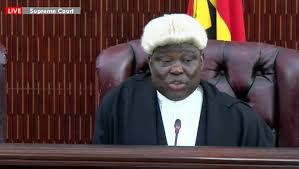
Justice Gabriel Scott Pwamang was elevated from the Ghana Bar to the Supreme Court in 2015 . At that time, he was 27 years in good standing as a lawyer. That meant he was eminently qualified to be a Supreme Court judge within the meaning of Article 128(4) of the 1992 Constitution. 2025 marked his decade on the Supreme Court Bench. His elevation to the Supreme Court was not surprising to lawyers and judges who knew him.
When Justice Gabriel Scott Pwamang was a student of the Ghana School of Law, he was nicknamed Scott J by his contemporaries and colleague students, in recognition of his legal brilliance. In this article, the writer would attempt to appraise objectively the judicial works of His Lordship Pwamang JSC over the past decade. It would , however, be impossible to touch on all his judicial works , given the fact that he is very prolific when it comes to judgment writing. In this regard, the writer would only highlight what he considers to be some of his monumental works that have significantly contributed to the development of law .
The writer would first deal with selected, iconic, encyclopedic , erudite judgments delivered by His Lordship Pwamang JSC, which judgments received concurrence from his learned colleagues on the various panels. An attempt would then be made to examine some of his brilliant dissenting judgments. The reason is that , whenever His Lordship Pwamang JSC dissents, the erudition in his dissenting judgment increases exponentially. His Lordship’s knowledge of the law is finely and splendidly distilled in his numerous judgments which judgments can be found in various law reports.
The first case that His Lordship Pwamang JSC decided as a Justice of the Supreme Court , is Andreas V Birm Wood Complex Ltd. This case is of commercial significance. He delivered the judgment in this case 9 months upon becoming a Supreme Court judge and within 6 months upon being empaneled to hear the appeal. It is instructive to know that this case spent a total of 14 years at both the trial High Court and the Court of Appeal .
This reminds us of how slowly the wheels of justice were grinding in those days . Conversely, His Lordship Pwamang JSC brought effectiveness and judicial industry to bear on his work and delivered the Supreme Court decision within 6 months. This is highly commendable. The relevant facts of this case were that the parties entered into a contract worth DM 1.2 million for the supply and installation of a saw-mill for the defendants/appellants, to be paid for with the supply of timber products to the plaintiff/respondent. It was a secondhand plant . After the installation of the saw-mill plant, the plant experienced some technical problems, some of which the plaintiff rectified, and the others the defendants spent their own money to repair. The timber products supplied by the defendants did not fully settle the claim of the plaintiff and so the plaintiff sued for the balance.
The defendants counterclaimed for damages in diminution.
The central issue confronting the Supreme Court was rightly identified by His Lordship Pwamang JSC. It was whether or not the Court of Appeal erred when it held that a “buyer of used goods has no remedy in law if the goods do not meet expected standards.”
If the said holding of the Court of Appeal was the correct position of the law, then the commercial ramifications for Ghanaian consumers would be far-reaching. It is a notorious fact that markets in Ghana sell a lot of used or secondhand goods. These goods range from used spare parts, used electronics, used vehicles, used agricultural machinery to used clothing . It would mean that Ghanaians who buy used goods would not have any remedy in law if the goods develop defects and are not fit for purpose. It would mean that sellers could conceal defects in used goods and sell them to the unsuspecting buyer who would not have any remedy even though the seller had perpetuated fraud on him . The buyer of used goods would be helpless and hapless and would always be at the mercy of the seller. It would mean that a rice farmer in Fumbisi who buys a secondhand combine harvester would not have any remedy if the machine develops mechanical problems and is not fit for purpose even one day after it is purchased.
Yes, this was the effect of the decision of the Court of Appeal . It would mean that the defendants in the case under review whose secondhand saw-mill developed mechanical defects soon after it was installed, would not have any remedy in law. Meanwhile, there is no provision in the Sale of Goods Act , 1962, Act 137 to the effect that a buyer of used goods has no remedy in law if the goods do not meet expected standards or are not fit for purpose. As rightly opined by His Lordship Pwamang JSC, “the Sale of Goods Act, 1962, is the main source of our law as far as contracts for sale of goods are concerned and that the rules of the common law and equity are subservient to the statutory provisions.”
Section 13(1) (b) of Act 137 was the relevant applicable law to the facts of the case. (Watch out for the full article. This is a redacted one. I will not reproduce the entire section) . Section 13 (1)(b) of Act 137 deals with quality and fitness of goods. It does not make a distinction between brand new goods and secondhand goods. The Court of Appeal refused to apply this section to the facts of the case and simply said “a buyer of used goods has no remedy in law if the goods do not meet expected standards.”
The Court of Appeal, with respect, erroneously relied on the authority of Rockson V Armah where the court quoted the distinguished Lord Denning in Bartlett V Sidney Marcus Ltd as opining that “a buyer should realise that when he buys a secondhand car , defects may appear sooner or later and in the absence of an express warranty, he has no redress.” The highly respected Pwamang JSC quickly detected that the Court of Appeal had misread and misapplied the case of Bartlett V Sidney Marcus Ltd to the facts before them . His Lordship Pwamang JSC had the following to say in that regard:
“With all due respect to the justices of the Court of Appeal, if they had read the case of Bartlett V Sidney Marcus closely, they would have realised that the court accepted that the seller in that case was under a statutory obligation pursuant to the English Sale of Goods Act, 1883, to ensure that the used car was fit for purpose, except it was held on the evidence that the car met the fitness test.”
Clearly, the Court of Appeal was in error for holding that a buyer of secondhand goods had no remedy if the goods soon developed defects. In characteristic fashion, His Lordship Pwamang JSC, distinguished Rockson V Armah from the case under review. His Lordship Pwamang JSC noted that in Rockson V Armah, sectios 51, 52(b) and 13 (1) (a) came up for discussion whereas in the case under review, that is Andreas V Birm Wood Complex, section 13(1)(b) was the applicable law relied on by the defendants. A hallmark of a brilliant judge is one who can distinguish cases. His Lordship Pwamang JSC, after brilliantly analysing the relevant law and reviewing with admiration the relevant decided cases, stated emphatically and authoritatively the correct position of the law of Ghana in relation to secondhand goods as follows:
“It is therefore an erroneous statement of the law of Ghana and of England to say that in all cases, a buyer of used or secondhand goods has no redress if the goods fail to meet the quality and fitness for purposes for which the buyer required them . The grounds for the condition as to fitness for purpose to be applicable are that the seller should sell the goods in the normal course of his business and the buyer should have made the seller aware of the purposes for which he requires the goods.”
The exposition of His Lordship needs no elucidation as it is clearer than the strongest light. The Supreme Court per His Lordship Pwamang JSC quickly reversed the wrong decision of the Court of Appeal. The case of Andreas V Birm Wood Complex Ltd is also authority on how general damages are assessed, the law pertaining to nominal damages, special damages, substantial damages and the principles governing the reversal of findings of fact made by courts lower than the Supreme Court. All these would be discussed in the full article. Watch out.
The outstanding judgment of Pwamang JSC in the case of Asante (No.1) V The Republic (No.1) deserves mention. This case has significantly enriched Ghana’s criminal jurisprudence and the law of evidence. The relevant facts of the case were that the appellant was a basic school teacher in Tamale. He was alleged to have carnally known a pupil of the school he was teaching. The pupil in question was 14 years old. The prosecution alleged that the appellant impregnated the victim . The medical doctor who examined the victim, certified that she was 23 weeks pregnant at that time. The appellant was subsequently charged with defilement. The appellant vehemently denied the charge.
The trial High Court in Tamale convicted the appellant of the offence, holding that the pregnancy of the victim had collaborated her oral evidence that the appellant had sexual intercourse with her . The appellant was then sentenced to 15 years imprisonment with hard labour. The Court of Appeal affirmed the decision of the High Court. On a further appeal to the Supreme Court, the court allowed the abduction of DNA evidence, which evidence excluded the appellant as the father of the victim’s child. Since the prosecution’s case was built mainly on the fact of the pregnancy, the Supreme Court acquitted the appellant of the charge since the DNA evidence had excluded him as the father of the victims’s child. At the time that the appellant was acquitted, he had already served the fifteen- year jail term. Commenting on this sad situation, His Lordship Pwamang JSC said that “this case is one of the tragedies of the criminal justice system.”
One area in which this case has contributed significantly to the enrichment of Ghana’s criminal jurisprudence has to with how grounds of appeal are drafted in criminal cases . The appellant per his lawyer had wrongly formulated the omnibus ground of appeal as “the judgment is against the weight of evidence” . Counsel’s formulation of the omnibus ground of appeal would have been correct if the case was a civil one . His Lordship Pwamang JSC, with his usual keen scrutiny, quickly detected the wrong formulation of the omnibus ground of appeal. His Lordship opined that counsel should have formulated the omnibus ground of appeal as follows: “the judgment is unreasonable or cannot be supported, having regard to the evidence.”
His Lordship explains the significance of formulating the omnibus ground of appeal appropriately. The formulation is legally significant because it determines how the appellate court proceeds to assess the evidence. In criminal cases, the court assesses the evidence by using the standard of proof known as proof beyond reasonable doubt. However, in civil cases, the standard of proof is preponderance of probabilities. A competent lawyer knows or ought to know the appropriate formulation to use in a civil case or a criminal case. The Supreme Court per His Lordship Pwamang JSC then amended the omnibus ground of appeal in order to do substantial justice in the case.
His Lordship Pwamang JSC next dealt with the ingredients of defilement. His Lordship did not spill much juristic ink on what constituted the elements of defilement. Though His Lordship was laconic, his exposition of the elements of defilement is most intelligible. The following was what His Lordship said regarding the ingredients of defilement:
“It is relevant to state the ingredients of the offence of defilement, which are as follows: (i) that the victim is under the age of 16 years, (as provided for in Act 554; (ii), someone had sexual intercourse with her, and (iii) that person is the accused; see the case of the Republic v Yeboah [1968]GLR 248” .
It must, however, be noted that His Lordship Pwamang JSC, extensively and with admiration, reviewed the evidence on the record to ascertain whether or not each of the three elements of the offence was proved.
Another way in which this case has enriched Ghana’s criminal jurisprudence is that it reaffirms the fundamental principle encapsulated in Article 19(2) of the 1992 Constitution that a person charged with a criminal offence shall be presumed to be innocent until he is proved or has pleaded guilty. The writer would exhaust this principle in the full article.
The contribution of this case to the enrichment of Ghana’s law of evidence is even more monumental and profound. This case is the first in Ghana’s criminal jurisprudence where DNA evidence was used in a sexual offence case. On the use and admissibility of DNA evidence as scientific evidence, His Lordship Pwamang JSC said the following in his brilliant judgment:
“We wish to also say a few words about the DNA evidence that has been adduced in this case which appears to be a new area of scientific evidence as far as our criminal justice system is concerned. Section 121 of the Criminal and Other Offences (Procedure ) Act , 1960 (Act 30) provides that in any criminal proceedings, a scientific report may be used as evidence of the facts contained in it . A scientific report is prima facie evidence of the matters contained in it and not conclusive evidence so the law requires that where the accuracy of a scientific report is disputed in proceedings, then the person who undertook the investigation or examination and produced the report should testify and subject himself to cross-examination; see Nyameneba v The State [1965] GLR723 .”
The definition of DNA and the role of DNA evidence would be extensively dealt with in the full article.
Another area of evidence law that this case has enriched is corroboration. Corroboration is evidence which confirms in some material particular the evidence to be corroborated and connects the relevant person with the crime, claim or defence; see section 7(1) of the Evidence Act, 1975, Act 323 . Both the trial High Court and the Court of Appeal had erroneously held that the pregnancy of the victim had corroborated her oral testimony that the appellant had sexual intercourse with her. The DNA evidence, however, destroyed the credibility of the victim. Therefore the victims’s pregnancy could not be said in law to be corroborative evidence. The full ambit of the concept of corroboration would be discussed in the full article.
The third work of His Lordship Pwamang JSC for review in this article, is his iconic judgment in the famous case of Cubagee v Asare & Another. This authority is always on the lips of many lawyers, judges and students of law because of the sheer brilliance of the judgment, the inroads it made in privacy rights, and most importantly its introduction of the discretionary exclusionary rule into Ghana’s law of evidence. In this case, the plaintiff at the start of litigation before a magistrate, secretly recorded a telephone conversation he had with the representative of the second defendant . He then attempted to tender the recording in evidence. The defendants strongly objected to the tendering of the recording in evidence on the ground that the recording contravened the privacy rights of the second defendant’s representative within the meaning of Article 18 (2) of the 1992 Constitution. The magistrate made a reference to the Supreme Court to answer the question whether or not the secret phone recording was a violation of the right to privacy under Article 18 (2) of the Constitution. The Supreme Court per His Lordship Pwamang JSC, upon sound legal reasoning, held that the secret telephone recording which was made without the consent of the recordee, was a violation of his privacy rights under Article 18(2) of the Constitution and therefore inadmissible in evidence. On the elements of the right to privacy, His Lordship Pwamang JSC had the following to say;
“It comprises a large bundle of rights some of which have been listed in article 18(2) as privacy of the home, property and correspondence or communication. This list is not exhaustive and the full scope of the right to privacy cannot possibly be set out in the text of the Constitution. However, under the right to privacy is covered an individual’s right to be left alone to live his life free from unwanted intrusion, scrutiny and publicity. It is the right of a person to be secluded, secretive and anonymous in society and to have control of intrusions into the sphere of his private life.”
This erudite judgment per His Lordship Pwamang JSC, gives guidance to the courts below the Supreme Court, regarding the law on privacy rights. As said earlier, this case is most remarkable for introducing the discretionary exclusionary rule into Ghana’s law of evidence. The discretionary rule is the practice that gives discretion to the court to determine whether or not to exclude evidence obtained in breach of human rights. The Supreme Court per His Lordship Pwamang JSC, after extensively and brilliantly reviewing the relevant English, Canadian, American and local authorities as well as the relevant provisions of the 1992 Constitution, adopted the discretionary exclusionary rule for Ghana in the following words:
“In our understanding, the framework of our Constitution does not admit of an inflexible exclusionary rule in respect of evidence obtained in violation of human rights, with the rudimentary facilities available to our police to fight crime, it will be unrealistic to exclude damming evidence of a serious crime on the sole ground that it was obtained in circumstances involving the violation of the human rights of the perpetrator of the crime. The public interest to which all constitutional rights are subject by the provisions of Article 12(2) , in having persons who commit crimes apprehended and punished would require the court to balance that against the claim of rights of the perpetrator of the crime. Similarly, civil proceedings always involve competing rights of the parties such that relevant evidence that was obtained in violation of the constitutional rights of one party is usually offered in a bid to protect the rights of the other party or parties in the action. It therefore seems to us that the framework of our Constitution anticipates that where evidence obtained in violation of human rights is sought to be tendered in proceedings, whether criminal or civil, and objection is taken, the court has to exercise a discretion as to whether on the facts of the case, the evidence has to be excluded or admitted. We therefore adopt for Ghana the discretionary rule for the exclusion of evidence obtained in violation of human rights guaranteed under the 1992 Constitution.”
It is submitted that the Supreme Court’s decision to adopt the discretionary exclusionary rule is progressive. It enhances the dynamism of the law. It has the potential to avert failure of justice. The reasoning of the court per His Lordship Pwamang JSC is sound. The reasoning is based on hard law and pragmatism and fits the peculiar legal terrain of Ghana. Watch out for the full article.
Like the venerable Kpegah JSC in the case of The Republic V Nana Kwadjo II , His Lordship Pwamang JSC would not suffer the judgment to be without his DNA in the case of Anyetei V Anyetei . In that case, His Lordship Pwamang JSC lambasted the trial High Court judge for making orders based on the beauty of the woman/ petitioner , and not based on the evidence. In Anyetei V Anyetei, the parties had immovable properties in South Africa . So the central question confronting the Supreme Court was whether or not it had jurisdiction to make orders pertaining to immovable property abroad. His Lordship correctly opines in that case that the general rule is that a court has no jurisdiction to make orders affecting or pertaining to immovable property abroad. This rule is popularly known as the Mozambique Rule.
It takes its name from the House of Lords case of The British South African Co v The Companhia De Mozambique [1893] AC 602 . The rationale for the Mozambique Rule is that no nation can execute its judgments, whether against persons or movable or real property, in the country of another. The case of Anyetei V Anyetei is legally significant because it comprehensively and authoritatively espoused the exceptions to the Mozambique Rule . Upon reviewing the relevant foreign cases and the local cases with unmatched industry, His Lordship Pwamang JSC splendidly espoused the exceptions to the Mozambique Rule as follows:
“Thus, the current state of the common law to be gleaned from the authorities on the Mozambique Rule is, that as a general rule, a court has no jurisdiction to adjudicate claims for declaration of title, possession and damages for trespass in respect of immovable property abroad except where the claim is based on contract between the parties, on fraud or on rights accruing in equity against a defendant who is subject to the jurisdiction of the court. Such a case should not be premised on a claim of right that is inconsistent with and disputes the root of title or possession of the defendant , but must assume the validity of the defendant’s title and only seek relief against the defendant personally. Where the claim of the plaintiff involves disputation as to the rightful acquisition of the property by the defendant in accordance with the laws of the foreign country, then a common law court ought not to assume jurisdiction.”
From the above exposition of the law, it can be said that His Lordship Pwamang JSC speaks authoritatively and with perfect clarity in his judgments.
His Lordship Pwamang JSC’s knowledge of the law is also finely and terrifically distilled in his judgment in the case of Florini v Samir . In that case, the plaintiffs were Italian nationals who sued through a lawful attorney in the High Court, Sekondi, to recover a house which was in the possession of the defendants. The case of the plaintiffs was that the house was the property of their late mother (an Italian) and that they were the heirs to their mother. The defendants challenged the capacity of the plaintiffs to mount the action as the plaintiffs did not obtain letters of administration in respect of the estate of their deceased mother. The defendants also contended that the power of attorney given to the plaintiffs’s lawful attorney was invalid on the ground that it was not witnessed within the meaning of section 1(2) of the Powers of Attorney Act , 1998, Act (459).
The trial High Court judge agreed with the defendants and struck out the suit for want of capacity. The Court of Appeal reversed the decision of the trial High Court. The defendants then appealed against the decision of the Court of Appeal to the Supreme Court. The Supreme Court in an illuminating and groundbreaking judgment per His Lordship Pwamang JSC who has a lucid mind , dismissed the appeal. This case authoritatively distinguishes capacity from locus standi. Another significance of this case is that it exploded the incongruous and irrational principle in Asante-Appiah V Amponsah which principle was to the effect that a power of attorney witnessed by only a Commissioner for Oaths was invalid.
On the legal distinction between capacity and locus standi, His Lordship Pwamang JSC delivered himself toppingly as follows:
“It is pertinent to recognize that though capacity and locus standi are closely related and in many instances arise together in cases in court, they are separate legal concepts. Capacity properly so called relates to the juristic persona and competence to sue in a court of law and it becomes an issue where an individual sues not in her own personal right but states a certain capacity on account of which she is proceeding in court . But locus standing relates to the legal interest that a party claims in the subject matter of a suit in court . This may be dependent on the provisions of the statute that confers the right to sue, such as the Fatal Accidents Act in Akrong V Bulley . Otherwise, generally locus standing depends on whether the party has a legal or equitable right that she seeks to enforce or protect by suing in court.”
It must be noted that before His Lordship Pwamang JSC distinguished capacity from locus standi, lawyers were using the two legal concepts interchangeably and in a confused manner. The distinction between the two legal concepts by his Lordship has brought perfect clarity to the law . The distinction is of fundamental legal importance. When a person is suing on behalf of somebody, capacity is at play , and when he is suing in his own name to assert his legal or equitable right in the subject matter, then locus standi is at play. His Lordship Pwamang JSC must be commended for always seizing the opportunity to clarify the law. This is a mark of judicial excellence.
The second crucial issue confronting the court in Florini V Samir was whether or not the power of attorney, having been attested by a Commissioner for Oaths, was invalid and thereby rendered the suit a nullity. The defendants relied heavily on the decision of the Supreme Court in Asante-Appiah V Amponsah, and argued vehemently that since the power of attorney donated by the plaintiff to the donee was only attested by a Commissioner for Oaths, the instrument was invalid. The defendants also contended that nobody signed the power of attorney as a witness within the meaning of section 1(2) of the Powers of Attorney Act, 1998, Act 549. Section 1 (2) of Act 549 provides that “where the instrument is signed by the donor of the power, one witness shall be present and shall attest the instrument” . In Asante-Appiah V Amponsah, the Supreme Court held that a power of attorney which was attested by a Commissioner for Oaths in the presence of the donor was invalid. The Supreme Court, with great respect, did not provide satisfactory reasons for its said holding. Therefore when the Supreme Court per His Lordship Pwamang JSC had another opportunity in Florini V Samir to espouse the law on the vexed matter, His Lordship faulted the unsatisfactory reasoning of the Supreme Court in Asante-Appiah V Amponsah. His Lordship Pwamang JSC , after defining the word “attest” by reference to the Black’s Law Dictionary Revised Fourth Edition, eruditely reasoned as follows:
“We have read all the seven sections of the Act (Powers of Attorney Act) and no where does it state any special criteria for a person to qualify to witness a power of attorney and it does not disqualify any group of persons from acting as witness to the execution of a power of attorney. In our understanding, the critical fact to look for when the validity of a power of attorney is questioned, on ground that it has not been witnessed, is for the court to satisfy itself that the donor signed the instrument in the presence of a witness and that that witness signed the instrument signifying that she was present at the execution of the instrument by the donor. In the case under reference, the Court of Appeal stated that the Commissioner for Oaths signed as the person before whom the instrument was signed. The question then is , in substance, how is that different from attesting the instrument as a witness as required by section 1 (2) of the Act ? It appears to us that both the Court of Appeal and the Supreme Court in Asante-Appiah V Amponsah were looking for a magic word “witness” with a signature against it on the document. This approach places form over substance but there is no basis for such an extreme literalist interpretation from even a casual reading of the Act as a whole.”
His Lordship then exploded the strange and outmoded principle in Asante-Appiah V Amponsah. He opined that a Commissioner for Oaths was even more credible as a witness than any other person since the Commissioner for Oaths does his work under the pain of sanctions coupled with the fact that his location is also known. Watch out for the full article. One can not add to nor subtract from the judgment of His Lordship Pwamang JSC. The reasoning is unassailable.
The seminal judgment of His Lordship Pwamang JSC in the very recent case of Softribe Ghana Ltd V Auditor – General , Civil Appeal No. 14/54/2023 dated 26th February, 2025 also deserves commendation in this article, otherwise the article would be incomplete. The relevant facts of this case were that the applicant had a contract with the Controller to provide the latter payroll services. The contract ran for several years. The Controller later wrote to the applicant, terminating the contract on a ground of alleged underperformance The Controller, however, committed himself in the terminating letter to pay the applicant its outstanding claims arising from the contract. The applicant then submitted its claim to the Controller for payment for its outstanding claims , amounting to more than GHC 22,000,000 .
The Auditor -General as part of its constitutional mandate, audited the public accounts, including the accounts of the Controller in respect of the year ending 2016 . After the audit, the Auditor -General/Respondent disallowed the claim of the applicant under Article 187(7) of the 1992 Constitution without hearing the applicant. Article 187(7) of the Constitution is to the effect that the Auditor -General may disallow any item of expenditure which is contrary to law and may surcharge any person involved in the unlawful expenditure. Article 187(7) does not however explicitly say that the Auditor -General should give a hearing to affected persons before issuing disallowances or surcharges.
The applicant then brought an application at the High Court under Article 33 of the Constitution to enforce its rights to administrative justice and to quash the disallowance of its claim by the Respondent. The trial High Court struck out the application on the ground that the applicant had improperly invoked the jurisdiction of the High Court. According to the High Court judge, the remedy available to the applicant under Article 187(9) of the 1992 Constitution, was to appeal against the disallowance , but not to bring an application under the human rights jurisdiction of the High Court. Article 187(9) of the Constitution provides that a person aggrieved by a disallowance or surcharge by the Auditor-General may appeal to the High Court. The Court of Appeal by a majority, affirmed the decision of the High Court. The applicant then appealed against the decision of the Court of Appeal to the Supreme Court. The Supreme Court in its lead judgment per His Lordship Pwamang JSC, reversed the decision of the Court of Appeal. This case exhaustively discusses the means by which the Auditor – General’s powers of disallowance and surcharge can be challenged in court. This case also authoritatively settles the question whether or not private persons are subject to the Auditor – General’s powers of disallowance and surcharge. Again, this case reaffirms the principle of filling the gap in statutory or constitutional provisions in appropriate cases as His Lordship Pwamang JSC brilliantly reads words into article 187 (7) of the 1992 Constitution to make the provision subject to the fundamental rules of natural justice. Also, this case reaffirms the fundamental principles of natural justice, specifically, the audi alteram partem rule .
The central issue in Softribe Ghana Ltd V The Auditor – General was intelligently identified by His Lordship Pwamang JSC as “whether or not an appeal to the High Court is the exclusive remedy open to a person aggrieved by a disallowance by the Auditor – General or whether, depending on the nature of the grievance, the aggrieved person is at liberty to invoke other jurisdictions of the High Court, particularly Article 33 ” . Put differently, is an appeal to the High Court the only remedy open to a person aggrieved by a disallowance by the Auditor – General no matter the nature of the grievance? The Respondent relied heavily on the earlier Supreme Court decision in Republic v High Court (Financial Division), Accra, Ex parte Arch Adwoa Company Ltd , to support his argument that any aggrieved person who intended to challenge a disallowance or surcharge by the Auditor-General , must file an appeal. The Supreme Court per His Lordship Dotse JSC as he then was , had held in Ex parte Arch Adwoa Company Ltd that:
“an appellant who desires to challenge the Auditor – General’s statutory surcharge and disallowance is required under both the constitutional provision in Article 187(9) of the Constitution and Section 17(3) of Act 584 to do so by an appeal process to the High Court.”
In characteristic fashion, His Lordship Pwamang JSC, admirably distinguished the Ex parte Arch Adwoa Company Ltd case from the instant case before him . His Lordship marvelously said at page 12 of the judgment as follows :
“The Respondent relies on Ex parte Arch Adwoa Company Ltd as authority for his argument , but as has been stated by the applicant, that case was not about the various means by which an aggrieved person may seek redress against disallowance or surcharge by the Auditor -General. The applicant in that case appealed to the High Court from a decision by the Auditor -General to disallow her claims and there was no dispute as to whether appeal was the appropriate remedy or not. It was only a question of what time limit does an aggrieved person have within which to appeal and what the Supreme Court said in passing about appeal was not binding on the lower courts.”
In other words, what Dotse JSC said in Ex parte Arch Adwoa Company Ltd was not ratio decidendi and therefore had no binding effect.
After painstakingly reviewing the relevant authorities, and by quintessential, masterly, legal reasoning, His Lordship Pwamang JSC came to the logical conclusion that an appeal against a disallowance and or surcharge is not the only remedy available to an aggrieved person. Part of the learned, revered judge’s reasoning is as follows:
“A person may feel aggrieved by a disallowance or surcharge by the Auditor-General on a number of different grounds. The ground of complaint may be that the decision of the Auditor -General to disallow an item of expenditure or to surcharge a person with an amount is wrongful in that the quantum of the disallowance or surcharge is excessive having regard to the facts of the case. Then , another person’s complaint may just be that the Auditor -General did not afford her opportunity to furnish him with information that would have influenced his decision to disallow or surcharge. In the former situation, there can be no doubt that his proper remedy would be by way of appeal under Article 187(9) .
An appeal, jurisprudentially, is a reconsideration of a case by a higher court or body using mainly the evidence that was initially examined by the first decision maker . See A/S Norway Cement Export Ltd V Addison [1974]2GLR177 . But , in the later example above, the aggrieved person was prevented from placing her evidence before the Auditor -General so an appeal will not be an appropriate remedy. The later situation falls well within the purview of the proper conduct of an administrative body and therefore Article 23 of the Constitution would apply. That , in our understanding, is the plaint of the applicant in this case and we find no policy reason to prevent the applicant from seeking remedy under Article 33 or even alternatively under the common law jurisdiction of the High Court to supervise administrative bodies” .
His Lordship continued his illuminating reasoning at page 22 of the judgment as follows:
“The nature of the question to be determined when the plaint is about Administrative Justice is different from where the question is whether, on the evidence, the Auditor -General came to the right or wrong conclusion. Both the remedy under Article 187(9) and the one under Article 33 are constitutional remedies and are not mutually exclusive” .
Per this case, the law is that a person aggrieved by a disallowance or surcharge by the Auditor-General, may either appeal against it or bring an application within the meaning of Article 33 of the Constitution, depending on the nature of the grievance . This clarification of the law by His Lordship is highly commendable.
The second important question confronting the court in Softribe Ghana Ltd V The Auditor -General was whether or not private persons were immune from disallowance and surcharge. The applicant submitted that the Auditor -General’s power of disallowance and surcharge could not be exercised against private persons, but only against public officials. The applicant cited the case of Zoom Lion Ghana Ltd V The Auditor -General as authority for his contention. His Lordship Pwamang JSC, with characteristic brilliance, quickly dismissed the erroneous contention of the applicant. His Lordship opined rightly that the Supreme Court in the case of Zoom Lion Ghana Ltd V The Auditor -General , never said that private persons were not subject to the Auditor -General’s power of disallowance and surcharge. Watch out for the full article.
Article 187(7) says the Auditor -General may disallow any item of expenditure which is contrary to law and surcharge the amount of any expenditure disallowed upon the person responsible for incurring or authorizing the expenditure, and any person whose negligence or misconduct led to the unlawful expenditure or loss is liable to a disallowance and surcharge. So the Constitution uses the words “the person” or “any person”. It was therefore mind boggling when the respondent contended that a private person was immune to the Auditor -General’s power of disallowance and surcharge. Let’s see how His Lordship Pwamang JSC brilliantly handled the argument by the applicant. Part of the relevant reasoning of His Lordship is as follows:
“Even if we consider the case of surcharge, the enactment uses the words “the person” and “any person” as those that may be surcharged . If the intention of the framers of the Constitution was to limit the power to operate against only public officials, it would have simply said “the officials” or “any official” in the public organization being audited. It is true that the power of surcharge would be exercised upon the audit of public accounts and that the first line of actors in making expenditure would be public officials. But it is also true that private persons do business with government through its officials so if we talk of wrongdoing, negligence or misconduct, private persons who do business with government may be the ones who either by themselves or jointly with public officials, engage in the wrongdoing, negligence or misconduct. A private person who claims for payment by a public entity for goods he did not supply and it is detected after he has been paid cannot say he did not commit wrongdoing or misconduct in relation to that payment. To accept the interpretation suggested by the applicant in this case would be to subvert the plain provisions of the Constitution.”
His Lordship also drew inspiration from the Supreme Court decision in CHRAJ V AG & Baba Kamara where the Supreme Court per the idolated and distinguished Prof. Date-Bah JSC held that :
“a purposive and holistic interpretation would require words to be implied into Article 218 enabling CHRAJ to investigate private persons alongside public officials even if private persons are not expressly specified in any particular provision of the Constitution where such investigation of a private person is necessary in order to expose the total picture of the corruption in which the public official is alleged to have participated”.
Based on sound reasoning, and fidelity to the law, the Supreme Court per His Lordship Pwamang JSC, came to the inescapable conclusion that private persons are subject to the Auditor-General’s power of disallowance and surcharge under Article 187(7) of the Constitution.
This case is also authority for the principles of natural justice, specifically, the audi alteram partem rule. The undisputed evidence was that the applicant was not heard yet the respondent or Auditor-General disallowed its claim. This clearly sins against the right to be heard. His Lordship Pwamang JSC accordingly held that the applicant’s right to administrative justice under Article 23 was violated.
Again, this case reaffirms the court’s power to fill the gap in statutory and constitutional provisions in appropriate cases. Filling the gap is a practice where a judge, sitting excathedra, reads or implies words into a statutory or constitutional provision so as to fill a lacuna or to make the provision intelligible. The indomitable Lord Denning was the number one proponent of filling the gap; see Seaford Court Estates Ltd V Asher [1949] 2KB 481. In Softribe Ghana Ltd V The Auditor -General, His Lordship Pwamang JSC brilliantly read words into Article 187(7) of the 1992 Constitution so as to subject it to the rules of natural justice. Article 187(7) of the Constitution says the Auditor -General may disallow any item of expenditure which is contrary to law and surcharge the amount of any expenditure disallowed upon the person responsible for incurring or authorizing the expenditure. The Auditor -General was in the habit of issuing disallowances and surcharges without hearing affected persons. An example is the disallowance issued against the applicant in Softribe Ghana Ltd V The Auditor -General. His Lordship Pwamang JSC , upon a proper construction of Article 187(7) of the Constitution, read into it the words “the right of prior hearing” . The immortal words of His Lordship at page 41 of the judgment are as follows:
“Consequently, for all the reasons explained above, we are of the firm opinion that the proper interpretation of Article 187(7) of the Constitution is to read into it the right of prior hearing in any person to be directly affected by the exercise of the power of disallowance and surcharge by the Auditor-General.”
It is submitted that His Lordship was spot-on in reading those words into Article 187(7) of the Constitution. The article is definitely subject to the rules of natural justice. His Lordship’s approach would prevent the Auditor-General from exercising his powers of disallowance and surcharge arbitrarily and capriciously. This will promote constitutionialism . This case will guide the Auditor -General greatly on how to properly exercise his constitutional powers of disallowance and surcharge. His Lordship’s judgment is what can be described as a seminal judgment. It influences the law in a profound manner. Pwamang JSC’s ten years on the Supreme Court Bench can best be described as a golden decade. When His Lordship Justice George Kingsley Koomson appeared before the Parliamentary Vetting Committee on 18th October, 2022 to be vetted as a Supreme Court nominee, the current minority leader, Hon. Alexander Afenyo-Markin whose party was then in power, asked the nominee why His Lordship Pwamang JSC and Thadeus Sory, Esq were his referees. His Lordship Koomson JSC answered the question to the effect that His Lordship Pwamang JSC, and Thadeus Sory, Esq knew him very well and could attest to his integrity and competence. Hon. Alexander Afenyo-Markin then urged His Lordship Koomson JSC to endeavor to write well reasoned and seminal judgments in the style of His Lordship Pwamang JSC. It was therefore unfortunate and regrettable that Hon. Alexander Afenyo-Markin disrespected His Lordship Pwamang JSC at the vetting of the Honourable Chief Justice, Paul Baffoe-Bonnie on 10th November, 2025 . At the vetting of Paul Baffoe-Bonnie CJ , the loquacious minority leader, Hon. Alexander Afenyo-Markin disrespectfully said to His Lordship Pwamang JSC that when His Lordship was nominated as a Justice of the Supreme Court, he (Alexander Afenyo-Markin) had resolved not to vote for him, but later changed his mind because of persuasion by Hon. K.T. Hammond who was the member of Parliament for Adansi – Asokwa. With all due respect, the conduct of Hon. Alexander Afenyo-Markin in that regard was most appalling. It also smacks of hypocrisy on the part of the minority leader because as a practicing lawyer, he knows or ought to know the judicial brilliance of His Lordship Pwamang JSC. When Pwamang JSC was a practicing lawyer, he was an inspiration to many lawyers. Now that His Lordship is a very respected Justice of the Supreme Court, he is an inspiration to most judges. Most judges aspire to be like him . His profound knowledge of the law is finely and superbly distilled in his numerous judgments . Thus, his well reasoned, seminal judgments speak for him. When His Lordship Pwamang JSC was called to the bar, Hon. Alexander Afenyo-Markin had not yet completed basic school, let alone reasonably conceive the idea of becoming a lawyer . His disrespect to the venerable Pwamang JSC was to say the least, very unfortunate and shameful . The writer was, however, glad on that sad day that the Honourable Chief Justice Paul Baffoe-Bonnie, said at his vetting that the minority leader was only being mischievous.
In the full article, the writer would also touch on the iconic, landmark judgments of His Lordship Pwamang JSC in the cases of Dalex Finance V Amanor ; Tettey – Enyo v ECG and The Republic v Amponsah and Others. The powerful dissenting judgments of His Lordship Pwamang JSC in Board of Governors , Achimota School V Nii Ako Nortei II ; The Republic v High Court (General Jurisdiction) , Ex parte Attorney General (Exton Cubic Group Ltd Interested Party) , and The Republic V High Court, Koforidua ; ex parte Ernest Yaw Kumi , will also be appraised objectively in the full article. Watch out. For now, the writer wishes His Lordship Pwamang JSC a very happy festive season. May the Almighty God continue to bless him so that His Lordship will also continue to bless the legal profession in particular, and Ghana in general , with well reasoned, landmark and seminal judgments .
By: His Worship Bright A. Akoande