
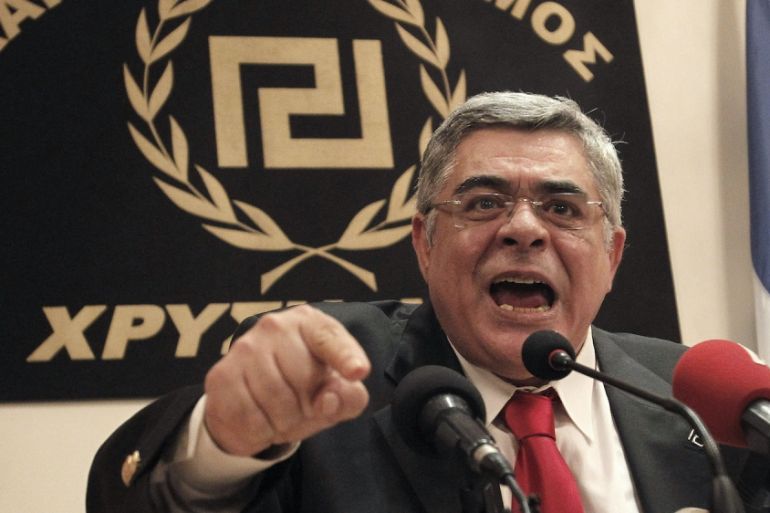
The founder of Greece’s far-right Golden Dawn party has been ordered back to prison after an appeals court overturned a widely criticized decision to release him on parole.
The judicial council of the court of appeals decided on Monday that Nikos Michaloliakos, who was granted early release on May 2, was “unrepentant” and should not have his sentence shortened. The 66-year-old was sentenced to 13 and a half years in prison in 2020 for heading a “criminal organization” that attacked and in some cases killed immigrants, refugees, and political opponents.
Michaloliakos was released last month after a board of judges approved his request, taking into account the time he had served and his health. The move drew criticism from political parties and non-governmental organizations.
Examining an appeal by the deputy prosecutor in Lamia, the judicial council of the court of appeals in the central Greek city ruled that Michaloliakos had not shown good behavior and should return to prison.
Michaloliakos had published writings about his conviction which proved he had not atoned for his previous behavior, a source told the AFP news agency.
The Athens News Agency said, citing the latest decision, that a panel found that Michaloliakos was “unrepentant”, continued to praise the Nazi-style practices of Golden Dawn, and was suspected of committing new crimes.
Violent history
Michaloliakos was detained on Monday and was expected to appear before a prosecutor, state TV and police officials said.
Crimes imputed to Michaloliakos and other Golden Dawn members include the 2013 murders of an anti-fascist rapper and a Pakistani migrant, as well as the beatings of Egyptian fishermen and communist trade unionists.
The mathematician and Holocaust denier has also been banned from contacting other people convicted in the case.
Golden Dawn, a xenophobic and anti-Semitic organization created by Michaloliakos, was for decades a fringe party until the country’s 2010 debt crisis.
The group then capitalized on public anger over immigration and austerity cuts, entering parliament for the first time in 2012.
At the height of its influence, it was the country’s third-biggest party.