
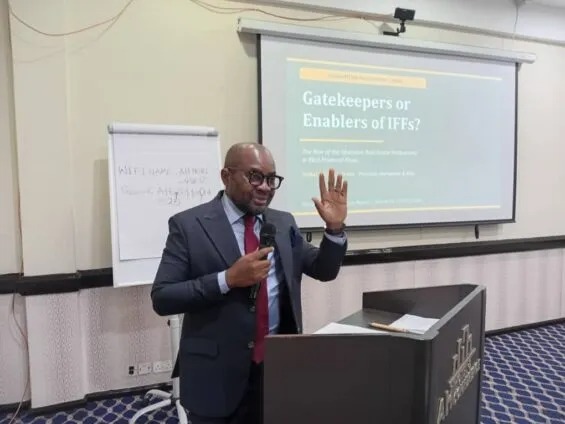
The Real Estate Agency Council (REAC) has warned that Ghana’s booming property market remains susceptible to illicit financial activities, urging practitioners to strengthen compliance and due diligence measures.
According to the Council, the sector, despite its significant contribution to economic growth and investment, remains vulnerable to money laundering and other illicit financial activities. Acting Chief Executive Officer of REAC, Mr Emmanuel Jeffery, said this.
He noted that the industry’s attractiveness to legitimate investors has equally made it a target for individuals seeking to conceal or legitimise proceeds derived from unlawful activities.
He made the remarks on Tuesday in Accra at a policy dialogue on the theme, “Gatekeepers or Enablers of Illicit Financial Flows (IFFs)? The Role of the Ghanaian Real Estate Professional,” organised by Global Financial Integrity (GFI) in partnership with REAC.
The event brought together officials of the Financial Intelligence Centre (FIC), representatives of professional bodies and training institutions, as well as brokers, estate agents, developers and other players within the property industry.
Addressing participants, Mr Jeffery said, “The real estate sector occupies a strategic position within Ghana’s economy. Beyond providing housing and facilitating investment, it contributes significantly to economic growth, employment creation and wealth generation.
However, the sector’s attractiveness to legitimate investors also makes it vulnerable to abuse by persons seeking to conceal or legitimise proceeds derived from unlawful activities.”
He noted that, globally, real estate transactions have increasingly been identified as one of the channels through which illicit financial flows are introduced into formal economies, placing a greater responsibility on practitioners to serve as the first line of defence against financial crimes.
“Real estate professionals are increasingly expected to serve as the first line of defence against money laundering and other financial crimes,” he stated.
Mr Jeffery said Ghana’s anti-money laundering architecture has been strengthened through the implementation of the Anti-Money Laundering Act, 2020 (Act 1044) and the Real Estate Agency Act, 2020 (Act 1047), which place clear obligations on practitioners and regulators alike.
He explained that the establishment of REAC under Act 1047 reflects government’s commitment to promoting professionalism, transparency and accountability within the industry.
According to him, the Council has intensified efforts to ensure compliance through licensing, inspections, stakeholder engagement and public education.
“Through licensing, inspections, stakeholder engagement and compliance monitoring, the Council is working to ensure that real estate practitioners understand and discharge their responsibilities under the law,” he noted.
The Acting CEO further revealed that Ghana is currently undergoing its third-round mutual evaluation under Inter-Governmental Action Group against Money Laundering in West Africa (GIABA) and the standards established by the Financial Action Task Force.