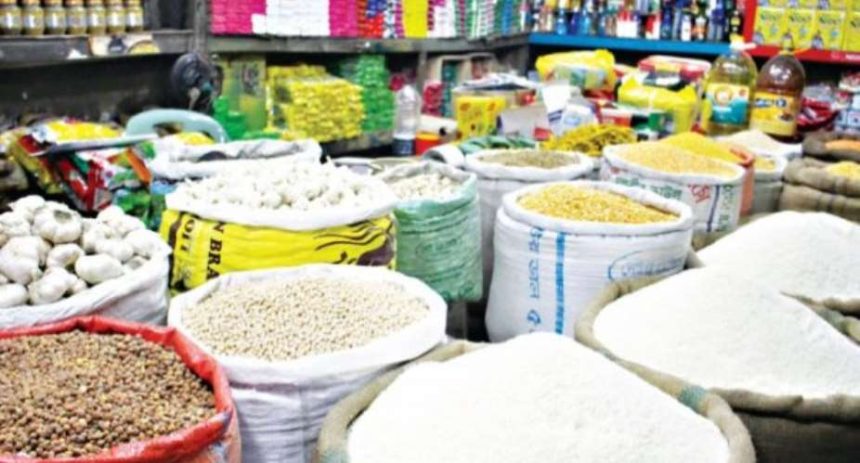
The Development Bank Ghana (DBG) is directing a significant portion of its financing toward key agricultural value chains to support food security and Ghana’s broader economic transformation.
Chief Executive Officer of DBG, Prof Randolph Nsor-Ambala, said maize, rice, cassava, sorghum, and poultry have accounted for a significant share of the bank’s agricultural investments.
He said the focus is based on evidence and analysis of sectors that can create jobs, strengthen food security and support sustainable economic growth.
“Our focus areas are essentially agriculture, manufacturing, ICT, and what we call high-value services,” he said.
Prof Nsor-Ambala explained that high-value services include education, health, transportation and tourism.
He said DBG’s interventions are targeted at sectors identified as having significant potential to drive economic transformation but which also face market failures and financing constraints.
“Our view, based on the evidence we have and the data and analytics that we have done, are that these are the sectors that will contribute massively, we call them growth pole areas, yet they’ve got market failures and binding constraints that require deliberate interventions that and those interventions must be considered as a public good because they cannot necessarily be financed by private capital or money,” he said.
On agriculture, he said the bank’s strategy goes beyond simply providing funding to individual businesses.
He said DBG is focused on transforming entire value chains in areas where financing can have wider economic benefits.
“If you take the area of agriculture that we have invested in particularly, the story again is around why do we invest in agriculture? We invest in agriculture for various reasons,” he said.
Prof Nsor-Ambala said job creation is one of the key considerations.
“Top among those reasons are jobs that need to be created. And we are here, we are talking about decent jobs that deliver on upward social mobility and economic empowerment,” he said.
He added that food security is another major consideration because of its potential impact on economic pressures.
“And then aside from the jobs, there’s the other element around food security, and that food security translates into lower economic pressures, i.e., inflation, exchange rate problems because of high levels of imports, etc., etc.,” he said.
Prof Nsor-Ambala said DBG has therefore identified specific agricultural value chains for targeted financing.
“Our interventions have been targeted because the value chains are many. And considering that we are focused on sector transformations and full value chain transformations, we have necessarily focused on areas around maize, rice, cassava, sorghum, poultry,” he said.
“These are the areas that have taken a chunk of our investments because our analytics is that these contribute to our ability to achieve the very parameters that I’ve spoken about,” he added.
DBG has so far disbursed more than ¢2.5 billion since its establishment.
Prof Nsor-Ambala said more than half of the funding has gone into agribusiness, agriculture and manufacturing.
He said the bank has also reached almost 1,000 businesses, with about half located outside Greater Accra.
“In excess of 2.5 billion cedis has been disbursed since the inception of the bank. Over 60% of that to women-led and women-owned businesses, in excess of 50% of that to agribusiness, agriculture, and manufacturing,” he said.
He added that about 40% of the disbursement has gone into micro, small and medium enterprises.
DBG currently has a footprint in every region except one, according to Prof Nsor-Ambala.