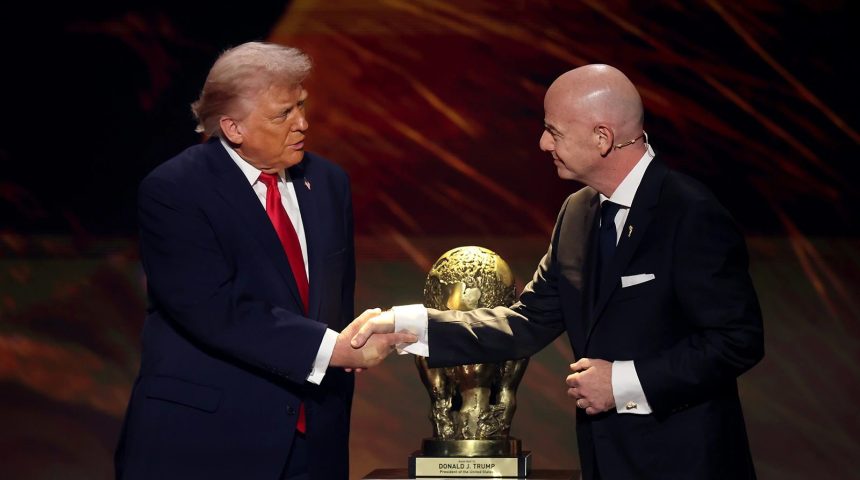
United States President Donald Trump has revealed that he personally contacted FIFA President Gianni Infantino regarding the controversial red card shown to United States striker Folarin Balogun during a match against Bosnia.
Speaking publicly about the incident, Trump said he requested that FIFA review the decision, insisting that Balogun’s dismissal was unjustified and should not have resulted in a suspension.
“I asked for a review by FIFA. I spoke to a man who is highly respected, and by the way, whose level of respect has gone up tenfold,” Trump said, referring to Infantino.
The incident has generated widespread discussion among football fans and pundits after Balogun was initially sent off following a challenge during the match. The decision was later reviewed, with reports indicating that the suspension linked to the red card was overturned.
Trump argued that the challenge was simply a collision between two players competing for the ball and did not warrant such a severe punishment.
“It wasn’t a foul, and wasn’t even an infraction. These were two great athletes who got tangled up,” he said.
The President also questioned the officiating in the match, suggesting that the referee’s decision deserved closer scrutiny. While stopping short of making direct accusations, Trump hinted at concerns over the official’s past performances.
“The referee, who is a little bit suspect if you check his past. I don’t want to say that because I don’t like to create controversy, but very suspect,” he added.
The remarks have further intensified debate around the role of political figures in sporting matters and the growing influence of football during major international tournaments. While FIFA has not publicly commented on Trump’s involvement, the governing body has procedures that allow disciplinary decisions to be reviewed under specific circumstances.
Balogun remains a key player for the United States national team and his availability is considered crucial as the Americans prepare to face Belgium in the round of 16.
The controversy has also reignited discussions about refereeing standards, the use of video review technology, and whether post-match interventions can affect perceptions of fairness and independence in football governance.
With the decision now overturned, attention is likely to shift back to events on the pitch, although the unusual involvement of a sitting U.S. president has ensured the story remains a major talking point in football circles.