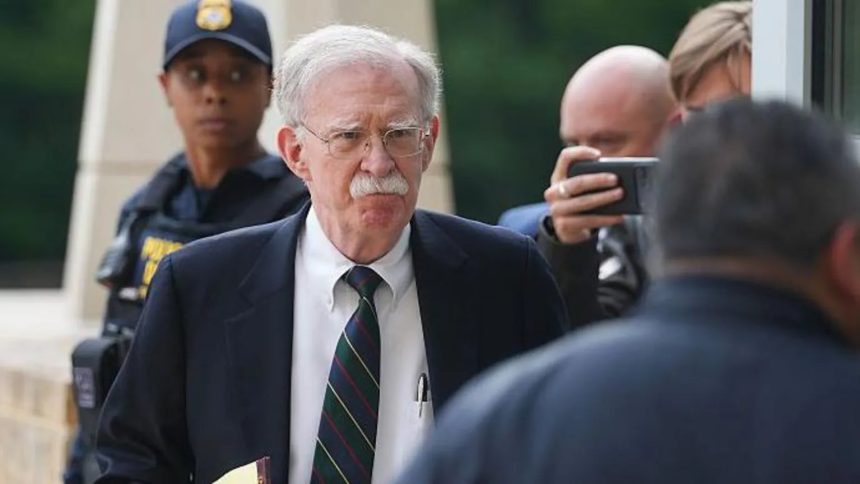
John Bolton, a former national security adviser to Donald Trump, has pleaded guilty to mishandling classified security information as part of notes he compiled for a book.
Bolton, now a prominent critic of the US president, was indicted on 18 counts related to improper handling of classified material, and initially pleaded not guilty.
On Friday, he admitted to a single charge of illegal retention of classified information. The documents he retained included diary entries containing national defence information, some of it classified at the top secret level.
Bolton faces a prison sentence of up to five years and has agreed to pay $2.25m (£1.7m) in fine, prosecutors said.
Bolton will also debrief national security officials on the classified information he illegally retained as well as perform 100 hours of community service, the BBC’s US partner CBS News reported.
After the judge read the allegations against Bolton in court on Friday, including about sending diary entries with sensitive information to his family members, Bolton said the accusations were accurate.
“I did your honor,” Bolton said about whether he committed the actions at hand today. He added he was “sorry for it.”
He is set to be sentenced on 28 October, US media report.
Speaking to reporters after the hearing, US Attorney Kelly Hayes said Bolton knew how to handle classified information and with whom he could share it.
“He also knew the damage to national security that could be caused by mishandling that sensitive information,” she said. “Nevertheless, as Mr Bolton just admitted, he put our national security at grave risk in violation of the law.”
Bolton was fired from Trump’s first administration in 2019. His 2020 memoir, The Room Where It Happened, recounted his time working under Trump, portraying him as a president who was ill-informed about geopolitics.
The White House filed a lawsuit to block publication of the book, arguing that it contained classified information and had not been properly vetted. A judge denied the request and the book was released days later.
The US Department of Justice then opened an investigation into whether Bolton had mishandled classified information by disclosing parts of it in the book.
He was also accused of transmitting some of the classified materials from his time as national security adviser to two relatives.
Bolton has continued to be critical of the president in the time since. Trump, in return, has suggested that Bolton should go to jail and called him a “sleazebag”.
The indictment said that at one point a hacker gained access to Bolton’s account, where documents were stored and sent an apparent threat to cause “the biggest scandal since Hillary [Clinton]’s emails were leaked”.
Bolton’s indictment came on the heels of other high-profile criminal cases brought against Trump critics, including former FBI Director James Comey and New York Attorney General Letitia James.
But former federal prosecutors and other legal experts told the BBC that Bolton’s case stood apart from prosecution of other Trump critics due to the evidence gathered by prosecutors.
“The ambassador has admitted to what he has done,” one of the people familiar with Bolton’s plea deal told the BBC.
Bolton also understood that if he continued to fight the case, “other classified information might have been released in his defence” and he did not want to “damage” the United States, the person said.
The decision to charge such a high-ranking official for mishandling classified documents is “rare” but not unprecedented, said Carrie Cordero, a senior fellow at the Center for a New American Security.
“Cases that involve classified information present challenges to prosecute, but they can and are brought against both low-level and high-level officials, from time to time,” she said.
Before joining the Trump administration, Bolton served as George W Bush’s UN ambassador. He was also among the former officials critical of Trump who had their Secret Service protection stripped in January.