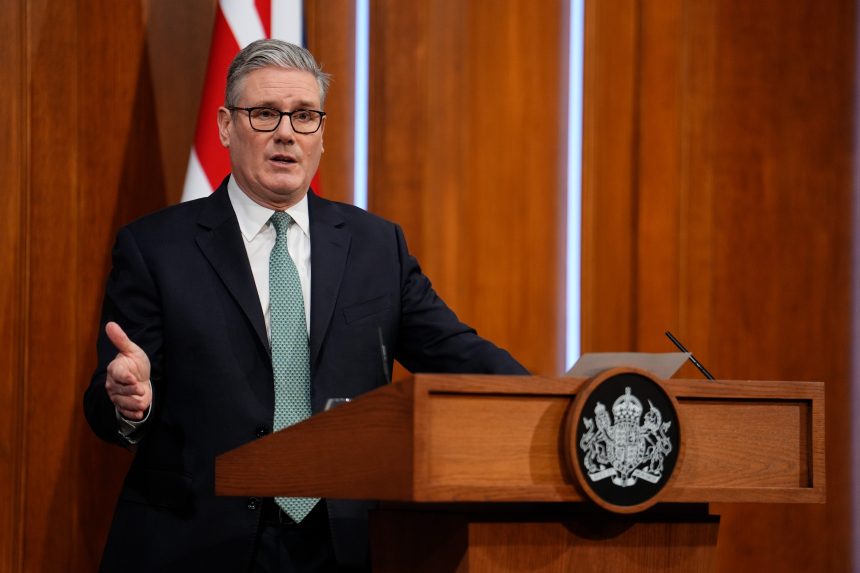
UK Prime Minister, Sir Keir Starmer, has announced plans to ban children under the age of 16 from using social media platforms.
Unveiling the proposals at Downing Street, the Prime Minister said social media companies had created platforms that encourage excessive use, expose children to abuse and interfere with healthy childhood development.
The restrictions would apply to popular services including Snapchat, TikTok, YouTube, Instagram, Facebook and X.
Messaging platforms such as WhatsApp and Signal would remain unaffected.
The plan would further prohibit under-18s from accessing so-called “romantic chatbots” and place limits on the use of artificial intelligence chat services by younger users.
Sir Keir hopes to secure parliamentary approval before Christmas, with the new rules expected to take effect in spring next year. Responsibility for enforcement would rest with technology companies rather than children themselves.
Defending the policy, the Prime Minister said the government had carefully weighed the benefits and risks associated with social media before reaching its decision.
He acknowledged that online platforms can offer opportunities for learning, communication and connection, but argued that ministers could no longer ignore growing concerns about their impact on children.
“it’s clear to me that a full ban is the right choice,” he said.
Drawing on his own experience as a parent, Sir Keir said his priority had always been the happiness and safety of his children.
“All I’ve ever wanted for my own children, hand on heart, is for them to be happy and for them to be safe. I think that’s what any parent wants.”
He challenged the idea that social media currently provides a safe space for young people.
“I don’t think I even need to answer those questions, do I?” he said.
The Prime Minister argued that online platforms have become breeding grounds for bullying and abuse, warning that the consequences can be severe for children’s wellbeing.
“Social media is making children unhappy,” he said.
He also accused technology firms of designing products that encourage compulsive use.
“It is ‘designed to be addictive’ with features that ‘lock you in for hours’,” he said.
According to Sir Keir, many children now spend so much time online that they miss out on activities that play an important role in their development, including reading, socialising, studying and getting adequate sleep.
“That may not sound like much, but these are activities that help a child develop into an adult,” he added.
The announcement prompted sharply contrasting reactions from campaign groups.
Children’s charity NSPCC welcomed the move, describing it as a significant breakthrough in efforts to improve online safety.
Calling the decision “a win for children and parents”, the organisation said campaigners had spent years urging tougher action against technology companies.
Chief executive Chris Sherwood said: “Big Tech must not have access to our children where their dangerous platforms are causing appalling harm to young people. This is a watershed moment for child protection.”
While backing the government’s direction of travel, he warned that a ban alone would not eliminate risks.
“Australia has shown that bans alone don’t keep all children safe, some young people will always slip through the net,” he said.
Sherwood urged ministers to introduce strong age-verification systems and ensure regulators have the power to enforce the new rules effectively.
Human rights campaigners, however, questioned whether the proposals address the root causes of online harm.
Kerry Moscogiuri, chief executive of Amnesty International UK, argued that ministers had correctly identified the problem but chosen the wrong solution.
“This is a case of the right diagnosis but the wrong prescription,” she said.
While acknowledging the dangers many children face online, Moscogiuri said social media companies should bear greater responsibility for creating safer products.
She argued that the focus should be on reforming the platforms themselves rather than restricting access for young people.
“But the problem is not that children exist on social media; it’s that social media companies have built platforms that are unsafe by design.
“Banning under-16s risks treating children as the problem rather than addressing the companies and systems that create the risks in the first place.”