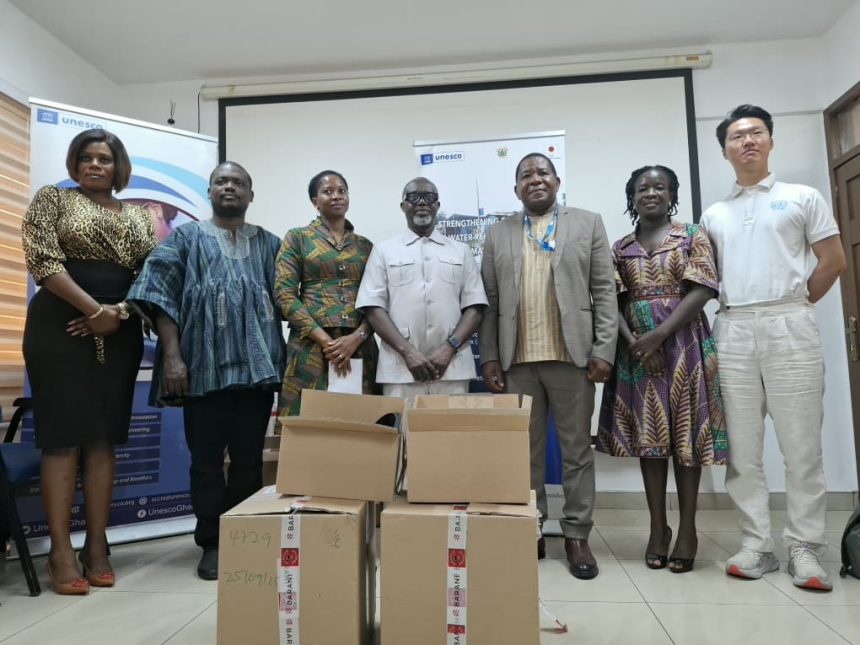
The United Nations Educational, Scientific and Cultural Organization (UNESCO) has presented nine automated weather stations to the Ghana Meteorological Agency (GMet) to improve early warning systems and strengthen climate resilience in northern Ghana.
The handover took place on Wednesday, May 6, under a project funded by the Government of Japan.
Officials expect the equipment to improve access to accurate and real-time weather data, helping authorities strengthen forecasting, disaster preparedness, and climate-related planning, especially in areas vulnerable to floods and droughts.
The weather stations form part of a $750,000 initiative titled “Strengthening Resilience on Water-Related Disasters under Climate Change for a Sustainable Society in Ghana.”
The project aims to help Ghana respond better to increasing climate threats and extreme weather conditions that continue to affect communities, livelihoods, and infrastructure.
The newly installed systems can automatically record and transmit weather data without manual operation.
Authorities believe the technology will help close existing gaps in weather observation networks, particularly in the Northern, Savannah, North East, and Upper East regions.
The stations are also expected to improve early warning alerts and speed up responses during emergencies.
Edmond Moukala N’Gouemo, UNESCO Representative to Ghana, described the handover as an important step toward building stronger climate resilience in the country.
“Accurate, timely and reliable meteorological data is the backbone of effective early warning systems,” he said.
He added: “These weather stations are instruments of anticipation rather than reaction, of prevention rather than response.”
Mr N’Gouemo stated that UNESCO remains committed to supporting Ghana through open science, climate resilience programmes, and improved early warning systems.
Director-General of GMet, Dr Eric Asuman, welcomed the support and described it as timely. He explained that reliable data remains central to the agency’s operations.
“These automated systems make data collection more reliable and efficient, especially in a resource-constrained environment,” he noted.
Dr Asuman also highlighted the importance of GMet’s services to sectors such as agriculture, aviation, health, energy, and disaster risk management. He further appealed for more investment in meteorological infrastructure across the country.
Matila Akua Afriyie, Disaster Risk Reduction Project Officer at UNESCO’s Accra office, said the project seeks to address growing climate shocks and the country’s limited capacity to manage them.
She explained that recent events, including the 2023 Akosombo Dam spillage and the 2024 drought that affected nearly one million people, demonstrate the urgent need for stronger warning systems and data-driven planning.
“To effectively manage climate risks, we must strengthen observation systems, build institutional capacity and empower communities with the right tools and information,” she stated.
She added that the initiative will also provide integrated early warning systems, detailed risk maps, and trained personnel to support climate resilience efforts nationwide.
The Ghana Meteorological Agency remains the state institution responsible for providing weather and climate information to protect lives and property while supporting Ghana’s socio-economic development and meeting international meteorological standards.