

Zohran Mamdani: The socialist that capitalist sheriffs could not stop – Kabah Atawoge writes
Zohran Mamdani’s life story stretches across continents and cultures, shaping the worldview that would later underpin his political philosophy. He was born in Uganda to a family deeply immersed in intellectual and artistic traditions.
His father, Mahmood Mamdani, is an academic known for his work on African history, politics, and post-colonial theory. His mother, Mira Nair, is a filmmaker.
When Zohran Mamdani was five years old, his family relocated to South Africa during a pivotal time in that country’s history, as it continued to transform in the post-apartheid era. Two years later, the family moved once again, this time to the United States, where they eventually settled in New York City.
New York would become not just home, but the place where Mamdani’s political identity solidified. Growing up in Queens, one of the most culturally diverse urban communities in the world, he experienced firsthand the challenges faced by working-class immigrant families, from the high cost of living to the daily struggle for economic stability and fair representation.
Years later, those early life experiences would help fuel his rise in city politics. In a historic election that surprised many political analysts, Mamdani defeated former Governor Andrew Cuomo — a long-established figure in New York politics—as well as Republican nominee Curtis Sliwa, a well-known media personality and founder of the Guardian Angels vigilante group.
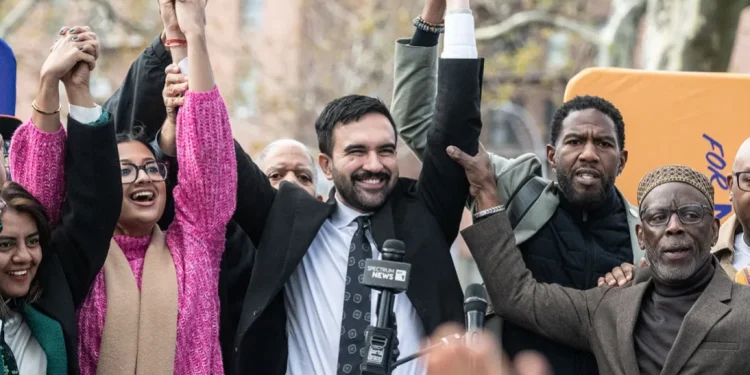
With his win, Zohran Mamdani became the youngest mayor of New York City since 1892—a striking achievement in a city known for seasoned political figures. More than that, he made history as the first Muslim to hold the office and also the first individual born in Africa to become mayor of the city.
Zohran Mamdani’s rise to national prominence was anything but conventional. He first went viral shortly after the 2024 U.S. presidential elections through a series of street interviews where he asked Americans why they voted for Donald Trump over Kamala Harris. The videos were raw, unfiltered, and revealed sentiments that many political analysts had missed.
Prior to his mayoral victory, he worked as a housing counselor and hip-hop musician.
Today, Zohran Mamdani stands as one of the most discussed figures in American metropolitan governance, a progressive organiser turned mayoral contender and victor, whose ideology has both electrified supporters and alarmed the political donor class.
New York has always been seen as the center of American capitalism. Home to Wall Street, global banks, and billionaire hedge fund executives, it is a city where financial power and political influence intertwine.
The political donor class, known for protecting the interests of corporate America, rarely hesitates to act when its priorities are threatened. And Zohran Mamdani’s campaign centered unapologetically on socialist policies and therefore seen as a threat.
Though he entered the political scene with limited traditional experience, Mamdani built his campaign around a message of integrity and economic fairness. In his view, New York is a city where the ultra-wealthy flourish while working families struggle to afford housing, transportation, healthcare, and basic living expenses. The heart of his campaign has been to make New York a city that works for everyone, not just those at the top.
Major promises and potential challenges
Affordability Agenda: Taxes on the wealthy and relief for working families
Mamdani promised to make New York more affordable—not through cuts or austerity, but by increasing revenue from those he believes can afford to contribute more. His plan involves raising the corporate tax rate in New York City, particularly targeting large profit-heavy corporations that benefit from the city’s infrastructure and labour force.
In addition, he proposed a new 2% tax on the wealthiest New Yorkers—individuals whose net worth places them among the highest income earners in the entire country. Implementing such changes, however, requires working closely with the New York State Legislature—where opposition is anticipated to be fierce.
His opponents, including business lobby groups, argue such taxes could drive away investment. Supporters counter that corporations and wealthy elites benefit disproportionately from a city that millions of others struggle to afford, and should therefore be expected to contribute more to the public good.
Freeze rent increase
Housing affordability remains the single most pressing crisis in New York. With landlords increasing rent at unprecedented levels, sometimes beyond inflation, working-class tenants and even middle-income earners have been squeezed.
Outgoing Mayor Eric Adams appointed individuals to the Rent Stabilization Board who approved rent increases of up to 9%. Mamdani has sharply criticised this move, saying it is a deliberate choice to push families out of their homes.
One of Mamdani’s most controversial pledges is to appoint a new board that will freeze increases on rent-stabilised apartments. For tenants, this represents relief. For landlords, it represents a direct threat to profits.
This policy is likely to be his first major battle, a showdown that could define his administration.
Free busing system to improve mobility
Another bold promise is his proposal to introduce a free citywide bus system. Mamdani argues that public transportation should be a right, not a privilege tied to income. He believes that removing fares will improve access to schools, jobs, and healthcare, while simultaneously reducing the city’s carbon footprint.
Critics argue the policy is expensive. Mamdani counters that the funds raised from taxing corporations and the ultra-wealthy would more than cover operational costs.
National political backlash
Mamdani’s rise has not gone unnoticed at the national level. Former President Donald Trump warned that if Mamdani were to win the mayoral race, he would push for federal funding cuts to New York. Trump and other conservative voices have labeled Mamdani a “full-fledged communist,” framing his policies as extreme rather than reform-minded.
Mamdani has responded by saying that public services, fair wages, and affordable housing are not radical ideas, they are basic human necessities.
Convincing New Yorkers
For all his momentum and viral popularity, Mamdani must still convince a broad base of New Yorkers that he can manage the complexities of governing one of the world’s most diverse and demanding cities. Critics point to his limited executive experience. Supporters emphasise his activism, community organising, and data-driven policy approach.