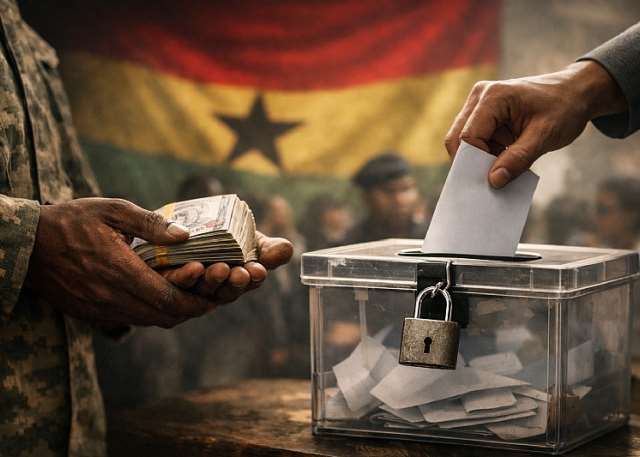
There are different types of government: monarchy, dictatorship, oligarchy, democracy, among others.
Of course, all these have their advantages and disadvantages.
For some reason, Ghana has opted for democracy.
With this system of government (democracy), power is held by the people, either directly or through elected representatives.
Citizens have some rights, including the right to vote and express their opinions, and participate in the decision-making process.
It should, however, be noted that free and fair elections, probity, accountability and rule of law are key characteristics of democracy.
Sadly, many of our elections cannot be described as free and fair. In fact, they are tainted with naked corruption.
Voters are induced with money and items [described as gifts], ranging from electronic gadgets to kitchen wares.
Some of these vote buyers engage in this corrupt practice on the pretext of paying travelling and transport allowances (T&T) for delegates.
It is obvious that delegates of political parties anxiously wait for elections to line their pockets from candidates.
We will be hypocrites to say that vote buying started just yesterday.
In fact, it has been with us for many years.
I am aware that some anti- corruption crusaders, civil society organisations and some prominent persons in society have been outspoken on the menace.
Unfortunately, there seems to be no change.
Offence
We should be reminded that in Ghana, vote buying is an offence under the Criminal Code 1960 (Act 29), punishable by imprisonment or fine.
Electoral Commission Regulation 2012 CI 72 also specifies what is expected of voters.
We should also know that the “vote seller” is equally guilty as the “vote buyer”.
Granted that we are ignorant about the laws of Ghana against the practice of vote buying and selling, our conscience should tell us that it is morally wrong.
Some “vote sellers” give reasons why they accept so-called gifts from their “buyers”.
According to them, during election campaigns, politicians make sweet promises which they do not fulfil after they are elected into power.
The very people who used to be nice and friendly to them before the elections suddenly do not answer their calls or change their phone numbers.
They therefore seize the opportunity to enrich themselves.
But should this kind of “short-term benefit” be encouraged? I don’t think so.
It is rather unfortunate that elections these days are no longer about who can deliver, who is competent, or who has good ideas, but who has enough money to influence voters.
Democracy suffers when people are elected into power not based on competence and the ability to perform but because they bribed their way through the electoral process.
One very important question we need to ask ourselves is, what at all will motivate someone to spend millions of cedis to influence voters to vote for him/her?
Could it be that they are sure of avenues to recoup their money?
To curb the menace, the number of delegates should be expanded