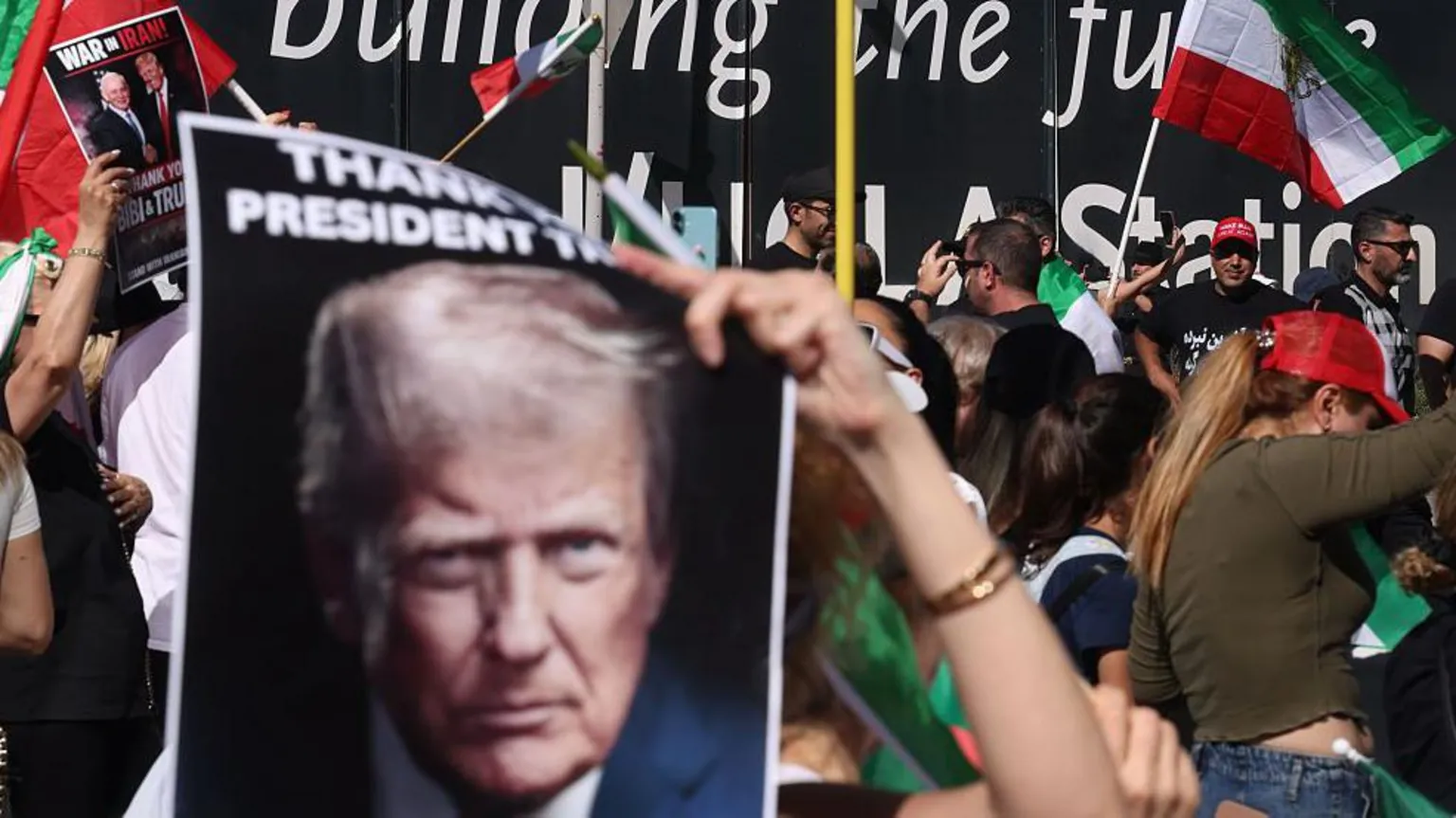
In attacking Iran and killing the regime’s supreme leader, US President Donald Trump has made an enormous bet: that he can succeed where past presidents have failed by using American military force to reshape the Middle East.
Trump will claim a generational victory if the US succeeds in fully destroying Iran’s nuclear programme and bringing about regime change in Tehran using air power alone, even if there seems to be no clear plan from Washington for what would come after the Islamic Republic.
But if the military strike, called Operation Epic Fury by the Pentagon, fails, or sparks a wider regional conflagration that demands ongoing US involvement, Trump could hurt his legacy as well as Republicans’ chances to retain control of Congress in the November midterm elections.
The president signalled how much is at stake in remarks early on Saturday when he announced the start of a military campaign in Iran.
“American heroes may be lost”, Trump said. He argued this would be a necessary price to pay to inflict damage on a regime he said has sown chaos across the Middle East since seizing power in 1979.
“For 47 years, the Iranian regime has chanted Death to America,” Trump said. He added later: “We’re not going to put up with it any longer.”
But as the world waits to see what the Iranian regime will do after the death of its supreme leader, it remains to be seen whether Trump will manage to avoid a prolonged military campaign.
It’s also an open question whether he can convince the American public – and especially his MAGA base who largely oppose US interventions abroad – to support another incursion in the Middle East.
It’s a pivotal moment for Trump, who returned to office little over a year ago with a promise to end so-called “forever wars” like those the US fought in Afghanistan and Iraq but has launched military operations in Iran, Venezuela and Syria, among other countries.
The US and Israeli bombing came after the White House warned of an attack if the regime did not agree to a deal to abandon its nuclear weapons programme, stop producing ballistic missiles and drop its support for proxy groups like Hamas and Hezbollah.
After amassing enormous military force in the region, Trump spent Friday night monitoring the attack as it unfolded with top advisers at his Florida estate Mar-a-Lago.
In Washington, Vice-President JD Vance, Director of National Intelligence Tulsi Gabbard and other senior administration officials gathered in the Situation Room at the White House, according to a source familiar with the matter, and dialled into a conference line with Trump to follow the bombing in real-time.
Khamenei’s killing signifies a major escalation, but analysts warn it could spiral out of Trump’s control.
“The die is cast and the US has to go all the way now to effect regime change. The problem is, you can’t do that without boots on the ground,” said Mohammed Hafez, a professor at the Naval Postgraduate School.
Iran’s retaliatory strikes on a host of US allies in the region – Bahrain, the UAE, Qatar and elsewhere – signalled the regime plans to fight back more aggressively than it did after the US strike on the country last year, he added.
“The Iranian regime’s strategy is [going to be] to create a regional conflict that affects the global economy, and the US economy, and that would not be a good thing for Trump,” said Hafez, an expert on Islamist political violence and Middle East politics. “This could lead to a quagmire.”
A protracted conflict in the Middle East could impact Trump’s other priorities in the region, such as rebuilding Gaza after the Israel-Hamas war and strengthening ties with Saudi Arabia.
It could also alienate supporters back home at a time when his presidential approval ratings have taken a hammering over voter frustration with the cost of living and other domestic issues.
In recent weeks, several senior administration officials voiced concerns about a major military operation in Iran, according to a former senior administration official in Trump’s first term who remains close to his team and has knowledge of internal policy deliberations.
The divisions are said to have played out in private as Trump publicly threatened to attack Iran and ordered the largest US military buildup in the Middle East since the invasion of Iraq in 2003.
Trump projected confidence about the mission on Saturday after choosing to launch the attack and end weeks of speculation about a possible strike. But he also sent mixed signals that raised new questions about what the US war aims are.
“I can go long and take over the whole thing, or end it in two or three days” and keep the threat of further strikes on the table, Trump told Axios.
He later said on social media that “the heavy and pinpoint bombing… will continue, uninterrupted throughout the week or, as long as necessary”.
The remarks underscored what critics say is Trump’s free-wheeling approach to foreign policy, and his disinterest in laying the groundwork to bring lawmakers and the public on board before launching military attacks.
It’s that same unconventional approach that the president’s allies and supporters say has allowed him to notch up successes, including an agreed ceasefire in Gaza and an increased European financial commitment to Nato.
 Los Angeles Times via Getty Images
Trump did little ahead of time to make a detailed case to the American public about why it’s in their best interest to start a war with Iran. The president could have used his State of the Union address last week to present his arguments, but chose not to.
The president launched the military campaign without first seeking congressional approval. But most Republicans came out in support of the action on Saturday.
“Iran is facing the severe consequences of its evil actions,” House Speaker Mike Johnson said in a statement. “President Trump and the Administration have made every effort to pursue peaceful and diplomatic solutions in response to the Iranian regime’s sustained nuclear ambitions and development, terrorism, and the murder of Americans – and even their own people.”
But the lack of coordination with Congress has angered Democrats and some in Trump’s party who oppose US strikes.
“Donald Trump is dragging the United States into a war the American people do not want,” former Vice President and 2024 Democratic nominee Kamala Harris said in a statement. She added, “our troops are being put in harm’s way for the sake of Trump’s war of choice”.
Senate Minority Leader Chuck Schumer said the administration did not provide “critical details about the scope and immediacy of the threat” to Congress and the American people. “President Trump’s fitful cycles of lashing out and risking wider conflict are not a viable strategy,” he said.
The fierce backlash from Democrats on Saturday suggested Trump may be forced to wage a political battle at home while presiding over the new war in the Middle East, just as primary elections begin ahead of November’s crucial midterms.
House Democrats are holding a meeting on Sunday evening to discuss their response to the military campaign, according to two sources who spoke on background to discuss the plans.
House Minority Leader Hakeem Jeffries said Democrats would resume their push to hold a vote on a resolution reining in Trump’s war powers in Iran next week.
“It’s easy to arrest the leader of another country, like in Venezuela, but what do you do in the days that follow?” a senior House Democratic aide said. The administration “hasn’t articulated a strategy or goal”.
Trump, meanwhile, told NBC earlier on Saturday of Iran: “At some point they’ll be calling me to ask who I’d like (as leader). I’m only being a little sarcastic when I say that.”
And while those midterm elections in November will be critical in defining what Trump can achieve during the remainder of his term, as past presidents have found, his decision to launch extraordinary military action in the Middle East may prove even more consequential when it comes to shaping his legacy.