WTI crude futures are trading around $55.81 through Thursday’s close, down 2.60% for the week with one session left.
Prices have held within a $54.84–$56.85 range so far, reaching fresh five-year lows before geopolitical headlines generated brief recoveries.
The setup continues to reflect a market dominated by oversupply concerns, with traders using geopolitical rallies to sell into strength rather than reprice the broader fundamental picture.
Across the week, geopolitical risks, refinery outages, U.S. inventory data, OPEC+ policy decisions, and the weakening China demand profile each influenced trading behavior. Collectively, these factors produced a market struggling to sustain any upside momentum even when supply risks briefly surfaced.
How Much Support Can Geopolitical Risk Offer the Oil Prices Forecast?
WTI’s strongest upward move came on Tuesday after President Trump announced a “total and complete blockade” targeting sanctioned Venezuelan crude shipments. Futures jumped more than 2% as traders assessed the risk to roughly 850,000 barrels per day of Venezuelan exports—primarily heavy crude moving through a shadow tanker fleet to China.
The rally was short-lived. The inability of prices to hold above $57 showed a market unconvinced that enforcement will meaningfully disrupt flows. Venezuela has spent years maintaining exports despite sanctions by rerouting vessels and offering steep discounts. Traders treated the announcement as a headline-driven event rather than a confirmed supply reduction. Still, the order introduces a conditional bullish factor for the oil prices forecast, entirely dependent on U.S. follow-through.
Could the Russia-Ukraine Conflict Alter Oil Prices Projections?
Ukraine accelerated strikes on Russian energy infrastructure this week, hitting major refineries such as Afipsky and Ryazan, as well as export infrastructure at Novorossiysk and platforms in the Caspian Sea. Russia’s refinery capacity is now down roughly 6% year over year, contributing to domestic fuel shortages and triggering a gasoline export ban.
Yet refinery damage offers limited support for crude prices. Reduced processing capacity forces more unrefined barrels toward export markets, not fewer. That trend showed up clearly in pricing: Urals crude slid to $38.28 per barrel, widening its discount to Brent to more than $25. New U.S. sanctions discussions added uncertainty, but traders have seen Russia repeatedly redirect crude to India, China, and Turkey. As a result, the strikes acted as only a mild bullish input—not enough to change the broader oil prices projections this week.
Inventory Trends Complicate Short-Term Crude Oil News Today
The EIA’s December 17 petroleum report added a mixed layer to the setup through Thursday. U.S. commercial crude stocks fell 1.3 million barrels, marking a second straight weekly decline and beating expectations. Cushing inventories posted their largest draw in nearly two months, lending some support to the WTI contract given the role of the delivery hub in futures pricing.
Refined products shifted sentiment in the other direction. Gasoline inventories surged 4.8 million barrels, and distillates rose 1.7 million barrels, highlighting soft end-user demand. Crack spreads fell to six-week lows, discouraging refiners from raising crude runs. For traders watching crude oil news today, the product builds and weak margins dampened the bullish effect of the crude draw, reinforcing concerns that refinery demand will remain subdued into year-end.
OPEC+ Production Strategy Pressures Sentiment
OPEC+ confirmed that its Q1 2026 production pause will follow December’s 137,000-barrel-per-day increase. The pause was meant to prevent seasonal oversupply, but instead it signaled to traders that even modest output additions are straining balances. The group has already unwound 2.2 million barrels per day of voluntary cuts and is restoring another 1.65 million barrels per day, reinforcing expectations that additional volumes will return after Q1.
Compliance inconsistency across member states further weighed on sentiment. Traders viewed this week’s communications as confirmation that supply growth will continue once the seasonal pause expires, keeping pressure on WTI through Thursday’s session.
China’s Demand Stagnation Sets the Market’s Bearish Foundation
China remained the dominant bearish force influencing prices this week. While November imports climbed 5% year over year, the increase reflected strategic stockpiling rather than consumption. China continues filling storage at a rate of 900,000 to 1 million barrels per day, with tanks only half full. EV penetration at 41% and rapid rail growth further limit fuel demand.
Industry executives suggested that consumption will stay subdued into mid-2026, offering little near-term relief for bulls. For traders, this reinforces that the world’s largest importer is no longer providing the demand pull that previously stabilized global balances.
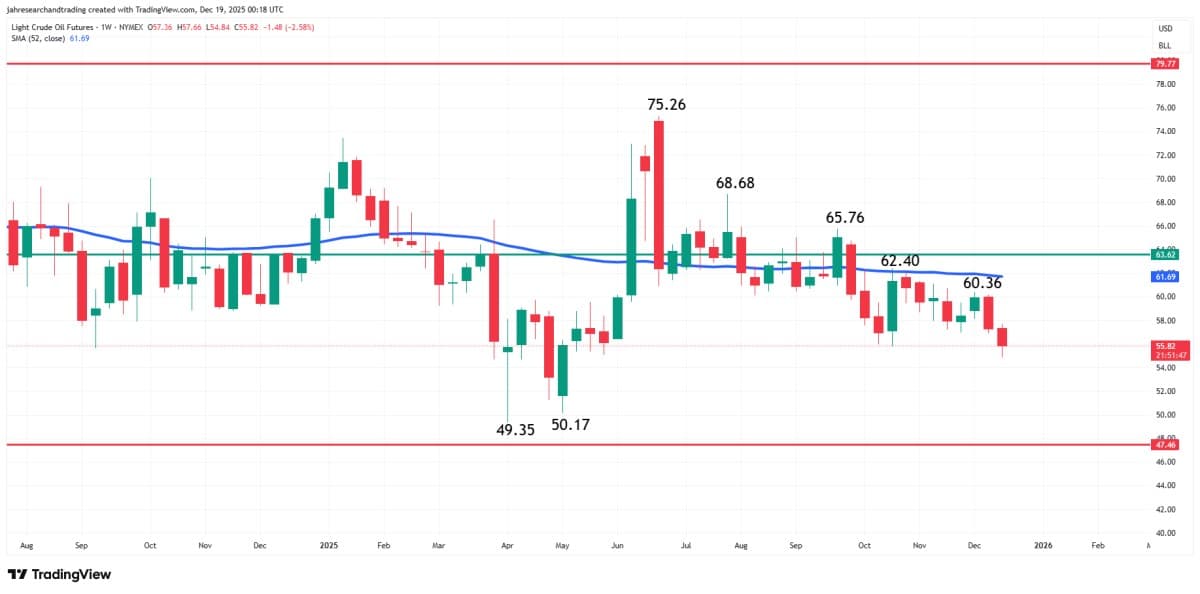
Weekly Light Crude Oil Futures
Trend Indicator Analysis
Light crude oil futures are in a position to finish lower for a second week after hitting its lowest level since May 16 at $54.84 earlier in the week.
Although short-covering on the daily chart helped stabilize prices, the market is still within striking distance of the weekly low, which could open the down to a steep decline with $50.17 to $49.35 emerging as a key downside target and support zone.
On the upside, the major resistance and trend indicator remains the 52-week moving average at $61.69. Over that is the long-term pivot at $63.62.
Overtaking the 52-week MA will indicate the presence of buyers and shift momentum to the upside, but taking out the pivot with conviction could trigger an acceleration to the upside.
Weekly Technical Forecast
The direction of the weekly Light Crude Oil Futures market for the week ending December 26 is likely to be determined by trader reaction to $57.30.
Bullish Scenario
A sustained move above $57.30 will signal strong short-covering and renewed buying interest. If this move generates sufficient upside momentum, the 52-week moving average at $61.69 will come into play. However, unless the buying is strong enough to overtake this indicator, we’ll remain in “sell the rally” mode.
Bearish Scenario
A sustained move below $57.30 will indicate active selling pressure. This could trigger a sharp decline through this week’s low at $54.84, putting $50.17 to $49.35 on the radar.
Market Forecast: WTI Bias Remains Bearish With One Session Left
Through Thursday, the market continued to lean heavily on fundamentals. The IEA expects Brent near $55 in Q1 2026, and global supply growth of 3 million barrels per day this year and 2.4 million barrels per day next year dwarfs projected demand increases below 1 million barrels per day annually. Floating storage near 180 million barrels further illustrates the difficulty producers face in placing barrels.
Geopolitical events generated intraday rallies but failed to produce follow-through. With WTI trading near $55.81 through Thursday and on track for a weekly loss despite supply-risk headlines, the prevailing setup for the final session of the week remains bearish.
Short-term fundamental forecast: bearish.
The weekly chart is also bearish with the 52-week moving average at $61.69 and the pivot at $63.62 controlling the longer-term trend.
Traders should note that there is nothing but daylight between this week’s low at $54.84 and the April/May combination at $50.17 to $49.35 so the market is set-up for a steep plunge, once traders assess the potential impact of the U.S. blockade on Venezuelan oil tankers.
We’re still in “sell the rally” mode, but be careful if volatility hits and traders go after the buy stops above the 52-week Moving Average.