

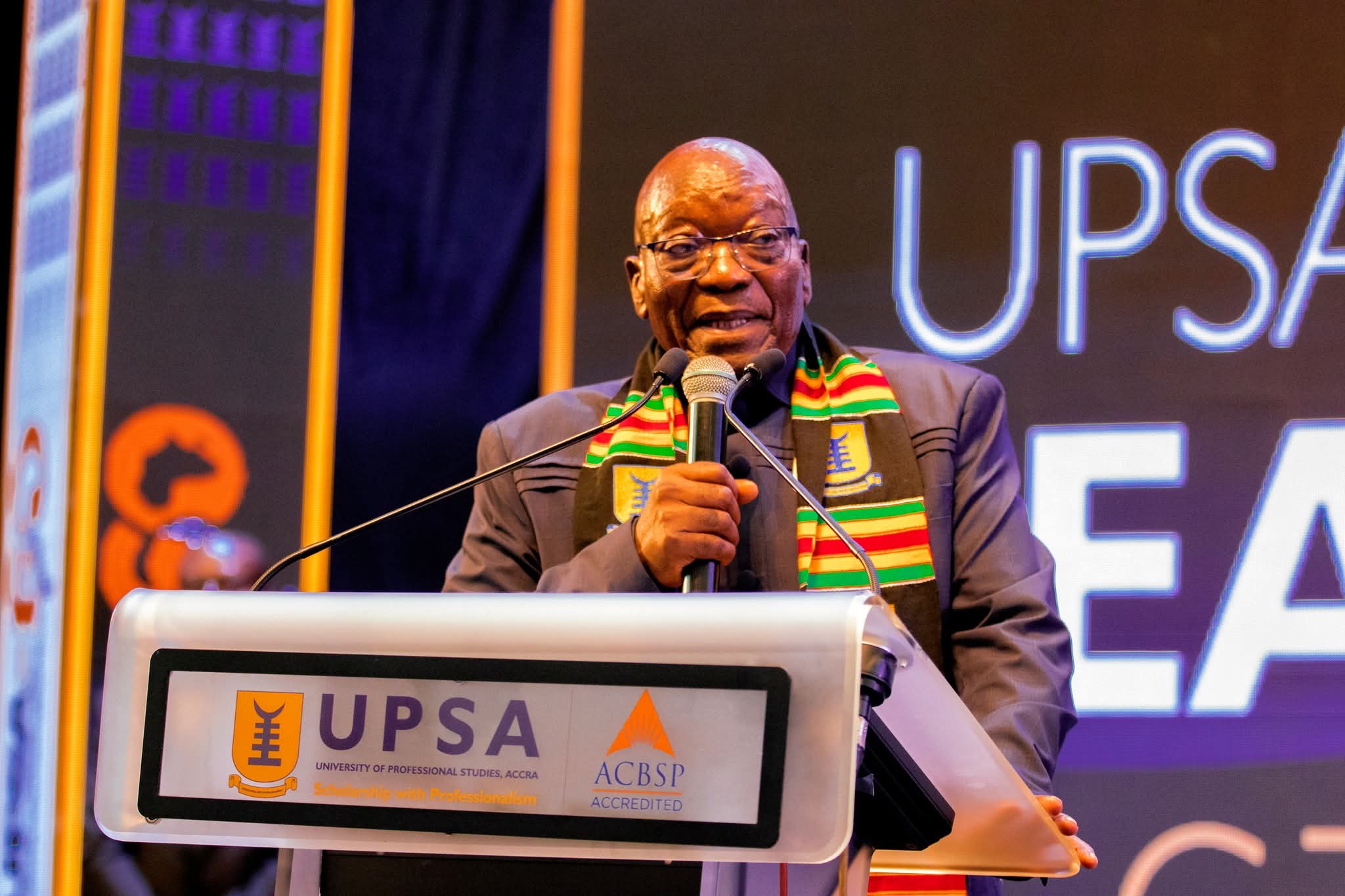
Should Ghana join BRICS? Insights from Jacob Zuma – UPSA Leadership Lectures
BRICS and the Shifting Global Order
The BRICS grouping, coined by Jim O’Neill of Goldman Sachs in 2001, includes Brazil, Russia, India, China, and, later, South Africa. This group represents key emerging economies, aiming to reshape global economic governance to better represent the interests of rapidly developing countries.
Today, BRICS has evolved into a significant multilateral platform, accounting for over 40% of the global population and more than 30% of world GDP in purchasing power parity (PPP), along with a growing share of international trade. The group has established institutions like the New Development Bank (NDB) and the Contingent Reserve Arrangement (CRA), promoting infrastructure financing and providing support against financial shocks.
At the 2023 Johannesburg Summit, BRICS expanded to include Saudi Arabia, the United Arab Emirates, Iran, Egypt, and Ethiopia, becoming “BRICS+” and signaling a goal of creating a more balanced global economic framework. A major focus has been the de-dollarization agenda, which involves discussions about developing a common settlement mechanism or currency to lessen reliance on the U.S. dollar in global trade. This effort aligns with the theme of the UPSA 2025 Annual Leadership lecture: “The Geopolitics and Geo-economics of De-dollarization: BRICS+ Currency Strategy, Lessons for Africa’s Common Currency and Beyond.”
South Africa joined BRICS in 2010, as noted by former President Jacob Zuma, emphasizing Africa’s role in global governance. Zuma stated that South Africa’s membership was about representing Africa’s collective voice in international discussions. He highlighted that BRICS provides an opportunity for African countries to address dependency on external influences and build more equal partnerships.
This raises an important question for Ghana: Should Ghana join BRICS? As an emerging center for democracy, finance, and Pan-Africanism, Ghana must balance alignment with traditional Western economic groups against the opportunities offered by BRICS+. Therefore, it is essential to evaluate both the benefits and challenges of membership, considering South Africa’s experiences and current developments within BRICS.
Lessons from South Africa with Insights from H.E. Jacob Zuma on BRICS
South Africa’s entry into BRICS, as narrated by H.E. Jacob Zuma, offers Ghana valuable lessons in opportunity and caution. Zuma reminded us that South Africa’s accession in 2010 was a strategic calculation, recognizing the global order’s shift towards multipolarity. The emergence of Brazil, Russia, India, and China highlighted the growing weight of emerging economies. South Africa positioned itself as Africa’s representative in this new bloc, ensuring the continent had a voice in shaping global trade and finance.
A key lesson from Zuma’s account is the importance of strategic foresight and political will. South Africa understood that joining BRICS was not about immediate economic gain, but about securing long-term influence in a world moving from dollar hegemony to multipolar financial structures. For Ghana, this emphasizes the need to think beyond short-term aid or bilateral trade. Joining BRICS could place Ghana at the heart of a new global financial system, where the proposed BRICS+ currency and de-dollarization mechanisms may protect Africa from the volatility of dollar-denominated debt and currency shocks.
Zuma’s reflections illustrate that BRICS involves political alignment as much as economics. South Africa entered BRICS with an understanding of joining a solidarity platform for the Global South. The grouping has increasingly opposed unilateral sanctions and structural inequalities in global trade. Ghana, as a stable democracy with Pan-African credentials, would find in BRICS an arena to amplify Kwame Nkrumah’s vision of African economic independence. Participating in BRICS could push forward the agenda of an African common currency, benefiting from innovations in currency swaps, local currency settlements, and regional payment systems.
Zuma’s story also points to the burdens and risks of membership. South Africa entered BRICS when its economy was stronger than today, yet had to negotiate its relevance amid economic giants like China and India. For Ghana, the risk is whether it would have sufficient economic weight and diplomatic agility to avoid being overshadowed in the grouping.
BRICS: Gains and Risks for Ghana
The potential gains of Ghana’s inclusion in BRICS are compelling, but the risks are equally profound. On the gains side, participation could enhance Ghana’s leverage in the global economy by diversifying alliances beyond traditional Western blocs. The BRICS alliance has undergone significant evolution since its establishment, now representing over 40% of the global population and playing a pivotal role in shaping international trade, finance, and development dynamics. Ghana’s potential membership in BRICS presents numerous advantages, particularly in securing essential funding for development initiatives through the New Development Bank (NDB). Such engagement could facilitate critical investments in infrastructure and foster technology exchanges with more developed member states, such as China, India, and Russia. This opportunity symbolizes a significant prospect for sustainable growth and collaborative ventures within the global context. Additionally, in the context of the dedollarisation agenda, joining BRICS may help Ghana reduce its reliance on the US dollar for trade settlements. This could shield the cedi from dollar-driven volatility, creating more room for monetary sovereignty. With Ghana striving for industrialisation under the “Ghana Resetting Agenda,” BRICS could serve as a vital platform for South-South cooperation and alternative markets for cocoa, gold, oil, and manufacturing exports.
However, there are significant risks. By joining BRICS, Ghana could become entangled in the geopolitical rivalry between the West and the BRICS+ bloc. Ghana’s historical partnerships with the IMF, World Bank, EU, and the US are crucial for aid, credit, and trade, and premature alignment with BRICS might jeopardise these relationships. Moreover, Ghana’s relatively small economy raises concerns that its voice could be marginalised in a large coalition, with policy directions potentially tilted toward the interests of larger members, such as China, India, or Russia. Domestically, adopting BRICS-linked currency strategies could complicate monetary policy, particularly as Ghana navigates fiscal indiscipline, debt overhang, and currency fragility. Without strong institutional reforms, BRICS membership might amplify external dependency rather than solve it.
Ghana’s decision should be cautious and strategic. H.E. Zuma highlighted that South Africa’s entry into BRICS was about asserting a political voice for Africa in global decision-making. Similarly, Ghana must consider if joining BRICS can provide a platform for positioning itself within a new pole of international influence.
The proposed BRICS+ currency and payment systems aim to de-dollarise international settlements, offering member states a buffer against dollar fluctuations, sanctions, and IMF conditionalities. For Ghana, an economy facing exchange rate instability, this is a practical solution.
Zuma’s reflection highlights that the BRICS offers a voice for Africa in global governance and a shield against economic marginalization. Ghana must weigh similar considerations: should it rely solely on Bretton Woods institutions or diversify alliances to include BRICS, where emerging economies are reshaping trade, technology, and finance? While risks exist, such as aligning with geopolitical tensions, the potential benefits for Ghana include access to alternative financing through the NDB, expanded trade partnerships, and participation in the development of an African common currency.
Ghana should pursue pragmatic engagement with BRICS as part of a broader diversification strategy. Joining BRICS would symbolise a bold step toward financial sovereignty, strategic autonomy, and continental integration.
The Geopolitics and Geo-economics of De-dollarisation: BRICS+ Currency Strategy, Lessons for Africa’s Common Currency and Beyond
Ghana’s potential membership in BRICS is linked to the broader issue of de-dollarisation. For Africa, including Ghana, this situation offers both opportunities and lessons. The continent faces challenges related to currency fragmentation, dependence on external currencies, and vulnerability to fluctuations in the US dollar. The BRICS approach to de-dollarization provides insights for Africa’s integration efforts, particularly the African Continental Free Trade Area (AfCFTA) and the concept of a common African currency. Important lessons include: aligning monetary coordination with actual trade flows; building strong regional payment systems like the Pan-African Payment and Settlement System (PAPSS) before issuing a continental currency; and using Africa’s resource wealth as potential support for new monetary systems.
President Zuma noted that South Africa’s entry into BRICS was a strategic move to position Africa within a new economic group that aimed to change global finance and development perspectives. For Ghana, joining BRICS should be viewed as a means of aligning with an emerging multipolar economic landscape, rather than merely gaining trade benefits. Ghana must also consider risks, such as possible Western resistance, internal issues within BRICS, and the uncertainties related to a BRICS currency.
Ghana should view BRICS as a complement to African integration, rather than a replacement. Engaging with BRICS’ de-dollarisation strategies could strengthen Ghana’s position in AfCFTA discussions, provide alternative financial resources, and reduce dependence on traditional financial institutions. However, Ghana’s monetary future should be rooted in African unity. Ghana’s potential membership should help accelerate Africa’s pursuit of a common currency and greater economic independence.
Ghana Joining BRICS: Will It Achieve Dr. Kwame Nkrumah’s Dream?
Dr. Kwame Nkrumah dreamed of a united Africa that was politically strong, economically independent, and respected worldwide. He believed Africa should overcome its reliance on colonial systems and build partnerships that focus on self-sufficiency, industrial growth, and unity across the continent. This leads us to consider: would Ghana’s joining BRICS help or harm this dream?
Joining BRICS could help Ghana strengthen its voice in international discussions. This move aligns with Nkrumah’s vision of Africa breaking free from economic dependency and finding partners who respect its sovereignty rather than impose neo-colonial conditions.
The BRICS focus on building a multipolar world aligns with Nkrumah’s ideals of creating new international frameworks that represent the Global South. As Zuma mentioned, being part of BRICS provided his country not only economic benefits but also political recognition and a platform to advance African interests as a group. If Ghana joins alongside Nigeria, it could help promote African unity by ensuring West Africa has a voice in this significant alliance.
Nkrumah’s vision was about united strength across Africa. The concern with Ghana joining BRICS individually is that it might weaken efforts for greater continental unity in favour of smaller, individual gains. Nkrumah emphasised that Africa’s power lies in collaboration, not in acting separately from global powers. While BRICS offers valuable opportunities, Ghana should ensure that its membership also supports larger continental initiatives like the African Continental Free Trade Area (AfCFTA).
I believe, joining BRICS could advance aspects of Nkrumah’s dream if approached strategically— leveraging BRICS platforms to secure fairer trade, investment, and industrialisation pathways, while simultaneously reinforcing African solidarity. The challenge is to avoid substituting one form of dependency with another. Ghana must enter BRICS not as a junior partner seeking aid, but as an equal actor championing Africa’s broader economic and political emancipation.
In weighing the question of whether Ghana should join BRICS, several key insights emerge. BRICS has evolved from Jim O’Neill’s 2001 projection of emerging powers into a concrete geopolitical and economic bloc with growing global influence. The group represents significant portions of global GDP and trade and offers an alternative voice for the Global South in a system historically dominated by the G7. The inclusion of South Africa demonstrates how strategic diplomacy and continental representation can propel a country into such a grouping. South Africa’s accession was about representing Africa and diversifying global governance.
For Ghana, the potential benefits of joining BRICS are multifold. Membership could expand access to development financing, particularly through the New Development Bank, strengthen South–South trade relations, and elevate Ghana’s geopolitical standing beyond its West African base. It would also provide a stronger platform to advocate for African priorities in global economic governance.
However, challenges remain. BRICS has internal contradictions due to the power asymmetry between China, India, and the other members. Ghana would need to balance its commitments to existing multilateral arrangements such as ECOWAS and the African Union while safeguarding its sovereignty and macroeconomic stability.
Ultimately, Ghana should strategically pursue BRICS membership if the opportunity arises, guided by a clear-eyed assessment of how it can advance national development, reinforce regional leadership, and amplify Africa’s collective voice in global affairs.
BARIKA …
The writer is an Accounting, Finance & Corporate Governance Professional