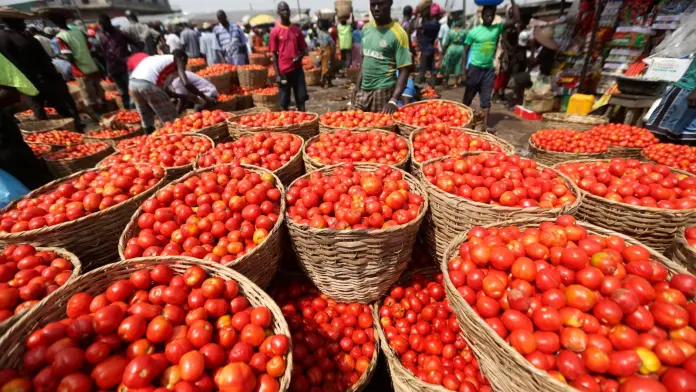
The Food and Beverages Association of Ghana (FABAG) has given the Ministry of Food and Agriculture a firm warning, calling for immediate action to address the country’s tomato supply shortage or risk becoming irrelevant.
In a strongly worded statement released on Monday, FABAG argued that the Ministry’s role is questionable if Ghana cannot produce enough tomatoes within 60 to 90 days.
The Association said it is deeply concerned and disappointed by the crisis, which followed Burkina Faso’s ban on tomato exports.
According to FABAG, the situation highlights serious weaknesses, poor planning, and policy failures in Ghana’s agricultural sector.
It stressed that it is unacceptable for Ghana to rely on another country for a basic food item like tomatoes, especially when the country has significant agricultural potential.
“It is completely unacceptable that a country with vast agricultural land, irrigation dams, agricultural colleges, research institutions, extension officers, and a full Ministry of Food and Agriculture cannot produce enough tomatoes to feed its own population and must depend on another country for such a basic food commodity,” the statement said.
The Association stressed that tomatoes are a short-cycle crop and can be harvested within two to three months under proper conditions.
“It is an agricultural fact, not a theory, that tomatoes can be produced within two (2) to three (3) months,” FABAG noted, adding that “with irrigation and proper seed varieties, tomatoes begin harvesting within 60 to 90 days after planting.”
It argued that any claim that Ghana cannot quickly resolve the shortage amounts to a failure of leadership.
“Therefore, any claim that Ghana cannot solve tomato shortages quickly is simply an admission of policy failure, planning failure, and leadership failure,” the statement added.
FABAG insisted the country has all the necessary resources, including fertile land, irrigation systems, farmers, unemployed youth, research institutions, and access to inputs and mechanisation.
“If after all these resources, Ghana still cannot produce tomatoes to feed its people, then the problem is not farmers, not land, not climate, but the problem is leadership and policy direction,” it said.
The Association warned that reliance on imports poses a national security threat.
“Depending on another country for a basic food item like tomatoes is not just an agricultural issue but a national security risk,” it cautioned.
FABAG is calling for immediate emergency measures, including a national tomato programme, rapid seed distribution, subsidised inputs, activation of irrigation schemes, youth mobilisation, and support for processing and storage.
It also wants Ghana to achieve tomato self-sufficiency within one year.
FABAG maintained that the time for action is now.
“The time has come for Ghana to move from policy speeches to food production results,” it said.
It concluded with a clear ultimatum to the Ministry.
“If within two to three months the Ministry cannot organise tomato production under irrigation across the country, then the government must seriously consider restructuring the Ministry into a Production-Focused Agricultural Authority with clear targets and accountability.”