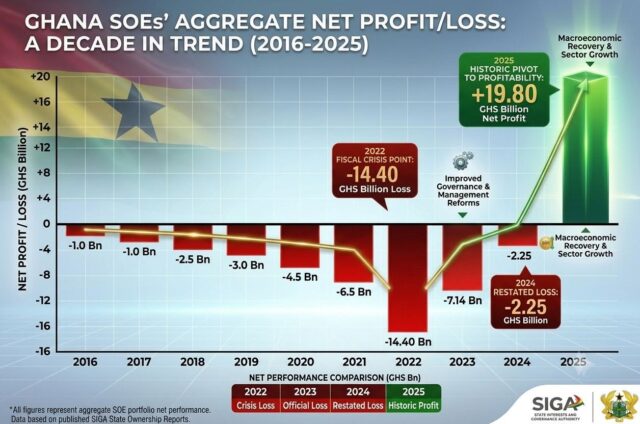
The headline number is a showstopper. For the first time in four years, Ghana’s State-Owned Enterprises (SOEs) broke their cycle of cumulative losses, posting a consolidated net profit of GH¢19.80 billion in 2025.
Out of the State Interests and Governance Authority (SIGA), the narrative is one of structural victory. Total revenue surged 28.12% to GH¢176.43 billion. More importantly, the growth wasn’t just pumped from the ground; non-energy sectors led the charge, with agriculture up 203.71%, manufacturing jumping 114.74%, and infrastructure rising 92.24%.
It looks, on paper, like the Holy Grail of emerging market public finance: a diversified, profitable sovereign balance sheet.
But look under the hood. A rigorous financial autopsy reveals that the 2025 turnaround was driven less by a sudden mastery of operational efficiency and far more by a volatile cocktail of macroeconomic tailwinds and accounting quirks. Ghana’s wholly-owned state enterprises generated billions in paper profits, yet returned virtually nothing in cash to the sovereign treasury.
If policymakers want to prevent this cyclical windfall from evaporating in the next downturn, they have to separate the operational alpha from the macroeconomic beta.
The Macro Illusion: Alpha vs. Beta
To understand the 2025 rebound, you have to look at the currency markets.
The revenue diversification is real. Historically, upstream oil, gas, and mining accounted for four-fifths of SOE turnover, but by 2025, non-energy industries expanded to 40.7% of total portfolio revenue. Agriculture hit GH¢8.50 billion via commercialized off-take ventures, and manufacturing scaled to GH¢14.60 billion.
But the bottom line is a different story. SOEs booked GH¢11.72 billion in net foreign exchange gains, reversing a catastrophic GH¢12.01 billion FX loss from 2024. That single macroeconomic variable, the cedi’s stabilization, accounts for a massive GH¢23.73 billion positive delta.
Meanwhile, net finance costs dropped 42.49%, largely reflecting monetary policy rate cuts and domestic debt restructuring pauses rather than aggressive corporate deleveraging. The harsh reality: more than half of the headline earnings turnaround is an unearned dividend of broader macroeconomic stabilization.
The Sovereign Dividend Paradox
If you want to understand where public sector capital goes to die, look at the cash flow. The SIGA data reveals a glaring performance chasm between entities run directly by the state and those run under private commercial management.
Despite generating nearly GH¢20 billion in profit on paper, Ghana’s 53 wholly-owned commercial SOEs remitted a negligible GH¢16.00 million in cash dividends to the state, a 29.4% drop from the prior year. Only two entities, TDC Development Company and Ghana Reinsurance, wrote a check to the treasury. The rest swallowed their paper profits to service legacy debt, plug historic deficits, and cover uncollected public receivables.