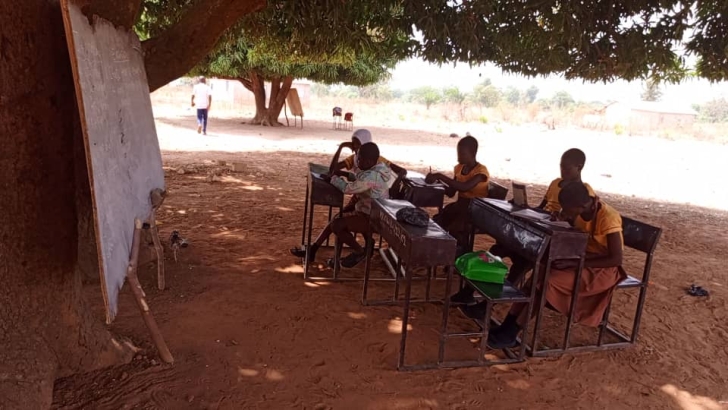
In the heart of the Kpandai District in the Northern Region, students of Mbowura D/A Junior High School do not sit within classroom walls.
Instead, for over a decade, their lessons have taken place under the sprawling shade of mango trees—a makeshift school where education is overshadowed by distractions, dangers, and neglect.
Here, learning is more than just textbooks and chalk—it means dodging crawling reptiles, stray cattle, and harsh weather conditions.

Frustrated future leaders
For these students, the reality of their education is heartbreaking.
“As you can see, we don’t have a school structure. We’ve been sitting under these three mango trees as our classrooms—Form 1 under mango A, Form 2 under mango B, Form 3 under mango C. Our teachers sit under mango D, which serves as their staff common room where they prepare their lessons. This is disgusting for us as future leaders,” one frustrated student lamented in an interview with Graphic Online’s Simon Unyan.
For 11 years, Mbowura D/A JHS has been operating under extreme conditions. Students endure dust storms during harmattan, torrential rains in the wet season, and constant threats of snake bites. Despite these challenges, the school has still managed to produce academically competitive students, many of whom have gained admission to reputable senior high schools across Ghana. However, the lack of proper infrastructure is pushing students away—with enrollment rates steadily declining as parents seek safer alternatives.

An abandoned project, A broken promise
The community once held onto hope when former MP Daniel Nsala Wakpal initiated the construction of a three-unit classroom block with an office and a store. But that hope vanished after the 2024 general elections, as the project was abruptly abandoned following his electoral defeat.
Today, the unfinished structure stands as a stark reminder of broken promises and political neglect. For students, it is not just about a lack of classrooms—it is a symbol of a system that has failed them.
The ICT gap: A digital divide that deepens
While digital literacy is now an essential part of modern education, Mbowura D/A JHS remains excluded from this reality. With no classrooms, no computers, no electricity, and no basic ICT materials, students are missing out on skills that their peers in urban areas take for granted.
“It’s unacceptable that a country that prides itself on inclusivity, fairness, and equal opportunities for all still lacks decent structures for its future leaders,” said Sanja Joshua, Chairman of the Parent-Teacher Association (PTA).
“Our children feel unsafe sitting under mango trees where they compete with snakes, endure harsh harmattan winds, and face constant distractions during lessons. We hope that one day our community will also have a modern school building, desks, a computer lab, and proper reading materials.”
Desperate plea for action
Teachers, parents, and students are now making a strong appeal to the former MP, the District Assembly, and key education stakeholders to prioritise the completion of the abandoned project.
The school’s eight teachers continue to sacrifice and educate under difficult conditions, but their morale is fading.
“We believe in the potential of our students, but how do we inspire them when their learning environment is a constant reminder of neglect?” one teacher asked.

A glimmer of hope?
When contacted, former MP Daniel Nsala Wakpal assured that he remains committed to the project.
“Education is my priority, and I hope and pray that once the President confirms his MMDCEs for the various assemblies, I will ensure the project is given due consideration by the assembly,” he stated.
For the students of Mbowura D/A JHS, these words offer a flicker of hope. But after 11 years of waiting, hope alone is not enough.
As Ghana pushes towards Sustainable Development Goal 4—ensuring inclusive and equitable quality education for all—the reality at Mbowura D/A JHS remains a painful contradiction. Beneath the mango trees, Ghana’s future leaders continue to wait—not just for their next lesson, but for a chance at a safe and dignified education.