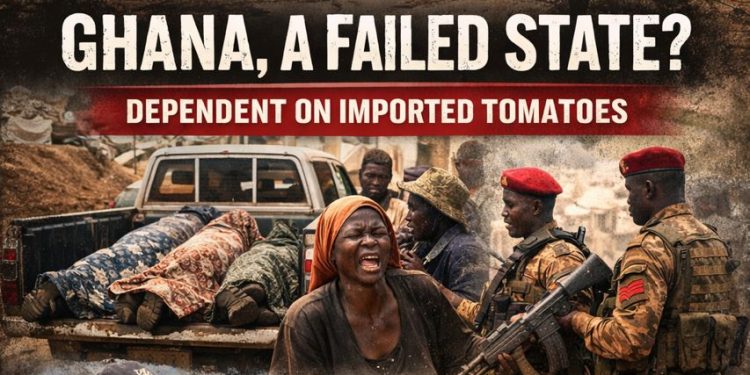
In recent weeks, the painful news of Ghanaian tomato traders being attacked and killed in Burkina Faso has shaken the nation.
These were ordinary traders, struggling to survive, who had travelled outside our borders, simply to buy tomatoes and onions to sell back home.
Their deaths raise a deeper and more troubling question:
How did Ghana get here?
How did a country blessed with fertile lands, rivers, and hardworking farmers become so dependent on food imports that its citizens must risk their lives in foreign lands just to trade in tomatoes?
A Nation Rich in Land, Poor in Policy
Ghana is not a desert. We are not surrounded by endless sand. We are blessed with forests, valleys, rainfall, and water bodies such as Lake Volta.
Yet today, our rivers are turning into muddy pools. Our farmlands are neglected. Our irrigation systems are broken or non-existent. Our farmers struggle without proper support, storage, and markets.
Ironically, we now depend heavily on food from countries with harsher climates than ours.
This is not nature’s failure.
It is a leadership failure.
Why Should We Import What We Can Grow?
Tomatoes.
Onions.
These are crops that should be grown in abundance in Ghana.
We have the land.
We have the labour.
We have the market.
So why do we still import them?
Why must traders travel to Burkina Faso to buy tomatoes when farmers in Navrongo, Keta, and Afram Plains could be producing enough for the entire country?
The answer is simple:
We have abandoned agriculture.
The Human Cost of Neglect
This failure is not just about statistics and policies.
It is about lives.
Those traders who died in Burkina Faso did not die because they were careless. They died because the system pushed them there. Survival forced them to cross borders in search of what their own country should have provided.
When citizens must leave home to trade in basic food items, something is fundamentally wrong.
A nation that cannot feed itself is vulnerable.
A nation that exposes its people to danger for survival is failing.
From “Backbone of the Economy” to Broken Promises
For years, leaders have described agriculture as “the backbone of the economy.” But in reality, it has been treated like an afterthought.
As a result, crops rot in villages while cities depend on imports.
This is a national contradiction.
Is Ghana a Failed State?
Ghana is not completely failed.
But in agriculture, we are failing our people.
We are old enough as a nation.
Mature enough.
Educated enough.
We should not be begging other countries for onions.
We should not be importing tomatoes in bulk.
We should not be exporting our suffering.
A serious nation invests in food security.
A responsible nation protects its farmers.
A visionary nation feeds itself.
The Way Forward
If Ghana is serious about development, then agriculture must be revived, not in speeches, but in action.
We need:
Functional irrigation systems,
Guaranteed markets for farmers,
Modern storage facilities, Real support for agribusiness
Protection for local producers
Until then, we will continue to mourn traders who should never have had to leave home in the first place.
Conclusion
The tragedy in Burkina Faso is more than a security issue.
It is a mirror.
It reflects our failure to build a self-sufficient agricultural system.
It exposes our misplaced priorities.
It questions our national direction.
A country that cannot feed itself is not yet free.
Ghana deserves better.
Our farmers deserve better.
Our traders deserve better.
And our future depends on it.
The writer, Isaac Offei, is a Broadcast Journalist with Channel One TV and Citi FM