


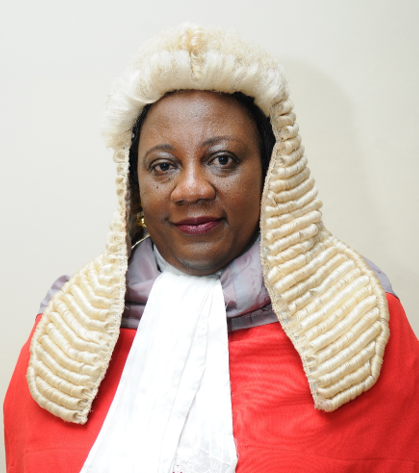
From Bantama to the bench: The quiet power of Justice Rita Agyeman-Budu
By Peter Martey Agbeko
On a warm September morning in 1960, in the city of Kumasi, a fourth daughter was born into the Ayiku family. They named her Rita Amaku Ayiku. Little did anyone know that this young girl, destined for modest beginnings, would grow into one of Ghana’s most respected High Court Judges — a gentle yet firm champion of justice, the rule of law, and the rights of women and children.
Her Ladyship Justice Rita Agyeman-Budu (Mrs.) passed away in July 2025 at the age of 64. Ghana’s legal community and many across the country — both in faith and in law — are still coming to grips with the enormity of this loss. A memorial and burial service was held on November 22, 2025 at the United Church, Teshie-Nungua Estate, attended by colleagues, friends and family from near and far.
Yet, even in death, her legacy endures — etched not just in court records, but in lives changed, rights defended, and a trail of inspiration for future generations.
Humble Roots, Early Promise
Born on September 19, 1960 in Kumasi, Justice Rita was raised by Emmanuel Okutu Ayiku, a Chief Telecommunications Inspector from Big Ada, and Elizabeth Serebour, a trader from Adansi Fomena. As the fourth female child in her family, Rita’s early life was shaped by hard work, modest means and deep community values.
She attended Bantama Methodist Primary School, later proceeding to State Girls Experimental Middle School in Kumasi. Her academic promise earned her a place at Yaa Asantewaa Girls Secondary School, before she transferred to Mfantsiman Girls Secondary School in Saltpond, graduating in 1978. It was at Mfantsiman that she was formally received into the Methodist Church on May 22, 1977 — a mark of the early faith that would remain central throughout her life.
A Life of Many Beginnings — Journalism, Business, Law
After her school days, Rita began working as a clerk at the Social Security Bank in Suame, Kumasi (1982–1983). In 1984 her life took a joyful turn when she married Kwame Agyeman-Budu, the love of her life. A week after her 24th birthday, she gave birth to her first child, Kwaku Agyeman-Budu (Pappy) — now a distinguished academic and Dean of the Law School at GIMPA. The couple’s second child,Nana Sarpong, arrived in 1987; a third child, Yaw Twumasi (Agya Yaw), came in December 2002, two decades after her first.
Putting education briefly on pause to raise a young family, Rita re-emerged in the late 1980s with renewed determination. She enrolled at the Ghana Institute of Journalism (GIJ) and graduated in June 1991 with a Diploma in Journalism — earning the Agostinho Neto Prize as the Best Student in English.
Though her career as a journalist was brief, it stirred in her a love for justice, fairness and a deep empathy for the marginalised.
Determined to broaden her horizons, she and her husband established RAKAB Ventures — a supermarket chain in Teshie-Nungua that served the working class and became a certified Unilever distributor. While managing the business and raising children, Rita’s ambitions grew ever larger.
By the late 1990s, she passed the Final University Examination (FUE) and enrolled at the University of Ghana, studying English, Sociology and Russian. Living at Sarbah Hall, she graduated with a BA in 1997, then went on national service with the National Youth Council in Accra (1997–1998).
Inspired by her husband — a lawyer — Rita went further and, in 1998, entered Ghana School of Law. Despite the demands of raising a family and working, she was called to the Bar in October 2004. Her journey had come full circle: from clerk, to journalist, to entrepreneur, to fully qualified lawyer.
On the Bench — A Quiet Force for Justice
Rita’s service with the Judicial Service of Ghana began formally in April 1999. She initially worked in administration and rose to become Chief Registrar, but her heart was always drawn to justice. On January 2, 2008 she was appointed a District Magistrate. A few months later she was transferred to the Tema White House District Court — a place she would soon call home.
By July 2011, she was elevated to Circuit Court Judge, and in 2014 she was transferred to the Gender-Based Violence Court in Kumasi — becoming one of the pioneer judges of that court, established under a UNDP-supported pilot.
In recognition of her dedication and legal acumen, she was promoted to theHigh Court bench in July 2016, assigned to Tema High Court C (Land Court), and later to Gbetsile High Court when it was established in October 2023. Even then she continued to sit at Tema courts, ensuring continuity and delivering judgements until her untimely death in July 2025.
Her colleagues remember her not only for her calm demeanour and quiet strength but for an unwavering commitment to dispense justice without fear or favour.
A Champion for Women, Children — And a Voice for the Voiceless
It was perhaps her early training in journalism and her inherent empathy that led Justice Rita to deepen her advocacy for women’s rights and equal access to justice. In 2013, she became Assistant Secretary of the International Association of Women Judges (IAWJ), Ghana Chapter; by 2016 she was elected Secretary, then Vice-President in 2018 — and in September 2022 ascended to becomePresident of the Ghana Chapter, a position she held until her passing.
Under her leadership, Ghana hosted the 18th IAWJ Africa Regional Conference in May 2024, under the theme “Combatting Negative Cultural Practices in Africa: The Role of Women Judges.” The conference welcomed judges from across the continent and underscored the vital role of women on the bench in dismantling harmful traditions that undermine the rights of women and the girl-child.
But Chairing conferences was not enough for her. In 2014, she wrote a powerful drama titled“A Call for Justice”, produced under the IAWJ umbrella. The film, adapted for television, was aired on Ghana Television (GTV) and helped raise public awareness about the barriers women and girls face when seeking redress for gender-based violence.
That drive to give voice to the voiceless, to bring the marginalised into courtrooms, and to ensure fairness even when the odds appeared to be stacked — that was who Rita was in her deepest essence.
Faith, Family — Foundations of Her Strength
Behind every robe, every judgement, every public role was a woman of deep faith and devotion. Rita’s Christian faith traced back to her childhood.
Originally a Methodist — baptised at Bantama in 1961 — she formally joined the Methodist Church at Mfantsiman in 1977. After her marriage in 1984 to Kwame Agyeman-Budu (a Presbyterian), they became founding members of the ICGC Sakumono branch, later relocating to Calvary Temple on Spintex Road, Accra.
In later years, she worshipped with the United Church at Teshie Nungua Estate, where she served as Elder, Chairperson of the Constitution Review Committee, and Patron of the Church Choir — roles she fulfilled with the same dignity, humility and sense of service that marked her judicial life.
Even while studying abroad for her LL.M in New York, she worshipped at Grace United Methodist Church in Valley Stream, and remained an active Christian leader.
For her husband, Kwame, she was more than a partner — she was mother to all his children, even those from a previous marriage, building a home filled with love, discipline, hope, and faith. Through the years of trials — including the difficult time when her husband was tried and acquitted in 1986 — she stood firm, praying, supporting, and keeping the light on when the world seemed dark.
Their son, Dr Kwaku Agyeman-Budu, known to many APSUnians, often recounts how she was his constant champion — travelling from Accra to Cape Coast as he began secondary school at St. Augustine’s College (Augusco); nursing him back to health during hospitalisations; cheering him on at every academic milestone; and celebrating his appointment as Dean of GIMPA Law School with pride only a mother could show.
In her, he saw not only a parent — but a mentor, a guide, and a living example of grace, strength, and faith. Significantly, she did the same for his other siblings, as highlighted in their individual tributes captured in the funeral brochure.
A Life That Spoke Softly — But Echoes Loudly
Those who knew Justice Rita Agyeman-Budu best describe her as gentle, soft-spoken and gracious. Yet beneath that calm exterior lay an unshakeable commitment to justice, fairness, dignity and truth. She never sought to demean others — instead, she lifted them, listened to them, made them feel seen.
Her style was impeccable, not for vanity, but to reflect the dignity she believed every human being deserved. Her decisions were measured; her judgements delivered with fairness, respect and compassion. Even as she rose to prominent judicial and international positions, she retained her warmth, her humility, and her readiness to mentor and support others.
In her three decades of public service — from the dusty files of a clerk’s desk in Kumasi to the polished wooden benches of Accra’s High Court — Justice Rita stood for something far bigger than herself. She stood for equal access to justice, for dignity, for truth. She stood for the voiceless.
Gone Too Soon — But the Flame Lives On
Her sudden passing in July 2025 sent shockwaves through Ghana’s legal, faith and women’s justice communities. Tributes poured in from colleagues, from the IAWJ in Ghana and abroad, from church members, friends, family — and from many whose lives she had touched, often quietly, without fanfare.
As the IAWJ Ghana Chapter noted, her name is “etched in honour, a judicial flame,” a beacon of hope for women judges, for vulnerable women, for justice itself.
Her life reminds us that great impact does not require loudness — sometimes, the softest voice, cloaked in robes of dignity and compassion, can speak the loudest truths.
Her Ladyship Justice Rita Agyeman-Budu may have left the bench, but the scales of justice she held — firmly, compassionately, fairly — remain balanced in her memory.
Rest peacefully in the bosom of the Lord