

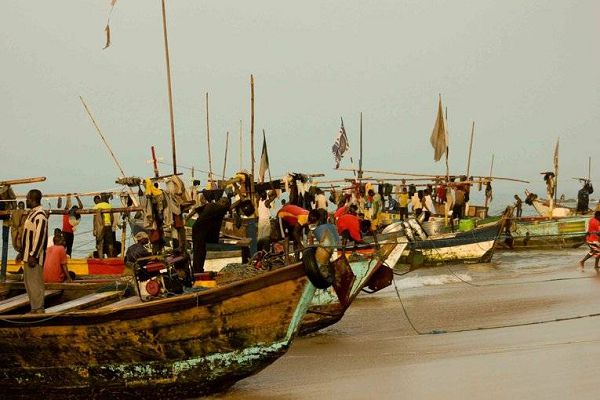
Enhancing canoe safety and connectivity – Using the Alon device
Overview
OVER the years, enhancing the safety and security of fishers has dogged stakeholders in Ghana’s fisheries and maritime domain, particularly when United Nations Food and Agriculture Organisation (FAO) estimates that, globally, about 3,200 fishers die yearly.
For generations, fishing has sustained communities and local economies but this lifeline is under grave threat, Environmental Justice Foundation (EFJ) notes, adding that about 300 Ghanaian fishermen lose their lives yearly due to unsafe working conditions.
Undoubtedly, fishermen have encountered situations whereby their canoes have capsised, sometimes getting missing due to bad weather or even face deaths during expeditions.
The situation is more worrying especially when data on fatalities are not forthcoming because fishers refused to report deaths at sea. They will only report when they trust that compensation will be paid by “bigger companies”.
The Alon safety device
To help curb these mishaps, Friends of the Nation (FON), in collaboration with the Fisheries Commission, the Ghana Canoe Fishermen Council (GNCFC) and others, have introduced the Alon safety device.
The device is technology-driven and satellite-based, designed to improve fisher safety, promote regulatory compliance and strengthen governance within Ghana’s artisanal fisheries sector.
Again, the solar-powered device enables continuous real-time tracking of artisanal fishing canoes, ensuring owners, investors and regulators have full visibility into fishing expeditions.
The Alon tracking device is installed on fishing canoes where crew members(s) will connect to the device via Bluetooth. Each canoe fitted with the device can send signals about where the canoe is at any time.
“The information goes to a system called SkyTracker, which shows the canoe’s location on a map. Up to three emergency contacts are linked to the device to provide timely alerts and reassurance when fishers are at sea,” Project Officer, FON, Philip Prah, explains.
He adds that Chief Fishermen and local Fisher Associations, including the Ghana National Canoe Fishermen Council (GNCFC) and the Canoe and Fishing Gear Owners Association of Ghana (CFGOA), also receive access, allowing them to monitor canoe activities within their communities.
Interestingly, with the Alon device, he reveals that information on fishers and canoe movements are received through alerts and real-time updates.
Canoe owners, relatives and chief fishermen could connect on their smart Android phones via the Adarna app to send and receive messages/alerts with the respective device installed on the canoe.
“The device transmits data to SkyTracker, which provides real-time activity recording the canoe’s location and other activities on a digital map accessible to stakeholders, and use the information to strengthen maritime safety, enforce fisheries regulations, and support effective resource management,” Mr Prah adds.
Another good news is that the new technology provides regulators real-time updates to enhance policy formulation, monitoring and enforcement.
FON and the Academia could also monitor offshore movements and activities of canoes to influence policies, inform advocacy and research.
Clearly, the benefits of safety at sea span families and communities, thereby promoting participatory processes, monitoring and transparency that erode suspicions and mysteries during fishing expeditions.
There is also improved governance on data on expeditions, Mr Prah reiterated.
Overall, he asserted that the Alon device empowered families and local communities, contributing to the protection of lives at sea, safeguarding and the sustainability of Ghana’s fisheries in the emerging blue economy.
Milestones
Milestones chalked so far include awareness creation to sensitise canoe owners, crew members and fisher associations on fishing safety, rights and occupational health.
Further, Mr Prah reported that together with the Fisheries Commission, 10 devices had been deployed and are currently being piloted in seven communities across the four coastal regions — Axim, two; Dixcove, two; Shama, two (Western Region); Elmina, one; Senya Beraku, one (Central Region); Lekpogunor, one (Greater Accra); and Vodza, one (Volta Region).
Stakeholder engagements have also been strengthened while fishers’ response has been positive, building trust and promoting a sense of partnership.
Kenneth Arthur, a fisherman, commented that “safety issues have become paramount and we need to go with the Alon device to secure fishers at sea.”
Simon Kwaw, also a fisherman from Lekpogunor in the Greater Accra Region, believed the Alon device had offered solace and helped fishing crews a lot in terms of catch data recordings, monitoring or tracing exact fishing spots for future expeditions, reduced fishing efforts and fuel wastage.
According to the Western Regional Director of Fisheries, Dr Charles Teye, the Fisheries Commission is currently focusing on education and sensitisation to encourage fishermen and boat owners to voluntarily adopt these safety measures rather than wait for enforcement.
Challenges
These include text messaging limitations whereby many fishers find it difficult to communicate effectively using the text-based Adarna app integrated into the device due to low literacy levels and the impracticality of typing at sea.
Conclusion
Happily, the FON’s approach reflects the United Nations Development Programme’s (UNDP) belief that strong institutions, transparency and inclusive leadership are key to delivering climate solutions.
Writing on the COP30 held in Belem, Brazil, recently, the organisation emphasised that climate change is not only an environmental issue, stressing that “Effective governance is critical to implementing effective solutions.”
UNDP continued: “Climate change is a multidimensional challenge that intersects with governance at every level. Effective governance determines how communities prepare for, respond to and recover from climate impacts. It shapes policy decisions, resource allocations and the inclusion of marginalised voices in climate action.”
Clearly, with the Alon device, FON and partners have demonstrated a renewed focus, a sense of connectedness, responsible participation and a shared choice to confront the future with science and technology.
We pray for success for the project and the sustainability of the blue economy in Ghana.
BY CLEMENT ADZEI BOYE