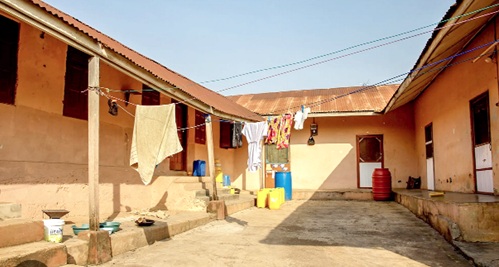
Like many children who grew up in peri-urban communities in the 1970s, 1980s and even into the mid-1990s, I spent my formative years in a compound house.
It was the typical living arrangement in many parts of Ghana.
Looking back now as an adult, I recognise that compound houses did not always guarantee full privacy for families.
Perhaps that is why modern housing arrangements—self-contained houses and apartments—appear more attractive toda
Privacy has become one of the most prized features of contemporary living.
Yet my experiences over the years have given me a broader perspective.
From growing up in a compound house with semi-shared facilities in my formative years to living in government bungalows during my early working life and eventually renting self-contained all-ensuite houses, I have come to appreciate more clearly the unique advantages that compound house living offered.
Yes, privacy in compound houses could sometimes be limited and, at times, overwhelming.
But the social richness of that environment created experiences that modern housing often struggles to replicate.
A typical compound house consisted of several households living around a shared courtyard and using common facilities such as bathrooms, toilets and sometimes kitchens.
Life in such an environment was deeply communal.
One of its greatest strengths was the sense of community it fostered.
Daily life required interaction, and residents came to know one another well. Mornings began with greetings, children played together in the courtyard, and neighbours naturally looked out for one another.
When someone celebrated a wedding, naming ceremony or birthday, the entire compound often felt involved.
When tragedy struck, the same neighbours rallied around the affected family in solidarity.
There was also a culture of shared responsibility.
Because facilities were communal, everyone had a role in keeping them clean and functional.
Of course, this arrangement was not always without tension.
In almost every compound there was that one mysterious resident who somehow never noticed the cleaning roster pinned to the wall.
Saturday mornings sometimes turned into small “United Nations meetings” as tenants debated who had skipped their turn to clean the washroom.
At the time such disputes could be irritating, but they later became part of the humour and nostalgia of compound house life.
Security
Security was another quiet advantage.
With many people living in close proximity, there was almost always someone around.
Strangers were easily noticed, children could play freely under the watchful eyes of multiple adults, and the elderly were rarely left alone.
In many ways, the compound functioned like a small protective village.
Compound houses were also affordable.
Compared with modern apartments or standalone homes, the cost of living was far lower, making housing accessible to many families with modest incomes.
Perhaps most importantly, compound houses created a natural social support system.
Neighbours often became extended family.
Food was shared, ingredients borrowed and children watched over when parents needed to run errands.
In difficult moments, support came not only from relatives but from everyone within the compound.
Even today, many of us who grew up in such environments still refer to former co-tenants as brothers, sisters, uncles or aunts.
When they lose a loved one, we attend their funerals.
The bonds forged in those courtyards were real and lasting.
For children especially, compound houses offered something modern housing sometimes struggles to provide—community.
There were always playmates, and the courtyard doubled as an informal classroom where advice, discipline and life lessons came from many adults.
One person I remember vividly from those days was a co-tenant, Opanin Tutu, of blessed memory.
I was probably between nine and twelve years old at the time.
Opanin Tutu was a veteran of the Second World War.
In the evenings he would sometimes sit with us in the courtyard and recount stories from the battlefield.
For us children, those stories sounded like tales from a distant and almost unimaginable world.
He spoke about the harsh winters of Europe and the difficult conditions soldiers endured.
He often mentioned Burma, where fierce battles were fought involving forces of the British Empire, China and the United States against Japan.
His stories were both fascinating and chilling.
He described soldiers marching through mud and rain in bone-splitting cold and merciless winds until their frost-ravaged feet swelled grotesquely inside their boots, their legs ballooning beyond the leather as the cruel foreign winter gnawed at flesh and spirit alike.
He spoke of the thunder of artillery, the whistle of bullets slicing through the air and the fear that accompanied every step forward.
Curiosity
One day curiosity got the better of me.
“So when you captured enemy soldiers,” I asked innocently, “did you kill them yourself?”
His response stunned me.
“Why shouldn’t I kill you?” he replied calmly. “Are you my brother?”
The bluntness of that answer shocked my young mind.
In that moment I caught a glimpse of the brutal reality of war—how it strips away the comforts of morality and pushes human beings into unimaginable situations.
Since then, the horrors of war have remained etched in my mind, even if only from a distance.
The closest many of us have come to a war zone is through films or television documentaries.
Yet even watching those scenes—the explosions, the chaos and soldiers diving for cover—I sometimes shudder.
Against the backdrop of those haunting memories, it is deeply troubling that young Africans today are voluntarily entering a modern battlefield.
Reports indicate that thousands of Africans are fighting for Russia in the ongoing Russia–Ukraine War, and many have died within days or even hours of arriving at the frontlines.
The numbers are alarming. About 1,780 young Africans from 36 countries are believed to be fighting in the conflict.
Ghana has not been spared.
The Minister of Foreign Affairs, Samuel Okudzeto Ablakwa, recently disclosed that at least 55 Ghanaians have been killed in the war, with two others currently being held as prisoners of war.
He also revealed that about 272 Ghanaians are believed to have been lured into the conflict since 2022.
Behind these numbers are real human lives, shattered dreams and grieving families.
In one particularly heartbreaking case, snippets of information indicate that at least one of the Ghanaians who died was reportedly a policeman who had resigned from the service in search of greener pastures abroad.
Life, however, did not turn out as he had hoped. Faced with disappointment and hardship, he eventually joined the battlefield for the Russians.
What a tragic turn of events.
Blown apart
A man who once served to protect lives ended up losing his own life on a distant battlefield, far away from home and family.
One cannot help but wonder whether better information and guidance might have saved him.
Even more horrifying are reports that many who die on the battlefield are blown apart by artillery and explosions, leaving bodies torn into pieces—sometimes with nothing meaningful left to retrieve or bury.
It is a chilling thought.
Young Africans—our brothers, sons and future leaders—reduced to fragments on foreign soil.
Why should our most precious human resource be crushed on distant battlefields simply because they feel they have no hope of building a future at home?
Governments across Africa must strengthen monitoring of recruitment networks that lure citizens into foreign conflicts.
Public education campaigns must warn young people about the dangers and deception involved.
Equally important is addressing the root causes—youth unemployment, economic frustration and the search for opportunity abroad.
If young people have hope and opportunity at home, the temptation to gamble their lives on distant battlefields will diminish.
The stories I heard as a child from Opanin Tutu were meant to be memories of a war fought long ago.
Sadly, for many young Africans today, those same horrors are becoming a present-day reality.
And that is something we must urgently work together to prevent.