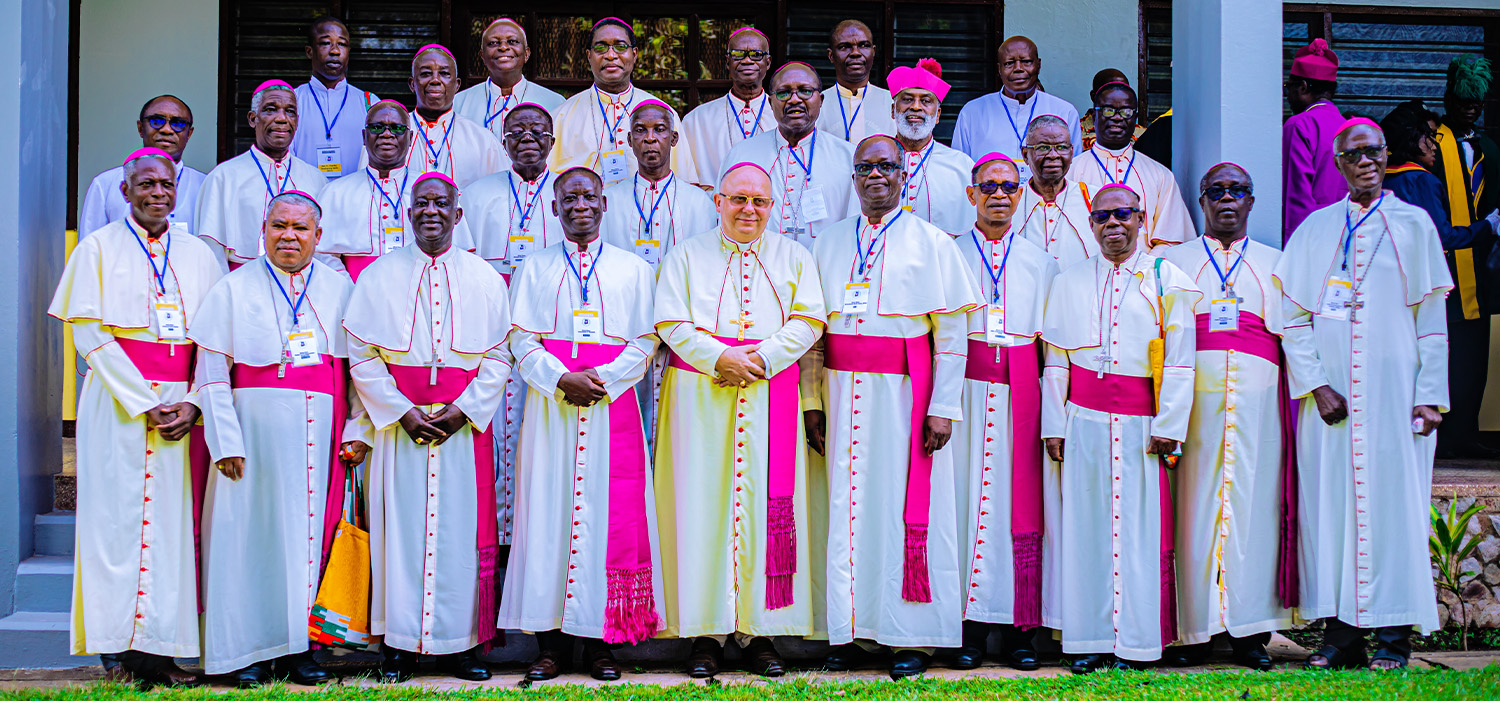
The Ghana Catholic Bishops’ Conference has called for a serious national discussion on family values and LGBTQ issues, warning against any attempt to treat the debate as unimportant.
In a statement issued on Friday, April 10, and signed by its President, Most Rev. Matthew Kwasi Gyamfi, the Conference responded to recent comments attributed to President John Dramani Mahama and Government Communications Minister Felix Kwakye Ofosu about the relevance of LGBTQ+ and family values discussions in Ghana.
The Bishops said they were speaking both as religious leaders and concerned citizens, with the aim of strengthening not weakening national dialogue on the issue.
They pointed to remarks reportedly made by President Mahama at the World Affairs Council, where he described LGBTQ+ matters as “not the most important issue” facing the country.
They also referenced comments by the Communications Minister suggesting the issue is “not a major priority” for Ghanaians and a “waste of time.”
While acknowledging that these statements may have been meant to highlight pressing economic challenges, the Bishops cautioned that such views could downplay the moral and social importance of the issue.
“Even if intended to prioritise urgent socio-economic concerns, such descriptions risk conveying that certain moral questions may be set aside as inconsequential. Yet no question that touches the structure of human identity, family life, and social continuity can be trivial. Nations do not live by bread alone. They are sustained also by the invisible architecture of values,” the statement said.
Addressing Ghana’s socio-economic challenges, including inflation, unemployment and gaps in public services, the Bishops said they recognised the pressures facing government and citizens but rejected what they described as a false separation between economic development and moral responsibility.
“We readily acknowledge the weight of Ghana’s present challenges,” the statement read. “However, it is analytically unsound to frame a choice between economic progress and moral coherence. The two are not rivals but companions.”
The Conference further argued that stable family structures contribute to improved educational outcomes, reduced crime rates and greater economic mobility, describing the family as a critical pillar of social stability.
Reaffirming its position on marriage and family life, the Bishops stated that for many Ghanaians, the debate is rooted in deep cultural and religious convictions.
“By ‘family values,’ we refer to the understanding of marriage as a lifelong union between one man and one woman, ordered toward mutual good and the procreation and formation of children,” the statement explained.
They added that “the family is the first school of virtue and the seedbed of civic responsibility,” warning that “when the family flourishes, society finds coherence. When it fractures, social costs multiply, often silently, often generationally.”
The Bishops also emphasised what they described as two inseparable moral principles: the dignity of every person and the traditional understanding of marriage.
“First, the inviolable dignity of every human person. No individual, regardless of sexual orientation or identity, may be subjected to violence, hatred, or unjust discrimination. Such acts are moral failures and social wounds. We condemn them without reservation. Second, the legitimate responsibility of society to uphold and protect the institution of the family, founded upon the union of a man and a woman,” the statement said.
The Conference further addressed the Human Sexual Rights and Family Values Bill, noting that it had closely followed its progress through Parliament. It recalled what it described as a prior assurance from the President regarding assent to the bill.
“Should Parliament complete its deliberations and pass the bill, we urge the president to honour this assurance,” the statement said.
At the same time, the Bishops acknowledged concerns surrounding the legislation, stressing that such issues require careful legislative scrutiny and possible refinement to ensure the law reflects both the moral convictions of Ghanaians and constitutional commitments to human dignity and fundamental rights.
Urging restraint in public discourse, the Bishops warned against dismissing sensitive moral debates.
“To describe such a debate as a ‘waste of time’ risks alienating citizens for whom these issues are existentially meaningful,” the statement noted.
They called on the executive, legislature, religious leaders, traditional authorities and civil society to engage in dialogue marked by intellectual seriousness, mutual respect and moral clarity.
“Words can either build a republic of trust or fracture it into suspicion,” the statement added.
Concluding the statement, the Bishops said Ghana stands “at a delicate intersection where economic aspiration meets moral self-definition,” warning that decisions taken today will have lasting generational consequences.
They prayed that the nation be guided by wisdom and justice, entrusting Ghana to “the intercession of the Blessed Virgin Mary and Saint Joseph,” and ending with the blessing, “May God bless our homeland Ghana and make her great and strong.”