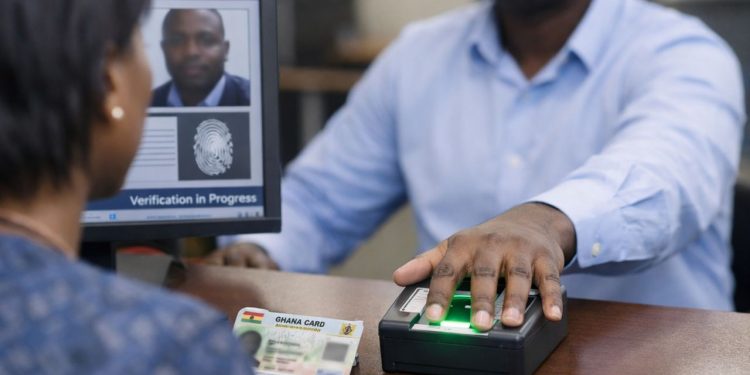
The Bank of Ghana (BoG) has issued a revised Supervisory Guidance Note that firmly establishes the Ghana Card as the primary, and in most cases, the only acceptable form of identification for financial transactions in the country.
The new directive, which takes immediate effect, replaces the earlier guidance issued in June 2022.
It underscores the importance of the National Identity Authority (NIA) database in strengthening Know Your Customer (KYC), Customer Due Diligence (CDD), and Anti-Money Laundering (AML) measures across Ghana’s financial sector.
Under the revised guidance, all BoG-licensed and regulated financial institutions are required to use the Ghana Card as the sole identification document when onboarding customers.
This applies to Ghanaian citizens, permanent residents, ECOWAS nationals living in Ghana, as well as foreign directors or shareholders who are signatories to accounts.
Financial institutions must carry out biometric verification using the features embedded in the Ghana Card and update customer records directly from the NIA database.
Where discrepancies arise, core personal details such as name, date of birth, and nationality must be corrected through the NIA, while secondary information like phone numbers and residential addresses may be updated through internal institutional processes.
The guidance introduces stricter controls for mobile and internet banking services, citing increased risks related to money laundering and terrorist financing.
Financial institutions are no longer allowed to apply a risk-based approach at the onboarding stage.
Instead, full biometric verification, including liveness checks, is now mandatory for all digital onboarding processes.
For third-party and other non-face-to-face transactions, biometric verification is also compulsory.
Institutions must keep detailed records of both the individual who conducted the verification and the transaction itself.
Existing customers may be managed using a risk-based approach; however, financial institutions are required to continuously update customer information using data from the NIA.
Customers who do not possess a Ghana Card or an approved alternative form of identification for non-citizens or refugees will not be permitted to carry out financial transactions.
Foreign non-residents who have been in Ghana for fewer than 90 days may only conduct limited one-off transactions, such as remittances or ATM and POS transactions.
These must be done using a valid international passport along with additional KYC checks.
Diplomats and their dependents remain exempt and may continue using diplomatic passports or identity cards.
The guidance also explains how institutions should handle failed or “no match” biometric verifications.
These include escalation procedures, alternative verification methods, and the use of offline tools such as MECO devices during system downtimes.
Financial institutions are required to properly document verification failures, notify the NIA when necessary, and assist customers in correcting any identity inconsistencies.
According to the Bank of Ghana, the revised guidance is intended to strengthen the integrity of the financial system by ensuring consistent identity verification, reducing fraud, and enhancing compliance with AML and Counter-Financing of Terrorism (CFT) requirements.
By placing the Ghana Card at the centre of financial transactions, the directive marks a significant step toward tighter regulatory oversight and deeper integration of Ghana’s national identity system within the banking and financial services sector.