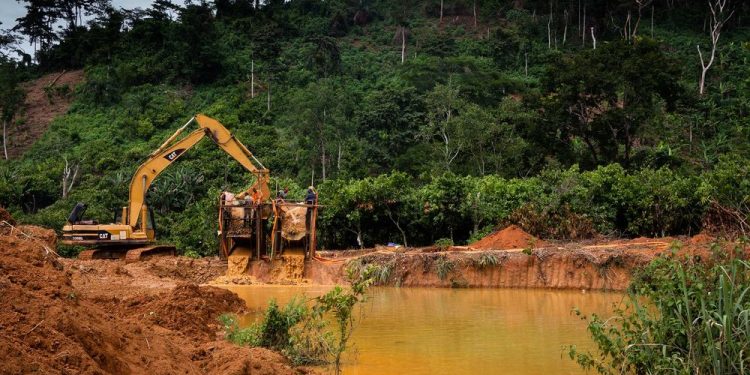
In November 2022, the erstwhile Akufo-Addo administration passed a Legislative Instrument, L.I. 2462, which allowed mining in Ghana’s forest reserves. The Environmental Protection (Mining in Forest Reserves) Regulations, 2022 (L.I. 2462), outlined statutory procedures for mining in production forest reserves and granted the President the authority to approve mining leases in these protected areas.
The move immediately sparked criticism from civil society organisations, environmental groups, and sections of the public, who argued that the regulation could be abused by license holders and open the door for illegal miners to encroach on forest reserves. Critics warned that the policy weakened existing protections and risked accelerating environmental destruction.
In practice, the regulation deepened concerns around forest protection, as illegal miners increasingly invaded reserves, leading to the destruction of farmlands, degradation of water bodies, and increased safety risks in affected communities.
Ahead of the 2024 general elections, then presidential candidate of the National Democratic Congress, John Dramani Mahama, pledged to repeal L.I. 2462 if elected. On Wednesday, December 10, 2025, the John Mahama administration followed through on that promise, revoking the regulation through the Environmental Protection (Mining in Forest Reserves) Revocation Instrument, 2025.
What does this mean?
The revocation of L.I. 2462 removes the President’s power to grant mining leases in forest reserves, effectively tightening Ghana’s mining framework around protected areas. It closes the avenue that allowed mining in forest reserves through executive approval, a development critics had long linked to the spread of illegal mining and environmental degradation. In effect, forest reserves are once again clearly defined as no-go areas for mining activities.
Impact on the fight against galamsey
The John Mahama–led administration has come under criticism over its handling of the fight against illegal mining, popularly known as galamsey, particularly as farmlands continue to be destroyed and forest reserves encroached upon. Against this background, the revocation of L.I. 2462 is being seen as a clear policy shift, removing the legal basis that previously permitted mining activities in forest reserves under executive authority.
Out of Ghana’s two hundred and eighty-eight forest reserves, more than fifty were reported to be under severe threat from illegal mining. Government says nine of these have since been reclaimed and cleared of illegal miners.
However, the repeal of L.I. 2462 does not by itself stop illegal mining in forest reserves. What it does is eliminate any legal justification for mining in these areas, making such activities clearly unlawful. This provides a clearer legal basis for enforcement agencies to act against offenders operating within forest reserves. At the same time, the continued presence of illegal miners in some reserves highlights that the galamsey problem goes beyond legislation, as mining has persisted even in areas where no permits were ever issued.
Civil Society reaction
Seventeen civil society organisations, including the Coalition Against Galamsey-Ghana, A Rocha Ghana, and Eco-Conscious, have commended government for revoking L.I. 2462. The groups describe the repeal as “one of the most significant and progressive legislative reversals in Ghana’s recent environmental history.”
The groups, however, say additional measures are needed to safeguard the environment. Among other recommendations, they are calling on government to:
• Review Act 703 to explicitly prohibit mining in forest reserves.
• Develop and implement a National Forest Protection Strategy in collaboration with national and international partners.
• Roll out a well-coordinated “Tree for Life” programme targeted at forest reserves.
• Urgently strengthen the capacity of the Forestry Commission to respond to emerging threats to forest sustainability.
Government’s plan moving forward
The Minister of Lands and Natural Resources, Emmanuel Armah-Kofi Buah, has assured of government’s continued commitment to environmental protection. Speaking on Eyewitness News on Citi FM on December 19, 2025, the minister acknowledged the legal challenges government faces in dealing with companies already licensed to mine in forest reserves.
“We need to really go into these matters because there are legal implications for some of the issues that have been raised. We are saying that going forward we’re going to make sure we don’t give license for people to enter our forest reserves; but we’re also aware that we’ve tied ourselves in legal obligations with companies already that have serious consequences for our country. So we have to juggle that fine line in making sure that we don’t renege on legal commitment that we would put our country at risk and so we’d be guided,” he said.
The minister added that government remains focused on strengthening environmental protection laws.
“One of the things we’ve done this year is to travel extensively across the country to review Act 703 and revamp a policy that has been in place since 2014. By the first quarter of next year, we will be going to Parliament to reform and strengthen Act 703, learning from past weaknesses, with the aim of improving environmental protection and making our mining laws more transparent,” he stated.
Conclusion
The revocation of L.I. 2462 marks an important step in protecting Ghana’s already fragile forest reserves. However, the move alone is unlikely to address the broader challenges posed by illegal mining. Sustained action, enforcement, and broader legal reforms will be required if the country is to make meaningful progress in reducing the impact of galamsey on the environment.