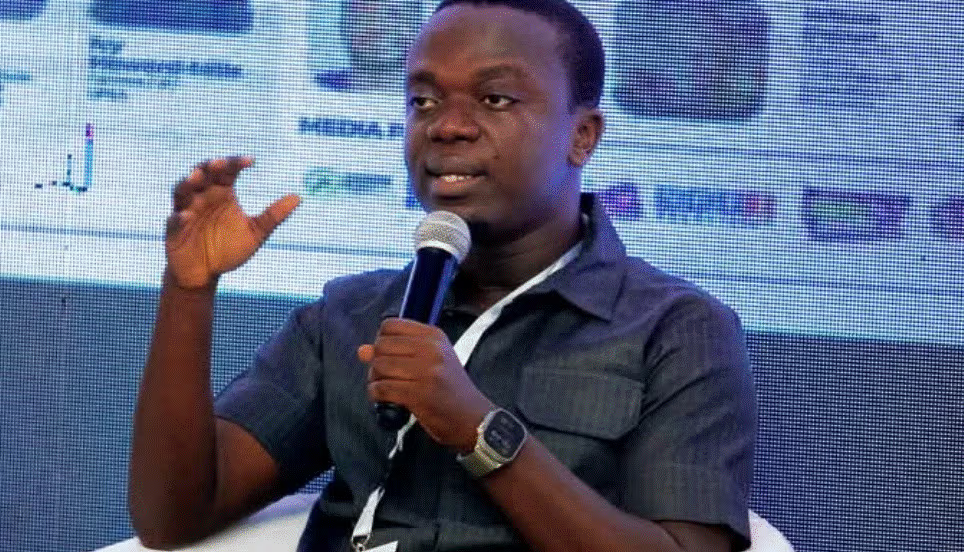
Development Economist and a Senior Research Fellow at the Institute of Economic Research and Public Policy (IERPP), Dr Kwasi Nyame-Baafi, has accused the Bank of Ghana of allegedly attempting to conceal losses arising from its arrangement with the Goldbod.
He expresses the view that the central bank relies on such questionable accounting practices to present its books. This situation places the Bank of Ghana’s auditors, Deloitte, on notice, he said.
As a global audit firm, Dr Nyame-Baafi said that Deloitte must not allow itself to be reduced to a political instrument.
“Its credibility and international reputation are at stake. We will challenge any attempt to misrepresent the Bank of Ghana’s true financial position and will invite scrutiny well beyond Ghana, scrutiny that would severely damage the firm’s standing,” he said in a statement.
His comments follow the clarification that the BoG gave on reports of the losses. The BoG said reports that it made losses due to GoldBod operations are speculative. The IMF had flagged the reported losses as a potential downside risk to Ghana’s broader macroeconomic stabilisation efforts, attributing them to transactions involving artisanal and small-scale mining (ASM) dore gold, as well as what it described as “GoldBod off-taker fees”.
While some structural reforms have faced delays due to their complexity, the report confirms that the macroeconomic environment has improved markedly, it said.
The central bank added that real GDP growth has exceeded expectations, inflation has declined faster than projected into the Bank of Ghana’s target range, and international reserves are expanding steadily.
Tentative data from Bank of Ghana as of mid-December 2025 suggest that international reserves could exceed US$13 billion by end-2025, contributing to rising confidence in the economy, it further said.
“Although the IMF review flagged financial risks associated with the Domestic Gold Purchase Programme(DGPP), it is important, to place these concerns within the broader context of the programme’s significant macroeconomic contribution. The DGPP is a policy tool that has helped shore up Ghana’s international reserves, supported currency stability, and enabled access to large volumes of foreign exchange without incurring new debt. The operational role of GOLDBOD as an aggregator has been important in channelling gold-based inflows from the small-scale mining sector into the official market. This collaborative structure between the Bank and GOLDBOD has ensured that the DGPP remains anchored in public policy objectives.
“The new foreign exchange operations framework introduced by the Bank of Ghana was also highlighted in the IMF report as a critical reform. Designed in line with global best practices, the framework clarifies intervention triggers, separates reserve accumulation from market intermediation, and enhances transparency, all aimed at deepening confidence in FX markets. The functioning of this framework is closely tied to the stability and efficiency of GOLDBOD’s operations, reinforcing the need for continued oversight and operational discipline,” the BoG said.
But Dr Nyame-Baafi in his statement, said “How low can we sink? The Bank of Ghana is allegedly attempting to conceal losses arising from the BoG–Goldbod arrangement through creative accounting in its annual report. If Goldbod is truly the “game-changer” it is being marketed as, why must the central bank rely on such questionable accounting practices to present its books? This situation places the Bank of Ghana’s auditors, Deloitte, on notice. As a global audit firm, Deloitte must not allow itself to be reduced to a political instrument. Its credibility and international reputation are at stake. We will challenge any attempt to misrepresent the Bank of Ghana’s true financial position and will invite scrutiny well beyond Ghana, scrutiny that would severely damage the firm’s standing.”
He added that “The IMF, too, should not look away. Under its safeguards assessment framework, the Fund has a clear responsibility to ensure that the Bank of Ghana’s financial statements accurately reflect economic reality. Accounting manoeuvres that obscure losses strike at the very core of these safeguards and cannot be treated lightly.
“As I write, both the Bank of Ghana and Goldbod have refused to respond to a Right to Information (RTI) request submitted by the Institute of Economic Research and Public Policy in May 2025. That a central bank and an institution vested with monopoly powers over all small-scale gold produced in Ghana can operate with such opacity and apparent impunity is deeply troubling.
“This refusal raises unavoidable questions: What exactly are they hiding? When will they respond? Is it only after public resources have been irreversibly squandered? Transparency delayed is accountability denied. President Mahama must not allow Governor Asiamah and the Goldbod Chief Executive to erode public trust, weaken institutional credibility, or stain his legacy.”