The Ghana Chamber of Mines reaffirms its commitment to working collaboratively with Government to ensure that Ghanaians derive maximum and sustainable benefits from the country’s mineral resources.
The Chamber is not opposed to Government’s objective of securing greater national benefit from mining, particularly in the context of prevailing high gold prices.
However, we are concerned that the proposed amendments, as currently structured, rather than taking advantage of the rising gold price and engendering an increase in output, risk constraining investment expansion and may not deliver sustainable revenues over the long term.
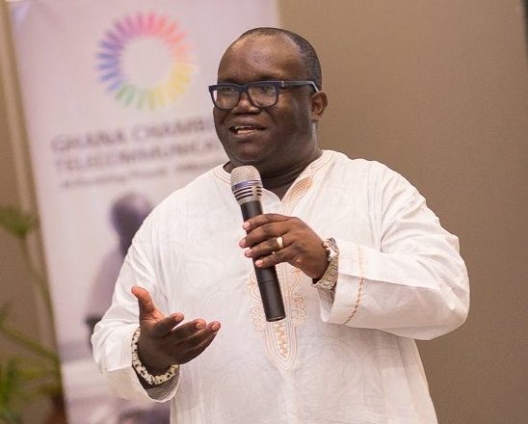
Commenting on a recent Reuters interview by the Chief Executive Officer of the Minerals Commission, the Chief Executive Officer of the Ghana Chamber of Mines, Kenneth Ashigbey, stated: “Our members are not opposed to Government seeking greater returns for Ghanaians, and we understand the rationale behind a sliding-scale approach. What we are advocating for is a sweet spot-one, where Government secures sustainable, increasing revenues for national development while the industry is able to expand, reinvest, and fully take advantage of the current high gold prices. Unfortunately, the current proposal does not strike that balance.”
The Chamber welcomes the continued engagement by the Hon. Minister for Lands and Natural Resources with industry stakeholders, noting that such dialogue is constructive and essential to achieving mutually beneficial outcomes.
“Meaningful consultation is critical to developing a fiscal framework that enhances national benefit without undermining Ghana’s competitiveness as a mining destination,” Ing. Ashigbey added.
Currently, large-scale mining companies in Ghana pay a 3 per cent Growth and Sustainability Levy (GSL). In addition, both royalties and the GSL are applied to gross revenue rather than profits, meaning that operating and capital costs are not taken into account.
Ghana is already positioned at the higher end of the global Average Effective Tax Rate (AETR) for mining jurisdictions. The current fiscal regime includes:
i. 5 per cent royalty on gross revenue and not profit
ii. 3 per cent Growth and Sustainability Levy on gross revenue
iii. 10 per cent Free Carried Interest for the State
iv. 35 per cent corporate income tax
v. 8 per cent tax on dividends, etc
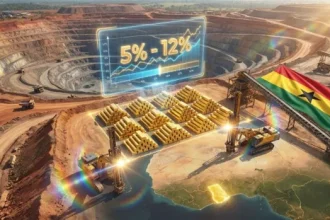
So a sliding scale of 5 per cent to 12 per cent royalty on gross revenue, that is being proposed will further exacerbate the situation and could lead to reduced investments, stalled projects and job losses in the mining industry.
With respect to Stability Agreements and Development Agreements, the Chamber supports a review of these instruments but does not support their outright abolition.
Stability and development agreements play a critical role in an industry characterised by significant upfront capital requirements and long-term investment horizons.
As the government did with Tax Exemptions, these agreements should be reviewed and strengthened where necessary, rather than discarded.
The Ghana Chamber of Mines remains committed to working with Government to develop a competitive, transparent, and sustainable fiscal regime that maximises national benefit while ensuring the continued growth and resilience of Ghana’s mining industry.