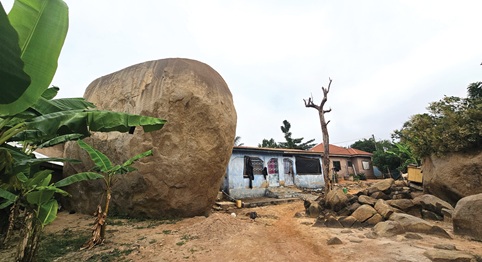
Near Sokoban, within the Kumasi Metropolitan District of the Ashanti Region, lies Ampayoo — a suburban enclave nestled among imposing granite outcrops.
Located in the Nhyiaeso Constituency and recognised for its proximity to the Sokoban Wood Village, Ampayoo stands apart for one defining reason: it is not built on cleared land, but among towering rocks.
The name “Ampayoo” is derived from the Akan phrase “ampɛ yoo yoo” — “I do not want disturbances,” or simply, “peace-loving.”
The quiet resolve embedded in that name mirrors its origin.
Oral history, confirmed by Oheneyere Agyeiwaa, the current Stool Wife, traces the settlement to the era of Otumfuo Opoku Ware I in the late 17th century.
The land is said to have been granted as a residence for one of his consorts, a woman remembered for her calm and peaceable nature.
Today, Ampayoo remains under the Asante traditional authority, headed by a Stool Wife, known in Akan as Oheneyere.
Its governance structure preserves a thread of royal heritage even as modern Kumasi expands steadily around it.
Unlike rocky settlements such as Tongo in the Upper East or Wulin near Jirapa in the Upper West — where rock formations dominate from a distance — Ampayoo integrates stone intimately into daily life.
Here, almost every home shares space with granite giants. Some boulders loom inches from bedroom walls, dwarfing houses and structures.
Others sit firmly in courtyards, silent and immovable.
While Kumasi, capital of the historic Asante Empire, has spread outward over centuries, Ampayoo chose adaptation over alteration.
In many communities, rocks are cleared to make way for development.
Ampayoo was largely built around them.
The rocks serve practical purposes.
Some have been blasted for construction and commercial use, while others provide natural shade against the midday sun.
A walk through the settlement reveals laundry drying on warm stone surfaces, children climbing natural platforms, and goats navigating elevated terrain with ease.
Whether the rocks carry spiritual meaning or once offered protection remains unclear.
What is certain is their permanence.
In Sokoban Ampayoo, architecture negotiates with ancient granite.
Homes rise beside formations older than memory.
In a rapidly urbanising Kumasi, Ampayoo offers a quiet lesson: development does not always conquer the land.
Sometimes, it learns to live with it.