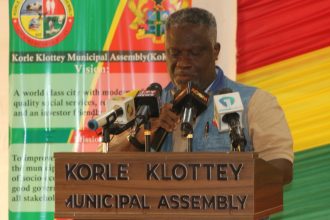
Economist and University of Ghana Professor, Godfred Bokpin, has cautioned that Ghana’s recent push to strengthen the cedi is coming at a significant cost to the economy and the environment.
Prof. Bokpin described the cedi’s recent appreciation as harmful in the long run, despite appearing positive on the surface.
“We’re achieving a stronger cedi, but it’s costing the country dearly,” he said. “It’s hurting private sector growth and damaging the environment.”
He pointed out that some of the aggressive interventions to stabilise the currency, including heavy reliance on gold exports, may be linked to increased illegal mining (galamsey), which is destroying water bodies and endangering lives.
“People are dying, and our rivers are being polluted, all in pursuit of a stable exchange rate. It’s as if 32 million Ghanaians are obsessed with a low exchange rate, no matter the cost,” he lamented.
Prof. Bokpin also raised concerns about the economic trade-offs involved in stabilising the currency.
He noted that the billions of cedis spent by the Bank of Ghana to prop up the cedi could have been used to support businesses.
“That money could have been available for the private sector to borrow at lower interest rates, to expand, and to create jobs. Now, that credit is gone,” he said.
He stressed that the current approach undermines private sector competitiveness and threatens Ghana’s long-term economic resilience.
Prof. Bokpin urged policymakers to rethink their strategy, calling for a more balanced approach that supports both economic growth and environmental protection.
“Yes, we need currency stability, but not at the expense of the private sector or our natural resources,” he warned.
His remarks come after the Ghana cedi recorded one of its strongest performances in recent months, appreciating by about 5% between October 6 and 10, 2025, according to data from major commercial banks. It’s the sharpest gain since the third quarter of the year.