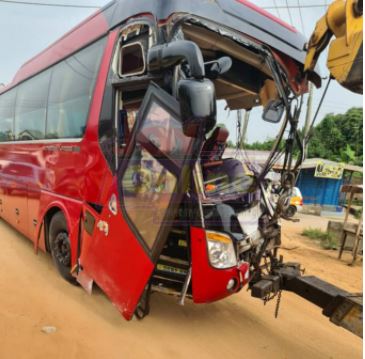
As far back as 2003, when I was a child, I witnessed a traditional ritual on the Awudome Anyirawase–Ho Highway in Ghana’s Volta Region, following a fatal road accident.
Weeks after the accident, members of the families of those who had died gathered at the scene. They poured libation and offered prayers as part of a traditional purification ritual intended to prevent further accidents at the same spot, or along that stretch of road.
As I grew older, I came to understand the spiritual reasoning behind such practices. Elders explained that when people die suddenly in an accident, particularly at a place far from their homes, their spirits are believed to remain connected to the scene because that is where their earthly journey came to an end.
The ritual, therefore, was not merely an act of mourning. It was also a spiritual appeal to the departed to leave the place peacefully and return, in spirit, to their ancestral home, where the necessary rites could be performed before burial.
In some traditional communities, such practices are considered an important part of ensuring that the dead are not abandoned in a strange land.
I recall an explanation from elders of a royal clan in my community that likened the practice to an incident involving a person who falls while walking. When someone falls, the person gets up and continues the journey. In the same way, they believed, when a person dies unexpectedly on a journey, the appropriate spiritual rites should be performed to acknowledge the interruption of that journey and guide the departed on to the next stage.
There is also a deeper traditional belief that, when the spirits of people who die at particular locations are not properly acknowledged or taken away through the appropriate rites, they may become restless.
According to this belief, some departed spirits may feel abandoned and, over time, become troubled or angry. Their restlessness is sometimes associated with subsequent accidents at the same location, as though they are seeking company or drawing attention to an unresolved spiritual matter.
This is why, in some traditional settings, repeated accidents at the same location are not viewed solely as physical or human failures. They may also be interpreted as a spiritual sign that something requires attention beyond what can be addressed through engineering, policing or human judgement alone.
Can this explain recurring road crashes?
Road crashes have become an alarming feature of Ghana’s road transport system, with fatal accidents occurring on major highways across the country.
The Accra–Kumasi Highway, in particular, has recorded a number of serious crashes, with several people losing their lives, others suffering life-changing injuries, and some dying later while receiving treatment in health facilities.
July 2026, in particular, witnessed a number of fatal road crashes reported in the media.
On Thursday, August 13, another fatal crash at Ofankor in Accra claimed 10 lives at the scene, while an additional victim reportedly died later at a hospital. The incident came after a series of crashes recorded during the first week of August, including several others along the Accra–Kumasi corridor.
The explanations for these crashes are largely physical and practical.
Many have attributed them to the poor condition of some roads, reckless driving, speeding, fatigue, vehicle defects and the use of illicit drugs by some drivers before taking the wheel.
These explanations are legitimate and must not be dismissed. Road safety requires properly engineered roads, effective enforcement, responsible driving, roadworthy vehicles and a robust emergency response system.
But a conversation with a friend about the increasing number of deaths on our roads reminded me of the traditional prayers and purification rites our forefathers used to perform at accident scenes.
He argued that such practices were once considered an important component of dealing with recurring accidents and that perhaps we should not dismiss them simply because modern society has developed beyond many of the practices of the past.
The physical and the spiritual
Modernisation has transformed our way of life. Science and technology have given us remarkable tools for understanding and addressing problems that previous generations could only explain through traditional knowledge and spiritual interpretations.
Yet, in our pursuit of modernity, we should be careful not to lose sight of who we are and where we come from.
For many Ghanaians, religion and spirituality remain deeply woven into everyday life. Traditional beliefs, Christianity and Islam, despite their different theological foundations, all recognise in various ways that human existence cannot be understood solely through what the eyes can see.
There is the physical and the spiritual; the living and the dead; the seen and the unseen. Our traditions teach us to acknowledge these dimensions of existence, even as modern science challenges us to examine claims about the supernatural with discernment.
This does not mean that every road crash should be attributed to spirits or that traditional purification should replace practical road safety measures.
Far from it.
The condition of our roads, driver behaviour, vehicle maintenance, enforcement and emergency medical services must remain central to the national response to road deaths.
But perhaps there is also room for a respectful conversation about the spiritual and cultural dimensions of death, particularly in communities where such beliefs remain deeply held.
Should we reconsider traditional purification?
If a particular stretch of road has become notorious for repeated fatal crashes, perhaps the authorities and traditional leaders could consider working together to examine the situation from both the physical and cultural perspectives.
Engineers could assess the road. Police could examine driving patterns and accident data. Transport authorities could investigate vehicle and traffic-related factors. At the same time, traditional authorities and religious leaders could, where communities desire it, perform prayers or purification rites at the affected locations.
Such an approach need not be a contest between science and tradition.
It could instead be an acknowledgement that a society is made up of people with different ways of understanding life, death and the world around them.
For traditional believers, performing such rites may provide spiritual closure for families who have lost loved ones and help communities mourn those who died far from home.
For religious believers, prayer may offer a means of seeking divine protection and comfort.
And for those guided primarily by science, the focus can remain on identifying and eliminating the physical causes of crashes.
Perhaps the answer is not to choose one and reject the other, but to allow each to contribute within its proper sphere.
Our ancestors may not have had modern road engineering, traffic cameras or sophisticated emergency response systems. But they had their own understanding of life, death and the spiritual world.
As we build a modern Ghana, perhaps we should not be too quick to discard every wisdom inherited from the past.
If traditional purification and prayers can offer comfort to bereaved families, strengthen community bonds and provide spiritual closure, there may be value in allowing such practices to coexist with modern road safety interventions.
The ultimate objective should be simple: fewer crashes, fewer injuries and, above all, fewer families having to bury their loved ones because of preventable road deaths.
Whether one approaches the problem through science, faith, tradition or a combination of all three, every reasonable effort should be made to protect human life.
After all, life is sacred, and every life lost on our roads leaves behind a family, a community and a story that may never be the same again.