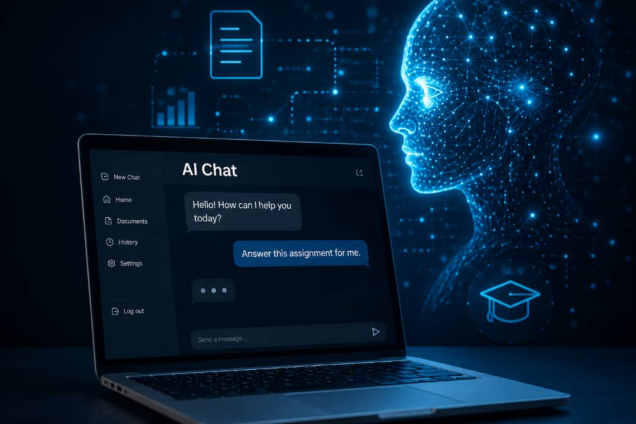
A university student sits at a desk long after midnight. A laptop glows in the dark. On one side is a course PDF downloaded from the class WhatsApp group. On the other is a chat window waiting for a prompt.
A few years ago, the next step might have been to open Google, search through scholarly articles, learn from lecture notes, or call a classmate. Today, many students type a different kind of request:
“Answer this assignment for me.”
For many university students, artificial intelligence has become more than a search engine. It drafts essays, creates presentation slides, summarises readings, explains difficult concepts and even writes computer code.
For Melson, a student at the University of Media, Arts and Communication’s Institute of Journalism (UniMAC-IJ), AI has become almost indispensable.
“I’m a big fan of AI because it’s made university work very easy.”
Michael, another UniMAC-IJ student, says he began using AI in Level 200 but found it especially useful in Level 300 while balancing lectures with work.
“I have been using it since Level 200. Especially in Level 300, second semester. I used to work whilst schooling, and because of the nature of the job, it was difficult to do research, but AI made it easier.”
For students balancing lectures, deadlines and, in many cases, employment, AI is becoming less of a luxury and more of an academic companion.
As universities embrace AI, they are also turning to detection software such as Turnitin to identify AI-generated work. But AI consultant, personal branding strategist, and founder of Zero to Visible, Linford Ofori Aborchie, believes those tools should be used with caution.
“Universities should never make disciplinary decisions based solely on detection reports. The best approach combines technology with human judgment. Oral defenses, draft submissions, classroom participation, and understanding each student’s writing style over time will always tell you more than any detection tool.”
Who Is Doing the Thinking?
Even students themselves are beginning to question whether constant dependence on AI comes at a cost. Melson admits that after relying heavily on AI, he noticed a change in his own writing ability.
“I was writing a letter to a lecturer, and I decided, ‘Let me not use AI. Let me just write the letter myself.’ As I was writing, I realised, ‘Hey, it’s not that easy anymore.’ I realised I’m not as proficient as I once was with it. So, to some extent, I’ll say yes, AI is making us lazy.”
Michael, however, sees the technology differently.
“AI aids us in learning but does not make us lazy. In my school, when you do an assignment and most of the work is from AI, you will be marked down.”
The contrasting views reflect a larger debate: Is AI replacing students’ thinking or simply changing the way they learn?
AI Consultant Ofori Aborchie believes the answer depends entirely on how the technology is used. He recalls one interaction that, in his view, demonstrates responsible AI use.
“Recently, a university student sent me a course PDF and a set of past exam questions. Instead of asking AI to generate the answers directly, we used AI to analyse the course material, identify the most relevant sections for each question, and point the student back to the original content to study. That’s responsible AI use.”
He argues that the line between responsible AI use and academic misconduct is clear.
“The difference comes down to three things—transparency, originality, and learning. Misconduct begins when AI replaces the student’s intellectual contribution or when it’s used to deceive instructors about who actually produced the work.”
An Educational System That Rewards Recall, Not Critical Thinking
AI is forcing universities to rethink not only how students are assessed but also what they are being assessed for.
Traditional assignments that rely heavily on information recall are becoming easier for AI to complete, prompting educators to place greater emphasis on critical thinking, application, and originality.
Mr. Ofori Aborchie believes assessments should evolve with the technology. “Assess thinking, not just writing.”
He argues that universities should prioritise oral defences, practical projects, reflection, and problem-solving over assignments that simply require students to reproduce information.
“The future of education isn’t AI-free classrooms. It’s classrooms where students learn how to think with AI, without letting AI think for them.”
Artificial intelligence is already part of university life.
The question is no longer whether students should use it, but whether they will continue to think for themselves while they do.