
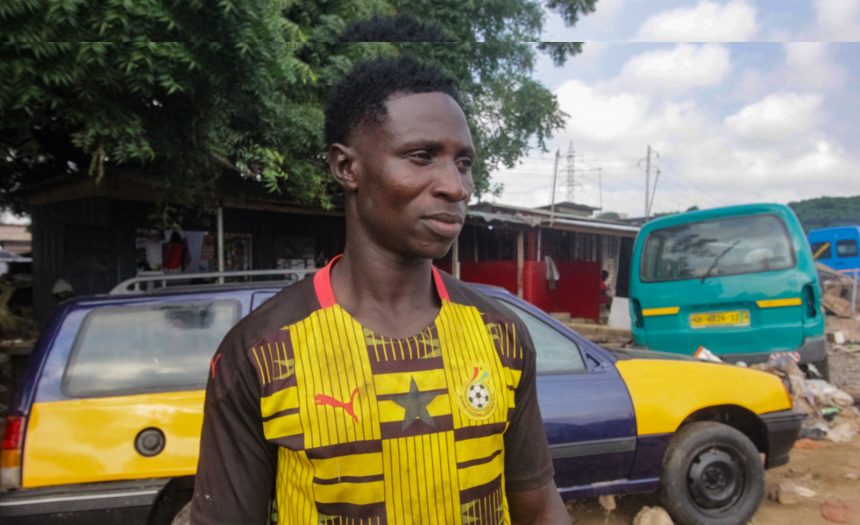
When floodwaters swallowed parts of Accra on June 29, one image captured the nation’s attention almost as much as the devastation itself.
A young man standing atop a car half-submerged in the murky Alajo drain, refusing to release the body of a flood victim until he received money he believed had been promised to him.
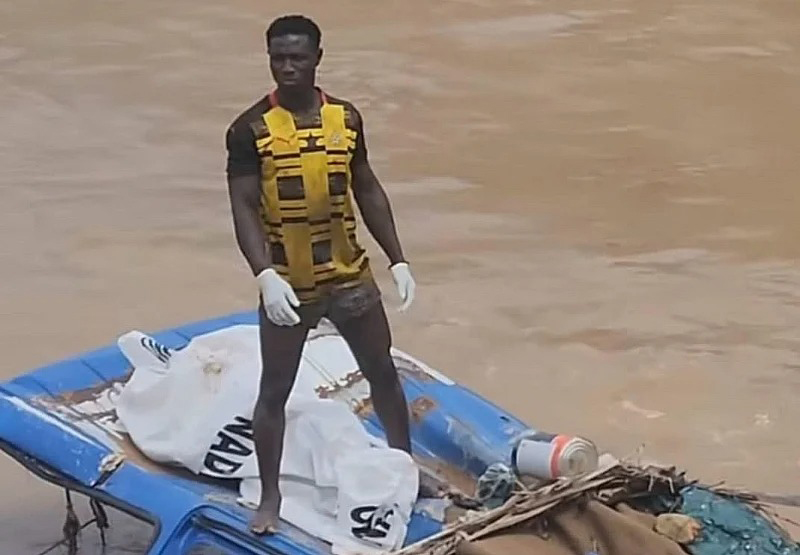
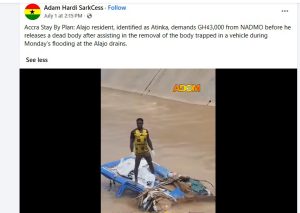
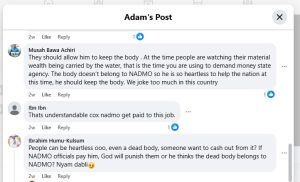
Within hours, social media had reached its verdict. Some branded him “heartless.” Others called him an opportunist who withheld the victim’s body until he was paid.
Memes circulated. Radio discussions erupted. Facebook and X users questioned his humanity, while another group argued that no one should be expected to risk their life in such dangerous conditions for free.
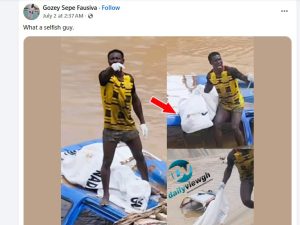
Weeks later, the man at the centre of that controversy says the public never heard his side.
“I didn’t charge anybody,” 34-year-old auto mechanic Prosper Baffour, popularly known as Atinka, told The Ghana Report during an interview at his workshop in Alajo.
“They made a promise before I entered the gutter. I only insisted they honoured what they had promised. If they hadn’t brought up money in the first place, I would probably have done it for free.”
A rescue many refused
According to Prosper, the body had remained trapped inside a vehicle submerged in the Alajo drain for about three days after the floods.
He said personnel from the Police and the Ghana National Fire Service had earlier visited the scene but left as efforts continued to retrieve the victim safely. Later, officials from the National Disaster Management Organisation (NADMO) arrived.
Prosper recalls that several young men attempted unsuccessfully to retrieve the body.
“My friends came to tell me they were looking for someone who could do it,” he said.
“When I got there, I asked whether it was true that anyone who retrieved the body would be paid. I was told yes, so I entered.”
The task, he says, was far from ordinary.
The victim’s body had begun decomposing. Prosper says he entered contaminated floodwater wearing only gloves, and later had cuts around his ankles.
“The body had gone bad,” he recounted.
“The smell stayed with me for days. I wasn’t wearing a nose mask. I got wounded on my leg, but someone had to do it because she was also a human being like me.”
He says it was while he was still inside the drain that bystanders warned him he might never receive the promised money if he released the body first.
“I remained inside until they paid because I believed I would lose it otherwise.”
NADMO disputes payment agreement
The Greater Accra Regional Director of NADMO, Dennis Nartey Adjannor, rejects Prosper’s account that officials promised money before the rescue.
“It wasn’t offered,” Adjannor told The Ghana Report. “When he came out, we decided to give him a token.”
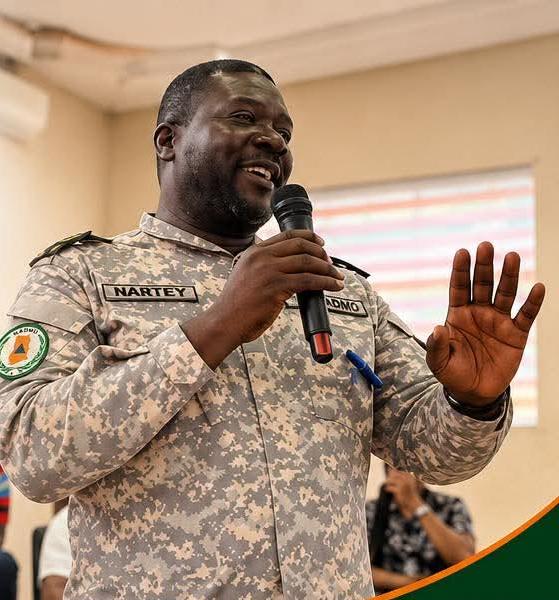
Mr Adjannor also disputed Prosper’s claim that he was equipped with only hand gloves. According to him, NADMO provided the volunteer with the necessary protective gear, including hand gloves, a helmet and body bags for the recovery operation.
“We gave him the hand gloves. He was having a helmet, but he was a little uncomfortable wearing it. We also gave him the body bags to keep the body,” he said.
Adjannor explained that NADMO routinely works with Disaster Volunteer Groups (DVGs), community volunteers recruited across districts to assist during emergencies.
“We recruit young men, especially those who know how to swim or can assist during disasters. They are volunteers, not salaried workers, although we occasionally provide support and training.”
He disclosed that Prosper has been recommended for inclusion in the Disaster Volunteer Group because of his willingness to help during the flood emergency.
The NADMO director also dismissed claims that officials negotiated to pay GH¢5,000 or later reduced it to GH¢3,000 before the recovery.
“There wasn’t any negotiation like that,” he said.
Social media judged before hearing him
Prosper says the public backlash has been more painful than the rescue itself.
“People point fingers whenever I enter a trotro,” he said quietly.
“They ask, ‘Isn’t this the boy?’ They ask, ‘Where is the money?’ ‘It hasn’t been easy,” he said.
Ironically, he insists he never kept the money.
“We bought food with it, and everyone here ate,” he said. “According to our tradition, after removing a dead body, there are rituals you have to perform, and those also require money.”
His explanation echoes a debate that dominated Ghanaian social media after the incident. While many users condemned what they viewed as monetising tragedy, others argued that recovering a decomposing body from contaminated floodwater without adequate protection exposed him to serious health and safety risks that deserved recognition.
A question bigger than one man
Beyond the online arguments lies a broader issue confronting emergency responders worldwide: how should spontaneous civilian rescuers be managed during disasters?
International disaster response standards, including the International Federation of Red Cross and Red Crescent Societies (IFRC) guidelines and the United Nations Office for Disaster Risk Reduction (UNDRR) framework, recognise that trained community volunteers often provide the first life-saving response before professional rescuers arrive.
However, they also stress that volunteers should receive appropriate training, protective equipment, clear command structures and safety protocols to minimise unnecessary risk.
Experts say relying on untrained civilians for hazardous body recovery operations without comprehensive protection raises important occupational safety and emergency management questions.
Mr Adjannor says NADMO is strengthening those systems.
He revealed that the organisation conducts refresher training for rescue personnel and volunteers and is working with the United Nations to acquire amphibious rescue vehicles capable of operating in floodwaters.
“We are looking at improving rescue response time. The UN has offered to assist us with floating rescue vehicles that can operate during floods,” he said.
“Next time, I’ll think twice”
For Prosper, however, the experience has fundamentally changed how he views helping in emergencies.
He says had he been swept away by the floodwaters, many of those criticising him today might never have known his family.
“Honestly, next time I’ll think twice,” he admitted. “If I had died, what would people have told my family?”
Even so, he says he still hopes to serve.
“If I get the opportunity to join NADMO or any rescue team, even as a part-time volunteer, I would gladly do it.”
As flood victims in Alajo continue rebuilding their lives, Prosper has one final appeal.
“People have lost their kiosks. Some are sleeping outside. Government and organisations should come to their aid,” he said.
He also believes the flooding cannot be blamed on nature alone.
“People throw rubbish into the drains every day. Those living too close to the gutters should also be relocated.”
His story leaves Ghana with an uncomfortable question: Was Prosper Baffour the villain social media portrayed, or a volunteer who risked his life in extraordinary circumstances, only to discover that public judgment can sometimes be harsher than the flood itself?





I think we need more of your type who will analyze things before publishing it,keep it up this is how journalism is supposed to be.