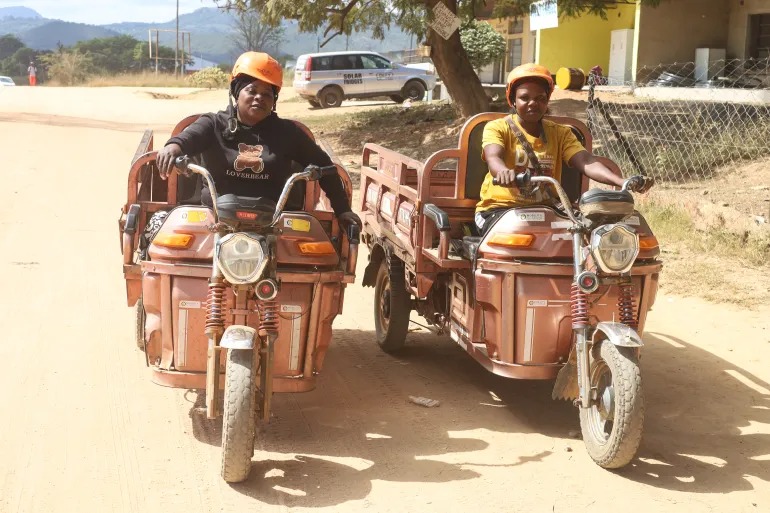
Daires Mutamangira was ferrying a customer and groceries on her electric tricycle along a dusty and unpaved footpath when traffic police arrested her in eastern Zimbabwe last month.
The officers demanded to see the e-tricycle’s registration and her driver’s licence, which she could not produce. She tried to negotiate, but they fined her $15 on the spot.
“It was scary,” she told Al Jazeera.
“I never thought they would be that cruel considering I was riding on the outskirts of the shopping centre and far away from the highway.”
Her experience reflects a growing police crackdown on e-tricycles in rural areas, such as Hauna and Chipinge in Manicaland Province.
Annual registration and licensing costs amount to nearly $500, far beyond the reach of the 300 rural women with e-tricycles, most of whom are single mothers and widows trying to make a living.
Powered by lithium batteries and reaching a maximum speed of 25km per hour, the e-tricycles were introduced across the country to empower women in rural areas.
Mutamangira is among 40 women who received an e-tricycle, known as Hamba, a Shona word that loosely translates to “go”, in May 2024 to run a small transport business in Hauna. The e-tricycle can carry goods weighing up to 450kg.
That is particularly helpful in Hauna, a farming community about 55 kilometres from Zimbabwe’s third-largest city, Mutare. Farmers need to move fresh produce, such as bananas, tomatoes and onions, from their farms to the highway for loading onto trucks bound for Mutare or the capital Harare. They also rely on e-tricycles to transport groceries and farm goods.
Mutamangira said she transports goods for a fee.
“In a good month, I made a profit of about $250. My husband is unemployed, so I am the breadwinner,” she said smiling.
She pays all the household bills and feeds and clothes the couple’s four children.
In emergencies, the community uses e-tricycles as makeshift ambulances to transport women in labour and the sick to the nearby hospital. Zimbabwe faces a chronic shortage of ambulances and in rural areas like Hauna there is often only one ambulance, which is frequently out of service.
Supported by Mobility for Africa, a local startup, the women pay a small fee to swap batteries at the Hauna charging centre and another fee for the tricycle over a set period until it becomes theirs.
To Mutamangira, the e-tricycle is not just a source of income but a symbol of economic empowerment and independence.
“It feels good as a woman to contribute financially to my marriage. I earn respect from my husband because I am bringing something to the table and not just a stay-at-home parent,” she said.